

- Events
- Posted
From compliance to performance: reflections from Essen
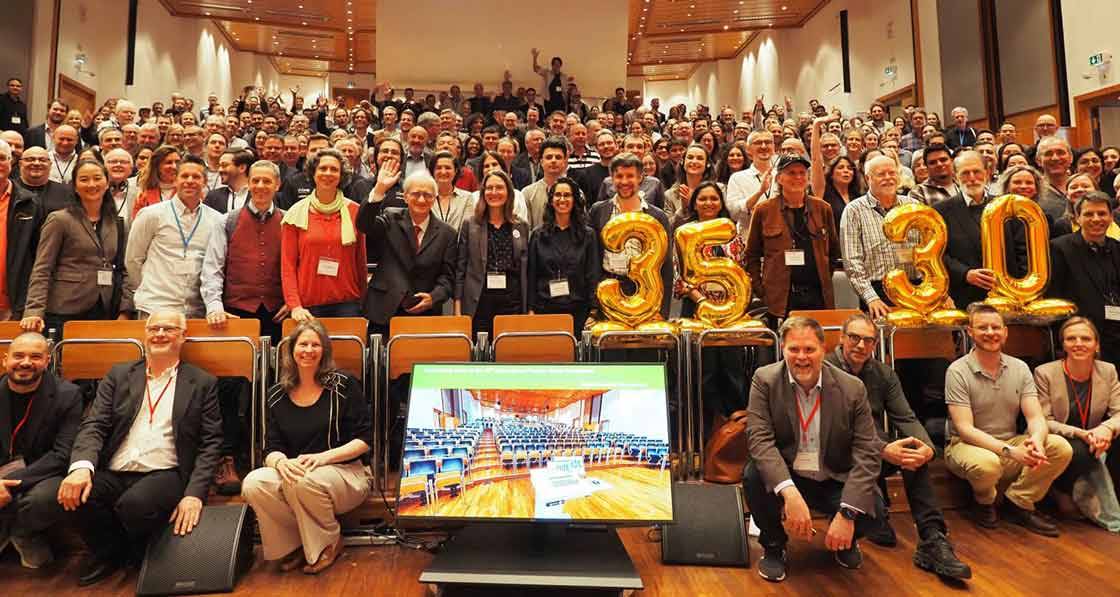
The 28th International Passive House Conference brought together experts and practitioners in April to discuss the world’s leading low energy building standard. Niall Crosson, group technical director at Ecological Building Systems, summarises this year’s event, which marked the 35th anniversary of the first passive house, and the 30th anniversary of the Passive House Institute.
Want immediate access to all back issues of Passive House Plus and exclusive extra content? Click here to subscribe for as little as €20, or click here to receive the next issue free of charge
There was a strong UK interest at the 28th International Passive House Conference in Essen, where the themes could hardly have been more relevant as the industry prepares for the Future Homes Standard, continues under Part L 2021, and confronts the limitations of SAP and EPC-based compliance.
A central message was Efficiency First, reinforced by Professor Wolfgang Feist, whose own passive house – now over 35 years old – continues to perform as designed.
At a time when the UK industry still questions consistency of delivery, the lesson is clear: measured performance over time matters more than design intent alone.
The UK's regulatory direction broadly aligns with this. Part L 2021 improved fabric standards and lowered carbon targets, and the Future Homes Standard aims to deliver very low operational emissions in new homes. But many standards still fall well short of passive house levels – particularly on airtightness – and compliance rests largely on SAP calculations and EPC ratings, which predict rather than reflect real performance.
The performance gap therefore remains critical. The message from Essen was that closing it is less about new technologies and more about process, verification, accountability and build quality – exactly what passive house delivers through rigorous design, airtightness testing, thermal bridge-free detailing and commissioning. The UK's cool, damp, wind-driven climate reinforces the point: moisture, air leakage and thermal bridging present ongoing risks, while overheating is an emerging concern demanding more careful design.
Another key theme was the shift beyond operational energy toward embodied carbon and wholelife performance. UK regulations and SAP still focus mainly on operational emissions but calls for whole-life carbon assessment are growing. It prompts a key question: are we building to meet today's regulations, or preparing for future performance requirements?
Case studies reinforced these themes. Deep retrofits demonstrated energy reductions of up to 80 per cent, even in complex heritage buildings – highly relevant to the UK's existing stock. Claridge House in Mayfair, presented by Federica Romeo Bettie of Studio PDP, cut energy use by around 80 per cent despite heritage constraints and occupation, using insulating plaster, vacuum glazing and detailed hygrothermal analysis. In social housing, Glasgow's Dundashill scheme showed high performance delivered with modest capital uplift and lower heating costs, while larger projects such as Oxford University’s Schwarzman Centre for the Humanities highlighted a shift in risk toward coordination, construction quality and verification, especially as delivery expands through MMC (modern methods of construction).
Essen reaffirmed that passive house is not about perfection, but predictability, transparency and disciplined delivery. The knowledge already exists – the challenge is moving beyond compliance to consistently deliver better buildings at scale.
Related items
-
 Housing minister calls for faster retrofit to shield homes from energy shocks
 -
 £100m LSE retrofit to headline as passive house conference returns to London
 -
 Free solar for energy-poor homes under reported €200m government plan
 -
 Expanded EJOT range provides soffit insulation boost
 -
 Study: passive house costs as low as 2%
 -
 New BER takes effect while ZEB details remain unclear