

- Government
- Posted
New BER takes effect while ZEB details remain unclear
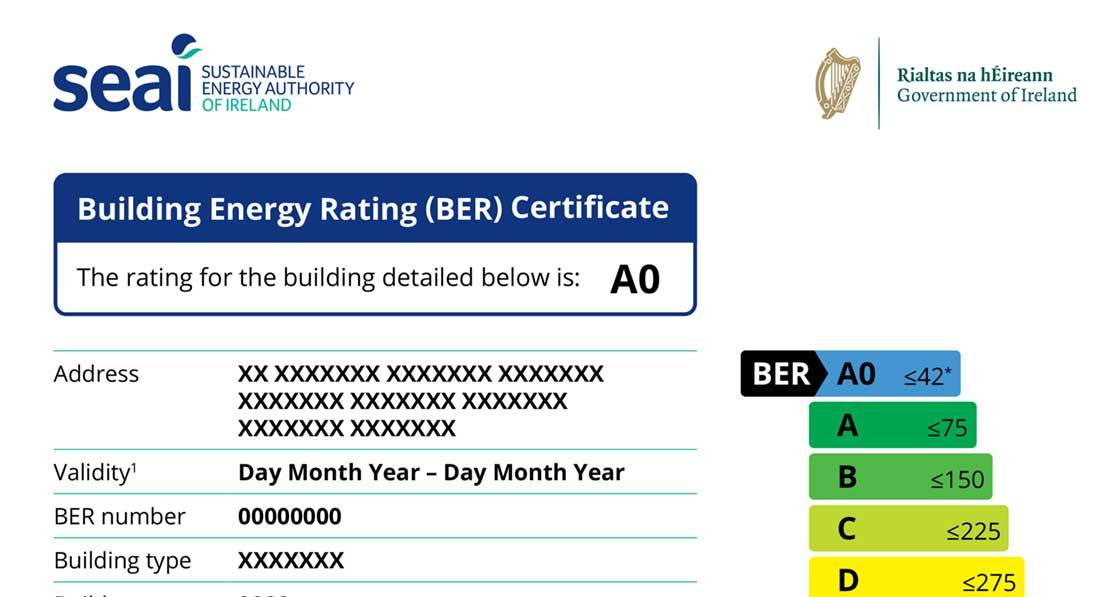
Ireland's Building Energy Rating system has moved to a simplified eight band scale, with a new A0 rating at the top reserved for zero emission buildings (ZEBs).
Meanwhile, with the deadline for the ZEB standard less than 18 months away for public buildings, the state is yet to finalise details on the temperature and indoor air quality levels assumed for ZEBs. The changes to BERs, which apply to all ratings published from 24 May, were introduced under regulations signed in April by housing minister James Browne to transpose the recast EU Energy Performance of Buildings Directive (EPBD), which requires member states to harmonise their energy performance certificates.
This article was originally published in issue 53 of Passive House Plus magazine. Want immediate access to all back issues and exclusive extra content? Click here to subscribe for as little as €20, or click here to receive the next issue free of charge
The 15 classifications of the old scale, from A1 to G, are replaced by A0, A, B, C, D, E, F and G, with all subcategories removed. Existing certificates remain valid for ten years from their date of issue.
To achieve A0, a dwelling must qualify as a zero emission building, meeting six criteria in all — among them a primary energy value of no more than 42 kWh/m2/yr, CO2eq emissions of no more than 5 kg/m2/yr, and no on-site use of fossil fuels.
The recast EPBD also sets requirements regarding indoor environmental quality (IEQ), including temperature, humidity, ventilation rate, and the presence of air contaminants.
With the ZEB deadline set to apply for public buildings by 1 Jan 2028, Passive House Plus put questions to the Department of Housing regarding the IEQ parameters underpinning Ireland’s ZEB definitions. A spokesperson for the department said, “work is ongoing on this matter”.
The redesigned certificate also discloses considerably more data, including annual primary and final energy use, building energy demand, the renewable share of energy used and the amount produced on site, and operational greenhouse gas emissions.
Two new indicators state whether the building can adjust its energy use in response to external signals, and whether its heat distribution system can operate at low temperatures.
A field for whole life global warming potential appears for the first time, ahead of EU requirements to report embodied carbon on certificates for large new buildings from 2028 and all new buildings from 2030, and a QR code links to tailored upgrade advice.
SEAI has also updated the underlying DEAP calculation, including revised solar photovoltaic inputs covering panel wattage and battery storage, replacing the previous assumption that all electricity generated was used in the home.
Related items
-
 Widespread insulation failures found in EU tests
 -
 Kingspan fined €40 million by EU
 -
 Households feeling the heat of global oil conflict
 -
 New and enhanced Irish retrofit grants go live on 6 October
 -
 Campaigners tell Irish government to publish Climate Action Plan
 -
 Central Bank: Irish housing completions set to fall as housing crisis continues