


- Insight
- Posted
How deep is too deep for cost-optimal retrofit?
Decarbonising homes at scale demands pragmatic sequencing, not doctrinal purity. Lloyd Alter reconsiders the retrofit strategy he once vigorously opposed – while mounting a defence of deep fabric retrofit, with caveats.
Want immediate access to all back issues of Passive House Plus and exclusive extra content? Click here to subscribe for as little as €20, or click here to receive the next issue free of charge
A cri de coeur in the passive house world is "Fabric First!" – let's fix the building envelope or fabric before we do anything else. In 2021, this was challenged by consultant Richard Erskine in an article, 'Insulate Britain! Yes, but by how much?' Toby Cambray summarised this heresy in Passive House Plus, of all places: "A basic fabric retrofit is relatively expensive, and heat pumps are getting better and cheaper; therefore, we should do a bare minimum of fabric work and focus on deploying heat pumps."
In 2023, engineer Nigel Banks picked up on the concept and published a short paper on LinkedIn calling for "ASHPs ASAP" – getting off gas with air source heat pumps (ASHPs) first, and "Fabric Fifth!" I was outraged and even wrote a paper, "Why Fabric Remains First," for the 27th International Passive House Conference in Innsbruck. Times change, as do heat pumps and the consensus on retrofits.
Even Nigel Banks changes; he has issued what I would call a more temperate update, which he calls "(Deep) Fabric Fifth." It starts with the sentence, "Two years ago, my 'Fabric Fifth' article came across to some people as an attack on Fabric First and on insulation." I was definitely one of those people, but most of my complaints have been addressed with the update. He starts with his description of my perfect world:
In a world of no constraints and where we could do everything, I think we would all agree that we would all love to all live in highly efficient Passivhaus, with no energy bills, great ventilation and high levels of comfort. Most would also want to be generating and storing our own energy and producing pollution-free heat and hot water, with simple and responsive controls. In this nirvana, we would be able to achieve this without disruption; cost-effectively; with local tradespeople; and use ethical, sustainable, low embodied carbon, reusable, deconstructable materials.
We have to do enough fabric to improve comfort and health.
Alas, we do have constraints on time, money, and available trades. As Barnabas Calder described his own situation, "We were making plans to deep retrofit, but we just can't afford it – it would cost more than it cost us to buy the house, plus months of having to live elsewhere with our cats trying to escape and get home. I can't imagine a situation in which enough people will do that to make a significant difference to climate outcomes."
In the update, Banks notes that "ventilation improvements combined with draught proofing and insulation measures are key for improving comfort, health and wellbeing." A lot of older housing in the UK and Ireland is draughty and mouldy, affecting the health of the occupants, and I still believe that should be addressed first. Banks writes, "We have to do enough fabric to improve comfort and health" by combining Step 1 with subsequent steps.
Step 1 is still to get off gas and get a heat pump. He mentions health and air quality problems associated with gas, citing a study that claims an incredible 40,000 deaths in Europe from cooking with gas.
Step 2 he describes as “Get Smart”– by combining smart meters and smart controls to take advantage of smart tariffs. This could also help address peak loads. Nigel notes that "with smart control of heat pumps, electric vehicles and batteries, peaks can be significantly mitigated, in some cases eliminated." This has met with strong resistance in the USA, where many don't want the guv'mint controlling their thermostat, but might work better in the UK or Ireland.
Step 3 is to do the basics. "You can take some simple, low-cost steps to improve comfort, air quality and reduce our energy use as well as the timing of energy use,” he writes. “Measures such as draught proofing, loft insulation, cavity wall insulation (where appropriate), using timers/programmer controls, can all be cost-effective interventions." I would have put this at least as Step 2, and it would go a long way to addressing what I think people care about – comfort and health.
Step 4 is solar and storage, with Banks noting that “the economics of solar & storage vs deep fabric interventions have flipped in the past decade." I used to put this last and argue that solar was pretty useless when you are freezing in February, which is when you would really appreciate the deep fabric, but storage and smart grids change the picture.
Step 5, finally, is deep fabric. Here, I think Nigel is unnecessarily harsh and negative:
Deep fabric improvements (such as solid wall insulation, ground floor insulation, triple glazing, that all need to be combined with adequate ventilation) have a high upfront cost and also a large carbon footprint (higher in some materials than others) but currently do not have a good financial or carbon payback (in most cases, paybacks are often over 50 to 100 years). As has been shown recently, done badly, they can damage human and building health and be expensive to put right.
Draught proofing must be complemented by effective and continuous mechanical ventilation and users must embrace the counterintuitive approach of continuous heating.
There are also many cases of poor heat pump installations, thousands of failures of cavity wall insulations, and incompetent draught proofing. Deep fabric improvements that are done with passive house or Association for Environment Conscious Building (AECB)-certified designers and consultants do not generally have these problems. Pick the right materials, and you do not necessarily have a big carbon burp, and you might have nirvana.
This also points to what I think is the biggest failure of Deep Fabric Fifth: if one did decide to do a proper Enerphit deep retrofit, they would start with a full audit and what Mark Wille in the USA called "the red door of truth" – the blower door test. As Kate de Selincourt once noted, "The UK generally has no clue about the value of airtightness, or how to do it, or how to ventilate properly once you've done it." I don't think Banks pays nearly enough attention to airtightness, ventilation, humidity control and health. And he doesn't even mention what should really be Step 1: an audit and a plan to determine the best balance of "enough fabric to improve comfort and health" and heat pump sizing.
In Canada, the recent Greener Homes Grant programme was set up so that nobody got a penny unless they carried out a formal energy audit with a blower door test. They provided a checklist of what would get funded in what order, so that the window and furnace salesmen didn't jump the queue.
This should be the minimum before the heat pump gets installed.
Notwithstanding my cavils, reality bites hard here. Banks backs it up with numbers.
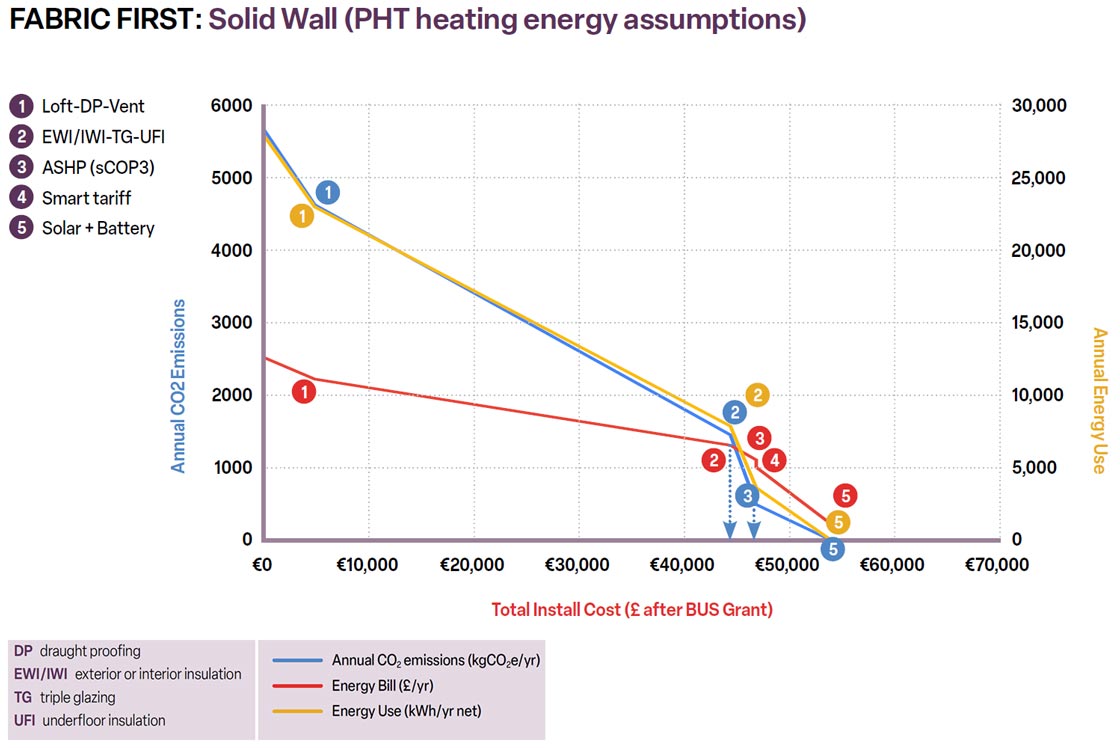
The deep fabric first renovation above gets really expensive, really fast.
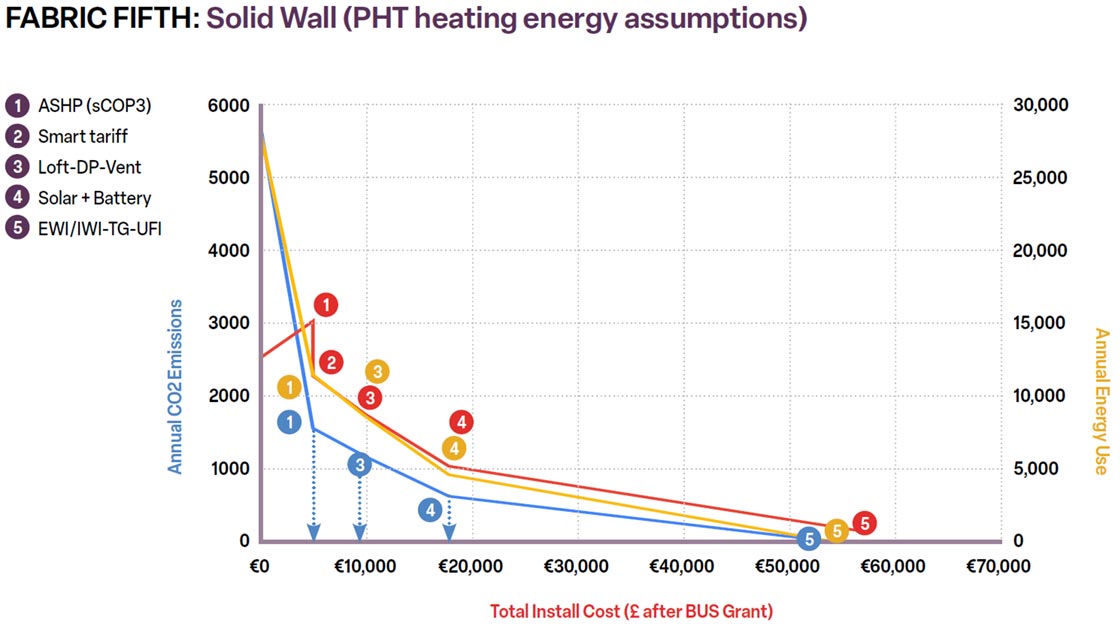
Fabric fifth in the graph is relatively cheap up to step 3, with a huge impact on carbon and energy bills, with a long tail of cost for 5, the deep energy retrofit stuff.
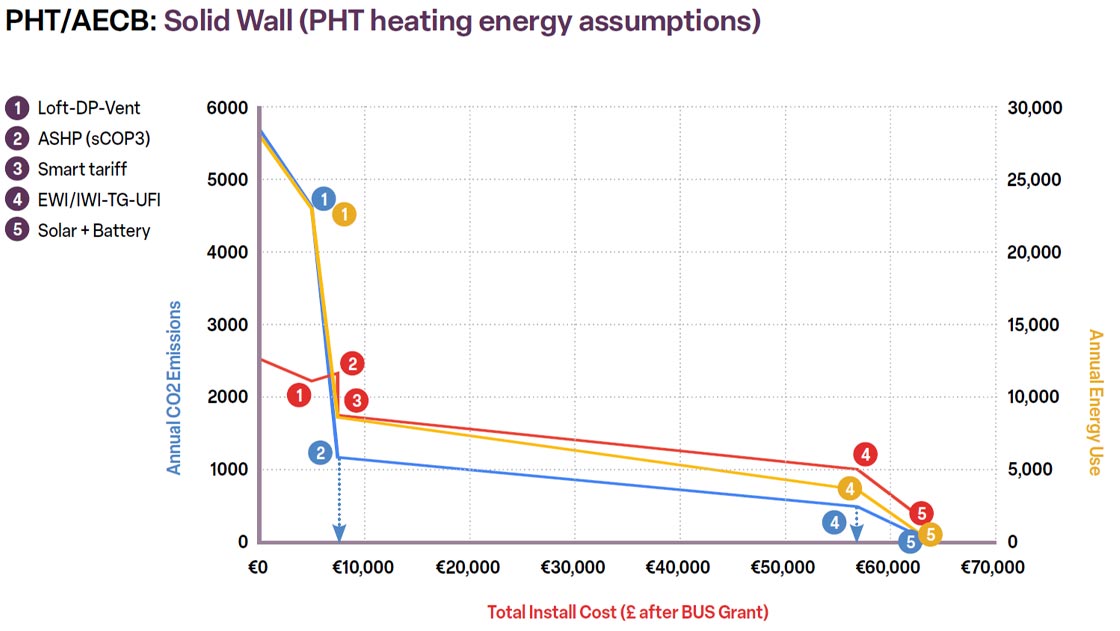
The Passivhaus Trust/AECB puts the deep energy retrofit before solar and battery, sticking the solar way out at the end of the tail.
Indeed, the fact that the Trust and the AECB have both developed guidance for light retrofits plus heat pumps shows how the ground has shifted in a few short years. As Jon Broome and Nick Grant note in the recently published 'Good Building Book':
In a recent guidance note for the UK Passivhaus Trust, Alan Clarke and Kate de Selincourt looked at how optimised heat pump installations with basic efficiency improvements can provide improved comfort and reduced carbon emissions in existing homes without difficult-toimplement wall insulation. They found that if radiators are well sized and the heating is run continuously in winter, the heat pump can run at a low temperature, improving the coefficient of performance (COP) enough to compensate for the additional heat input. By running the heating continuously with only a small temperature reduction at night, the comfort is improved and risk of mould is reduced.
However, it is not a simple case of just bolting on a heat pump. Any draught proofing must be complemented by effective and continuous mechanical ventilation and users must embrace the counterintuitive approach of continuous heating. Those on a pay-as-you-go meter and with limited means will be tempted to heat intermittently and will not enjoy the comfort and health benefit of steady heat input.
Not that long ago, I would argue for fabric first, saying: "When people spend money on their homes, they don't want efficiency or a low carbon footprint; they want comfort and health. Yet now we are pushing net zero and "fabric fifth" which deliver neither."
But in the light of the pressing need to decarbonise, I came up with the question: "How do we minimise upfront carbon and operating emissions while improving health and comfort with the least stuff for the most people?"
For new construction and major renovations, passive house is a no-brainer. For multifamily buildings, passive house retrofits have been done economically. But for the retrofit of vast numbers of single-family houses, my question is best answered by Nigel Bank’s Deep Fabric Fifth proposal (with a red door of truth upfront). I may never be able to show my face at a passive house conference again, but I begrudgingly have to admit that he may be right.