

- Case Studies
- Posted
King of the castle
Click here for project specs and suppliers
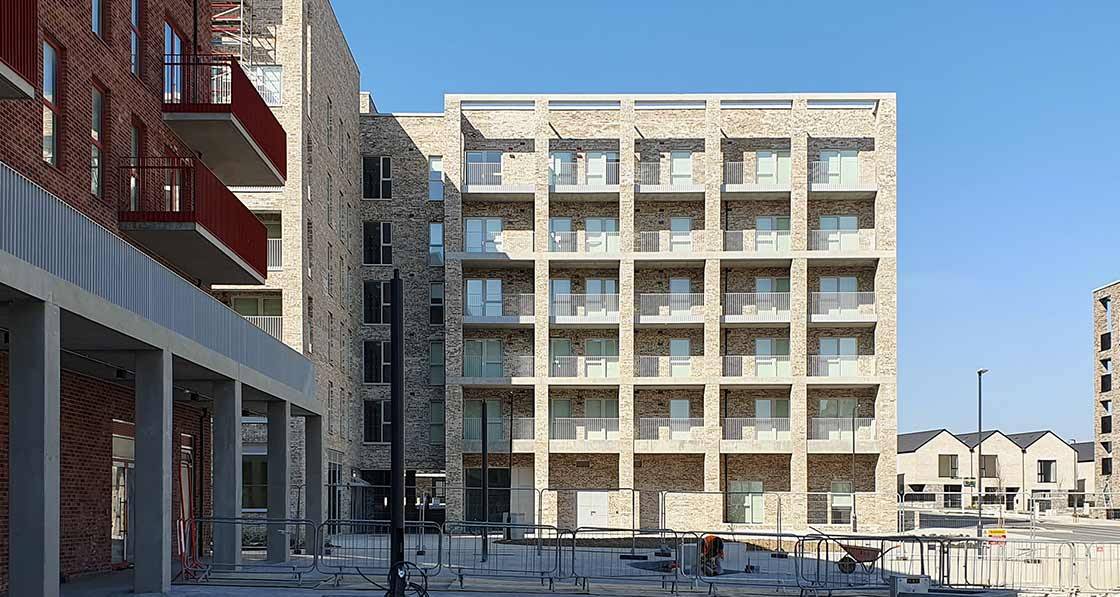
Development type: 597 housing units consisting of 51 NZEB houses and 546 apartments
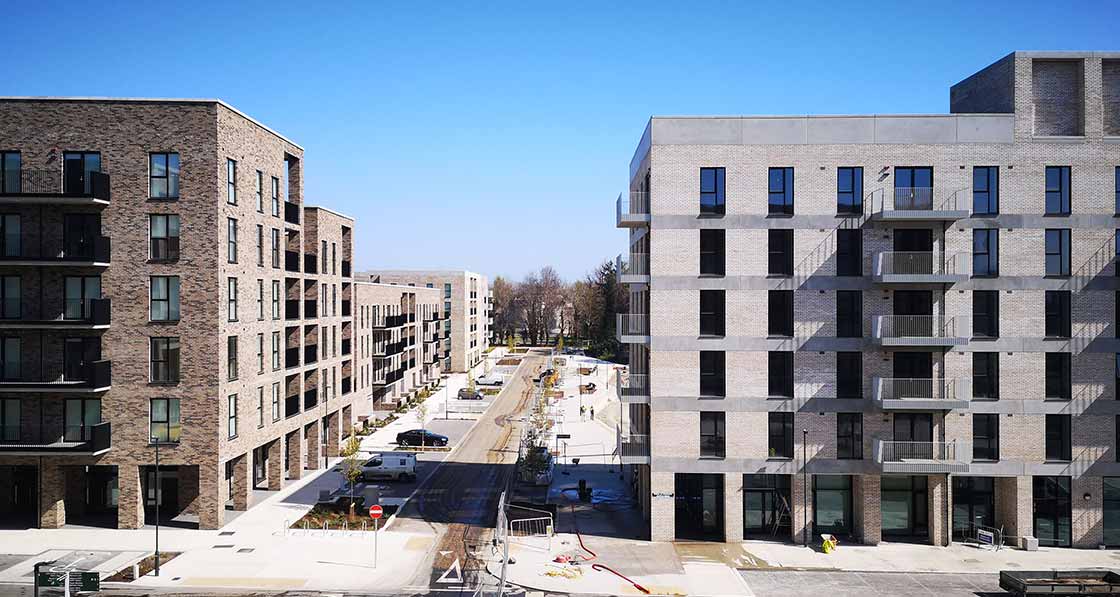
Method: Residential apartment development of externally insulated precast concrete walls across four blocks, totalling 4,398 m2 (Block A), 8,038 m2 (Block B), 2,796 m2 (Block C) and 2,603 m2 (Block D)
Location: Shankill, Co. Dublin
Standard: Passive house classic certification pending Space heating cost: €403 per annum calculated space heating costs, based on a 83 m2 2-bed apartment.
(see In Detail panel for a detailed breakdown)
You can tell that Dún Laoghaire-Rathdown (DLR) county architect Andrée Dargan is used to picking apart the myths that have collected around passive houses. When I ask whether — against the backdrop of the housing crisis — there was any pushback against imposing the rigours of the standard in Shanganagh, you can hear the smile in her voice.
“Well,” she says, “I suppose you're feeding, there, into some of the perceptions that people have. What we have discovered over time is that there’s not necessarily any additional cost.” Dargan has been at the forefront of sustainable public sector housing for many years now, having been a founding member of the DLR energy team back in 2009, and overseen numerous nearly zero energy building (NZEB), passive and Enerphit developments since then.
“When we started out, we wanted a science based, quality-focused strategy, and we landed on passive house because it's based on building physics and it works.” In particular, she asserts that the leap from NZEB to passive isn’t really a leap at all.
“People feel, for example, that it's much more onerous than NZEB, but we find that actually it's not. In reality, they’re very closely aligned. For passive house, you need continuous insulation, you need your air-sealed layer, you need to minimise thermal bridging, you need high performance windows and so on. Passive requires that attention to detail but you should be doing that anyway for NZEB. So, we don't find that it's much of a difference.”
Other misconceptions? That you have to use timber frame, that your contractors have to be steeped in passive house construction. The myth about not being able to open windows is particularly sticky.
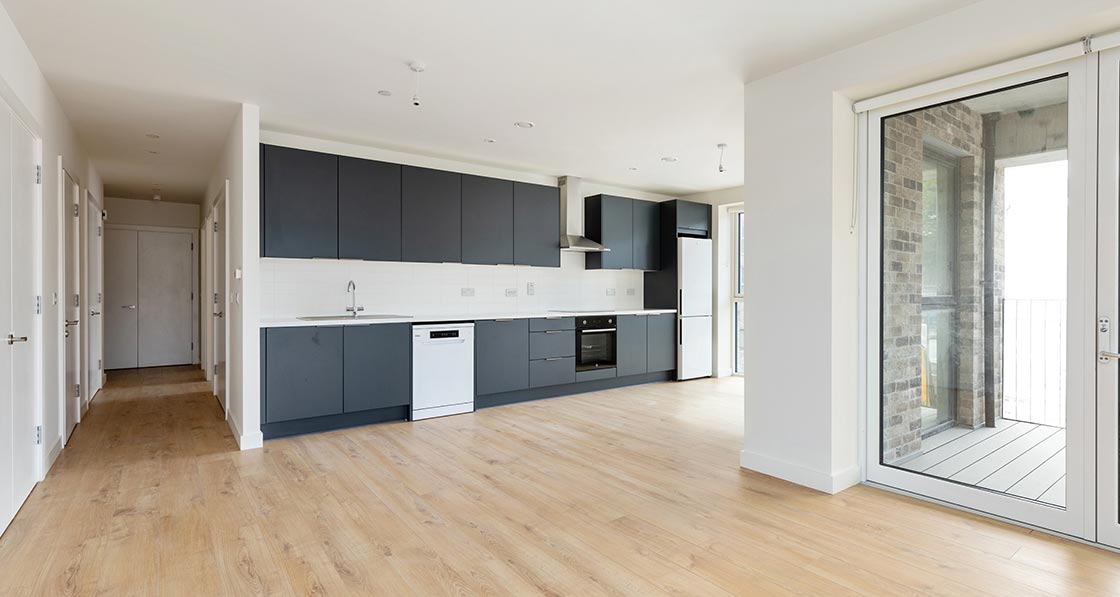
“We know the thing about windows is not true,” says Dargan. “And I think all of our completed schemes to date have been done by first timers. It just simply requires the right training and the right attitude. Airtightness is critical to get right, obviously, but with knowledge and with care, it is achievable.”
In the years since DLR first began building passive, Dargan has overseen all sorts of construction methods on all sorts of projects, from brick outer leaf to steel, timber and EWI. At Shanganagh, the contractor used precast concrete. The underlying message in all of this is that it’s less about what you build with and more about how you build it. You need great planning; you need great quality control. Critically, you need a build team that’s open to learning.
“We don't find that passive comes with costs. It comes more with an understanding of what you have to do. Once you design passive from the start, we find it to be cost neutral.”
Shanganagh Castle Estate comprises 597 housing units: 51 NZEB houses which launched in 2024. The remaining 546 apartments —in eight blocks—are set to be certified passive. Forty of these are affordable for sale. Two hundred are social housing units which will be managed by DLR while the other 306 cost rental units will be managed by the Land Development Agency (LDA).
Two phases have already launched and the final two will launch later this year. The scheme has also helped birth a boom in high density passive house. As reported in issue 47 of Passive House Plus, Shanganagh Castle helped inspire Cairn Homes to commit to passive house on a number of passive house apartment schemes around west and north Dublin.
A small piece of city
This article was originally published in issue 50 of Passive House Plus magazine. Want immediate access to all back issues and exclusive extra content? Click here to subscribe for as little as €20, or click here to receive the next issue free of charge
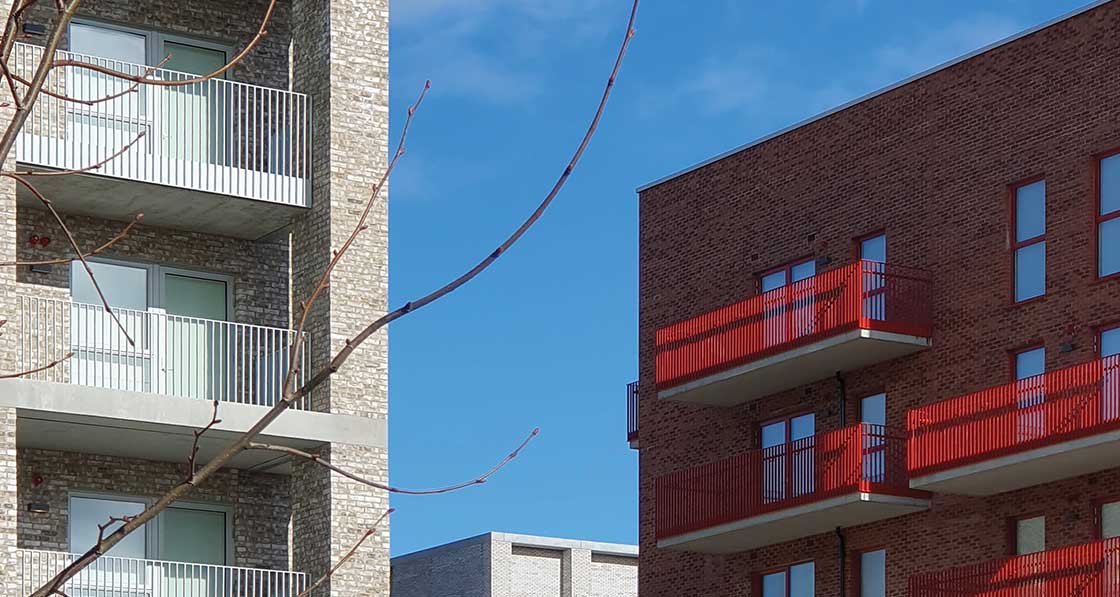
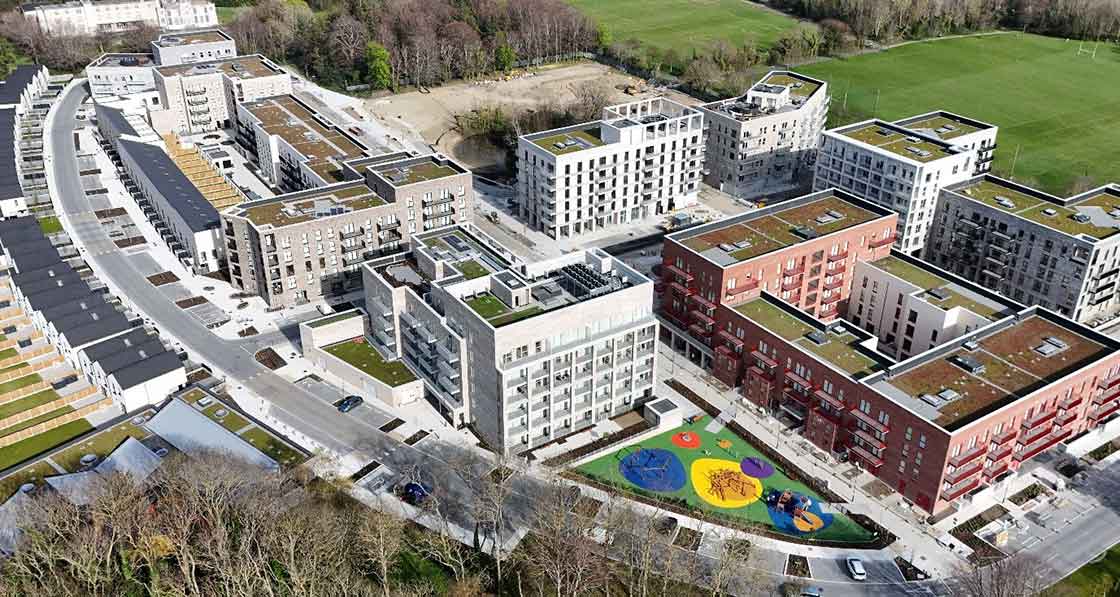
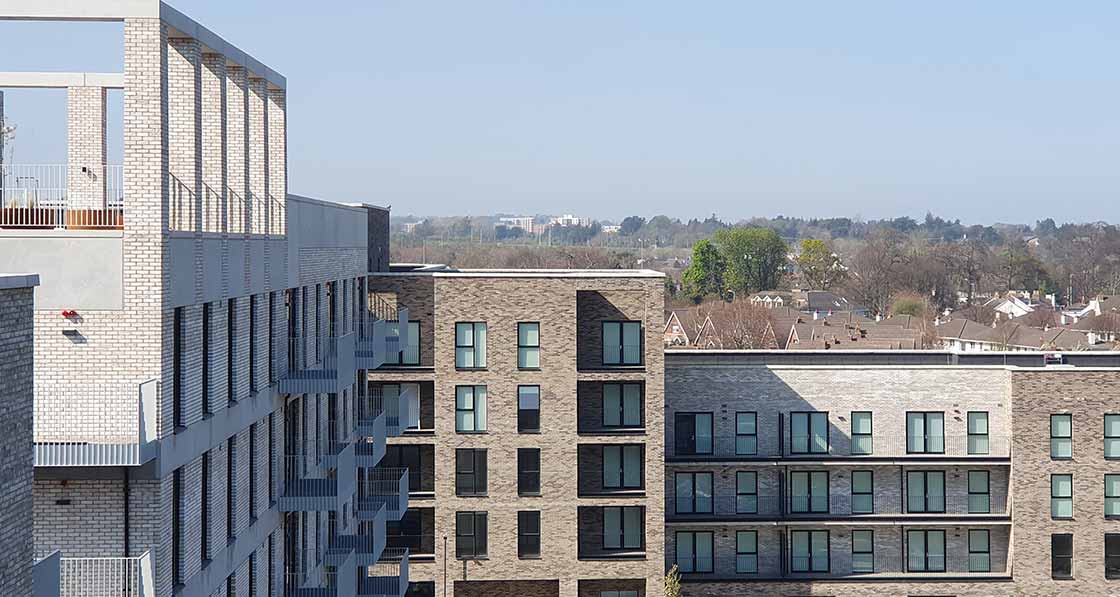
This is high-density housing; what Robert Davys of ABK Architects terms “a small piece of city.” There are green roofs, extensive green areas, external play and communal areas, a crèche, a nearby wood and the grounds of the castle which gives the development its name.
There is no underground parking, but ample bike parking and EV charge points. The new Dart station currently under construction in Woodbrook is a ten-minute walk away.
The site was originally bought by DLR for the development of housing as part of the Woodbrook/Shanganagh local area plan. ABK Architects were brought in to lead an ‘integrated design team’ which set out to embody the local authority’s exacting sustainability goals into the design, which were reflected in a passive house planning requirement in the County Development Plan. Shortly after the LDA came into being in 2018, it came on board as a partner, while passive veterans MosArt were retained as passive design consultants. ABK’s design was awarded planning permission and went out to tender as a design and build contract.
“We were conscious of the potential for a loss of quality,” says Robert Davys of ABK, “so we went into quite a lot of detail that one typically doesn't do: here's the facade we want, here are the recesses in the brickwork we want. Here's the heating system we want for example. But if you want to do it by some other method, come back to us and we'll discuss that.”
Davys emphasises that despite the fact that these pre-baked details were offered, the contractor was free to specify their own build method, so long as it met the standard.
“Whether the contractor chooses to do that in steel, concrete or light gauge steel, or whatever is their choice.”
Walls Construction won the tender. Contracts manager Peter McKenna confirms that the company had not built passive before, and that the passive standard airtightness target was probably the most daunting of the targets set before them.
Critical to making this more achievable was the decision at this point to change from a mix of concrete slab and metal stud to precast concrete construction. It wasn’t just about the airtightness however. Walls are champions of modern methods of construction (MMC), a sprawling term which describes a variety of offsite alternatives to traditional construction, with a heavy emphasis on offsite-manufactured build systems.
Manufacturing in factory conditions, where you’re protected from Irish winter, offers a range of advantages. Better quality control for one. Better health and safety conditions for another. You’re pouring walls on the flat, so you don’t have so many people working at heights.
Nor do you have to think about concrete supply and rebar deliveries. Peter McKenna says that changing to precast reduced the number of deliveries from 4,485 to 2,265 over the fourteen-month construction period. Offsite manufacture also generated a 60 per cent reduction in the energy used compared to onsite construction.
“But the big advantage was that it helped with airtightness,’ says McKenna. ‘When you have an inner leaf concrete wall, there are less details…and once you seal onto your concrete, you’re airtight. If you had a lightweight stud like the original design, then there would be a lot of detailing, and a lot more quality control monitoring. There's a much bigger chance of you getting a leakier façade.”
Early and frequent testing was also critical in delivering passive standard airtightness. Preliminary tests were carried out on each apartment before services were closed and the walls skimmed. That way, problems could be identified and rectified early, and as the build team progressed, they could take what they’d learned and apply that to ensure that problems weren’t replicated. It comes back again to Andrée Dargan’s assertion that getting it right is about attitude as much as anything else.
In the same vein, Mosart’s Tomás O’Leary explains how benchmarking was introduced on this project to great effect.
“This is essentially where you take an apartment or a corridor and say, ‘Right guys, we're going to apply everything that we're going to do here in this sample space,’ then that's vetted and reviewed and assessed, and everybody eyeballs each other and says, ‘OK, are we good with this? Is it meeting the standard? Is this what we had in mind? Is this what we're looking for?’”
By establishing that benchmark and getting everybody to agree to it, it becomes that much easier to maintain consistent standards across literally hundreds of apartments and dozens of common areas. If there’s any doubt about a detail or a risk area, you only have to refer back to the benchmark to confirm exactly how it was dealt with in real time.
When you’re working with a project of this scale, there’s novelty in everything, even for veterans of passive building. Tomás O’Leary admits that the sheer size of the development was overwhelming at the beginning. They simply hadn’t dealt with anything of this magnitude before. He can testify to the advantages offered by precast, both in terms of delivering airtightness and a rapid build.
“When you came back a week later, you’d find the building half up. Speed of assembly was very impressive.”
He also notes how form factor in apartment blocks allows greater freedom when it comes to U-values.
“When you're doing a single-family house, you've got four walls, a roof and a floor, so you've got a high surface area from which you can lose heat. But when you're dealing with apartments, it gets easier in terms of the insulation standards. We know that from other projects, but it's always impactful to see it on the energy model.”
Apartment blocks may give you a more forgiving form factor, but they also generate specific risks—overheating being a particularly significant one. O’Leary identifies two forms of summer overheating, internal and external. The former covers occupant activities like cooking and so on, but it also includes the risk of overheating from pipework.
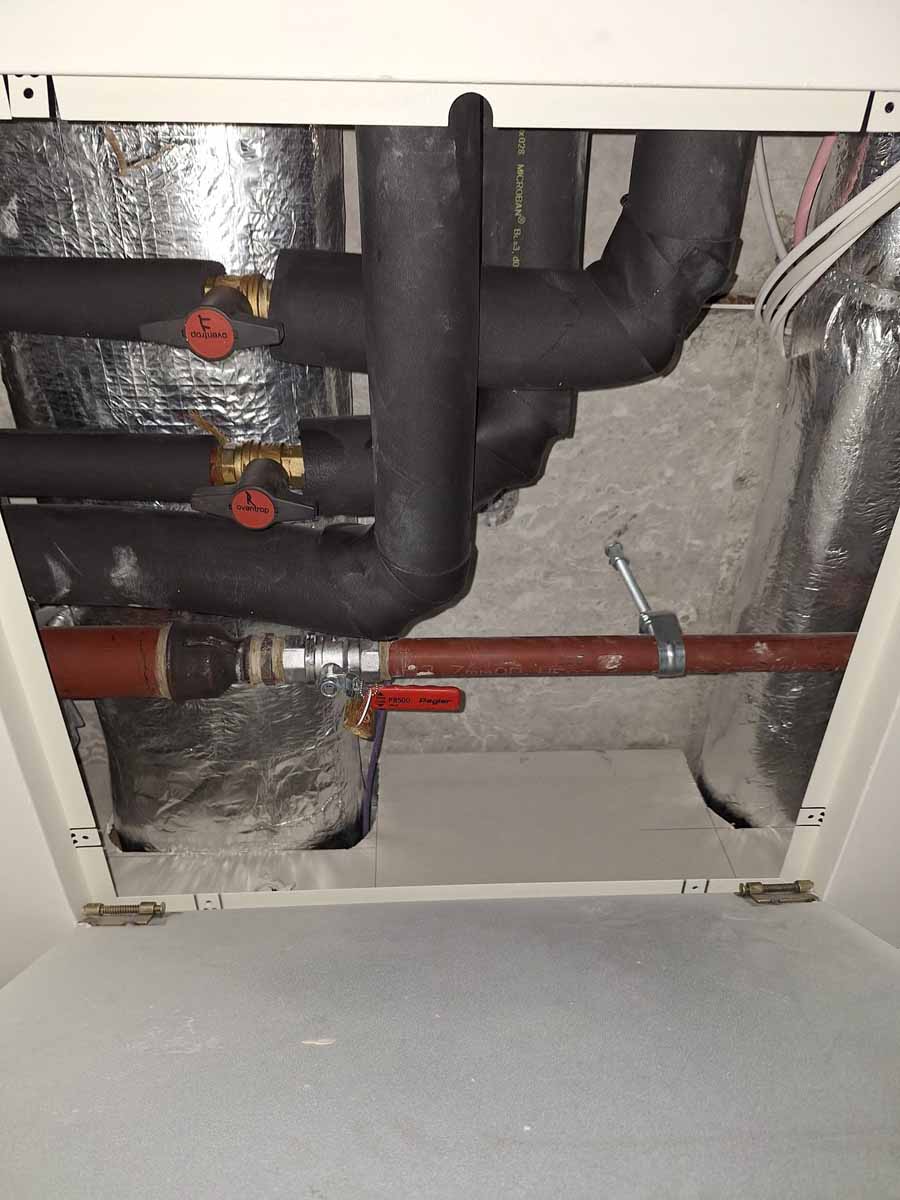
“When you lose heat from heating pipes, it's normally in the heating season, so it's not really regarded as much of an issue, right? But those same pipes are carrying hot water outside of the heating season, and there's a very significant problem globally with overheating being created by poorly insulated pipe work—and not just pipework; bracketry too.”
Often, he points out, the pipework itself will be well insulated but the myriad of brackets needed to hold it in place will not be. In any apartment building, there will be hundreds of these, and if they are left exposed, they will conduct heat where it’s not wanted with merciless efficiency.
“Our motto was: ‘If it feels warm to the touch, it's got to be fully and completely insulated.’ So, everything was very carefully wrapped: the manifolds, the connections, the joints, the pipes. The contractor — Walls — was excellent on that, and their subcontractors followed the same mantra.”
When it came to external overheating risk, each of the blocks in Shanganagh was carefully analysed in the software: “You're creating a three-dimensional model of the community of buildings,” says O’Leary, “and then, for every single pane of glass, the PHPP knows what the solar gains are, in both winter and in summer.”
The software takes into account shading from reveals, balconies, landscape and so on. From there, it was about balancing the need to optimise passive gains with minimising overheating risk. The design team opted for glass with a low-G value to curtail but not eliminate heat transmittance.
As it stands, the PHPP conception of overheating is a bit of a blunt instrument. It requires that internal temperatures do not rise above 25 degrees for more than 10 per cent of annual occupied hours. For a start, that’s more than a full month of overheating. For another thing, this is a whole building figure, so in an apartment block context, it’s even more flawed. You could have a south-west facing apartment that overheats continually for two months, but if that’s balanced by north-east facing apartments that don’t cross the 25 degree threshold with the same regularity, that means you’re compliant.
O’Leary was aware that merely hitting the target would never be good enough:
“It’s important that you do stress test analysis on individual apartments,” he says. “You know from common sense which apartments are likely to be in a critical situation, so we would drill down into those and see, right, what is the overheating frequency in this situation?”
It’s also worth pointing out that individual apartments will have their own MVHR systems which all incorporate a summer bypass option.
And of course, despite what you hear, you can also open windows. It’s also worth noting that MosArt prefers to model apartments with windows closed to reflect the fact that there are many reasons (cats, burglary, and noise, to name just three) why people can’t always open windows to cool down. And then there’s heating. All apartments are connected to a heat pump-based community heating system which provides the building’s hot water and tiny space heating needs.
-
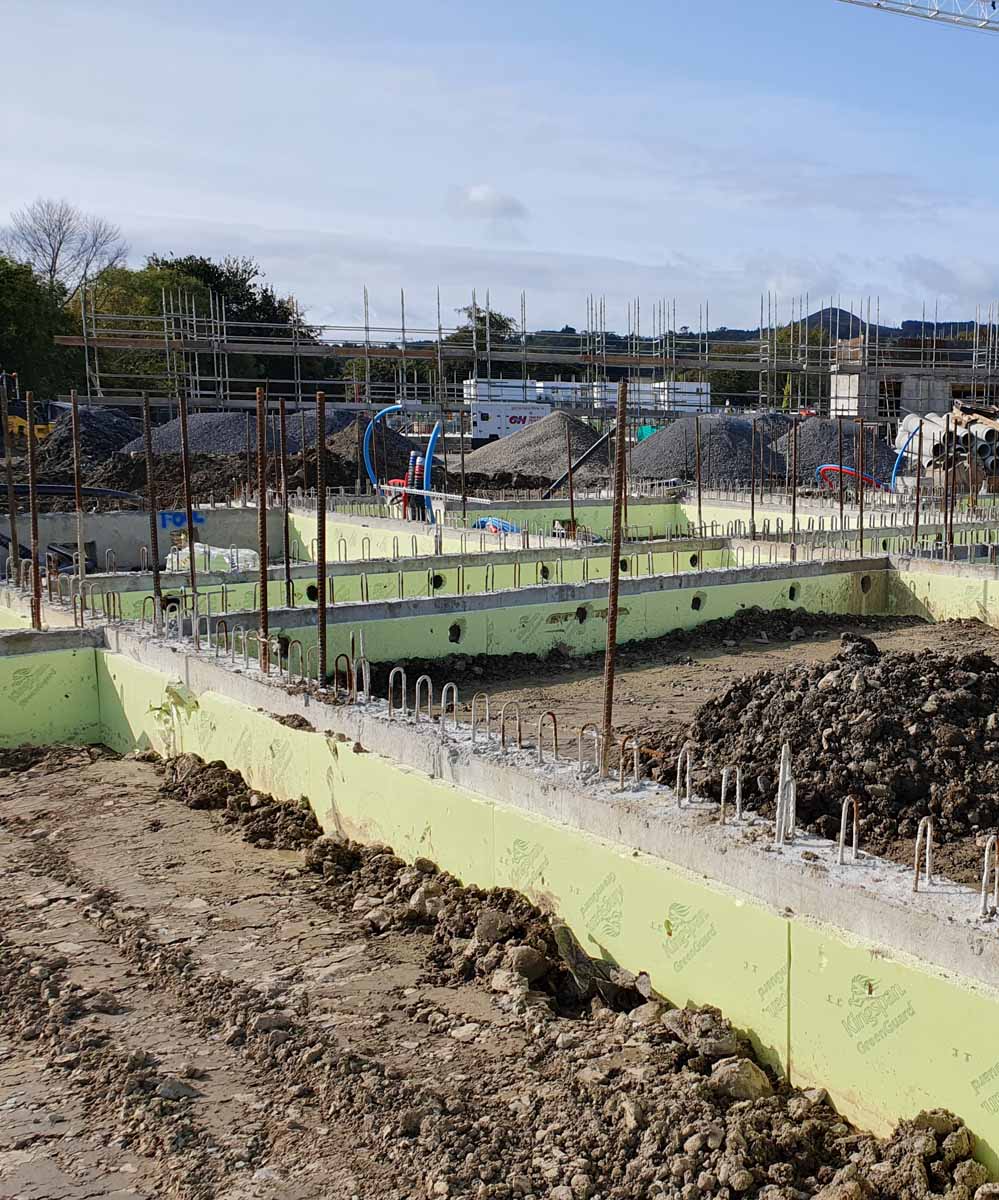
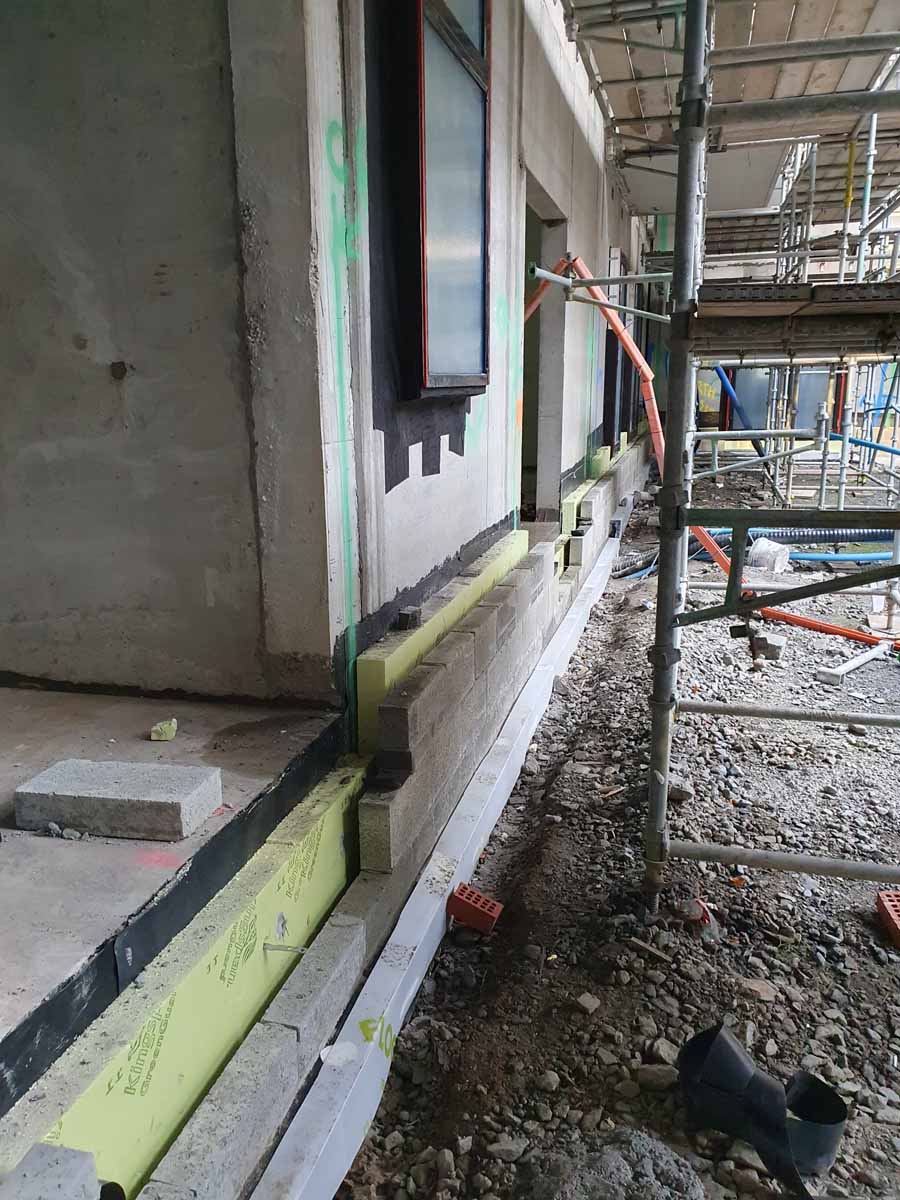
 The build spec includes XPS insulation to prevent thermal bridging at ground beams beneath a 150 reinforced concrete floor slab, insulated with 100mm of Unilin XT/ UF PIR insulation
The build spec includes XPS insulation to prevent thermal bridging at ground beams beneath a 150 reinforced concrete floor slab, insulated with 100mm of Unilin XT/ UF PIR insulation
The build spec includes XPS insulation to prevent thermal bridging at ground beams beneath a 150 reinforced concrete floor slab, insulated with 100mm of Unilin XT/ UF PIR insulation
-
The indoor unit in the energy centre
The indoor unit in the energy centre
-
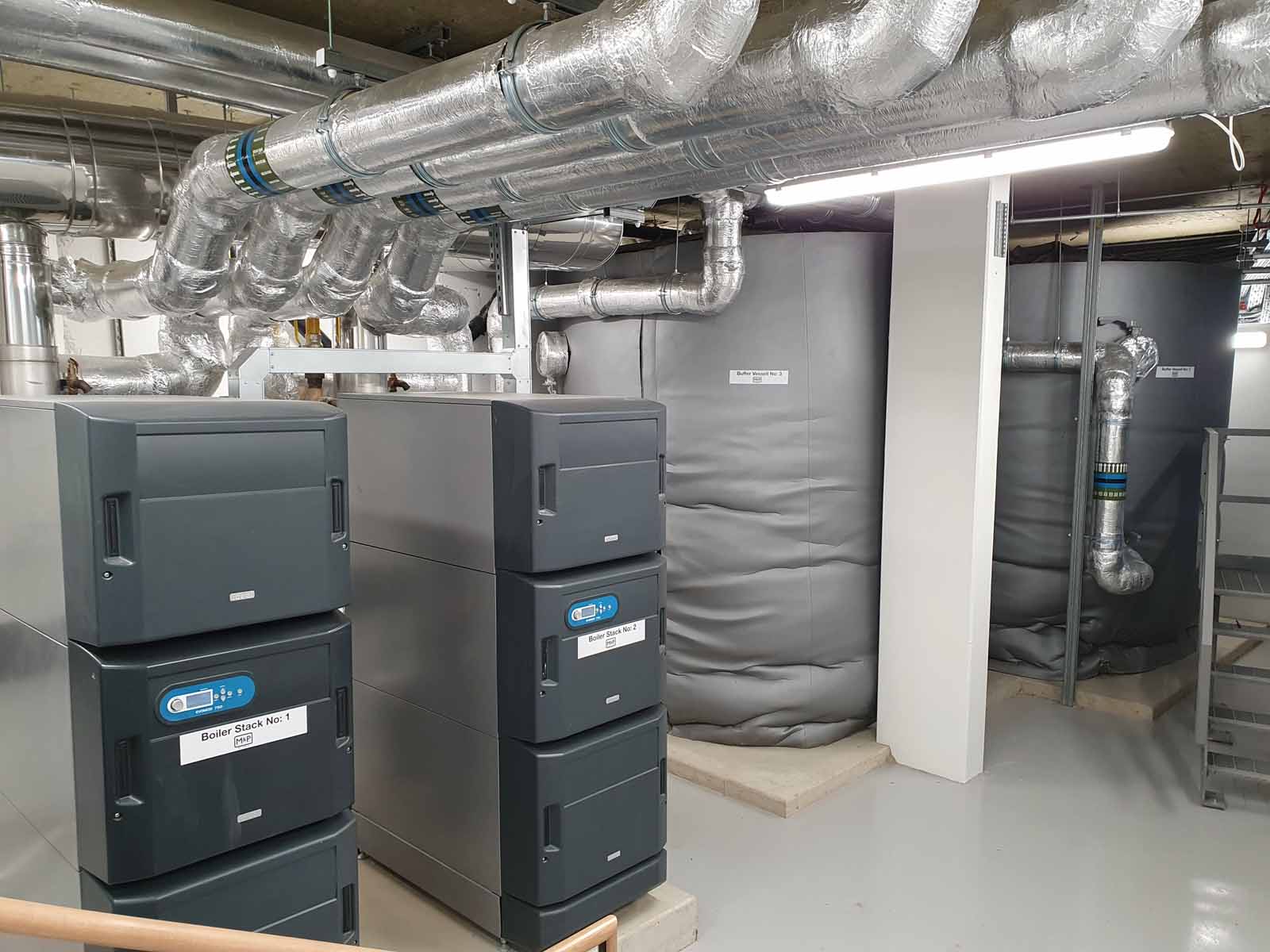
Back up gas boiler stacks and buffer vessel
Back up gas boiler stacks and buffer vessel
-
Insulated pipework at the access hatch
Insulated pipework at the access hatch
-
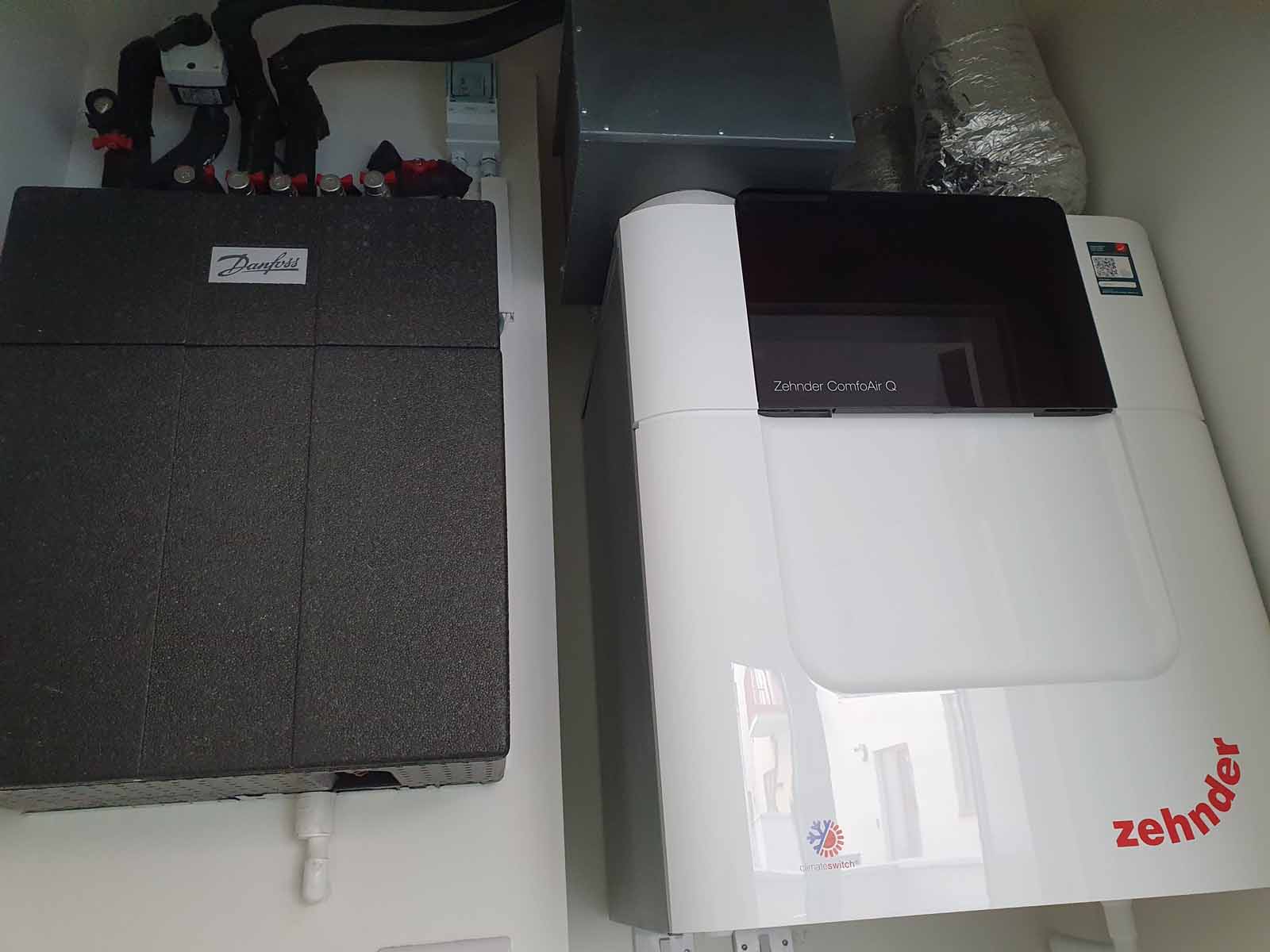
Apartment heat interface unit and Zehnder MVHR unit
Apartment heat interface unit and Zehnder MVHR unit
-
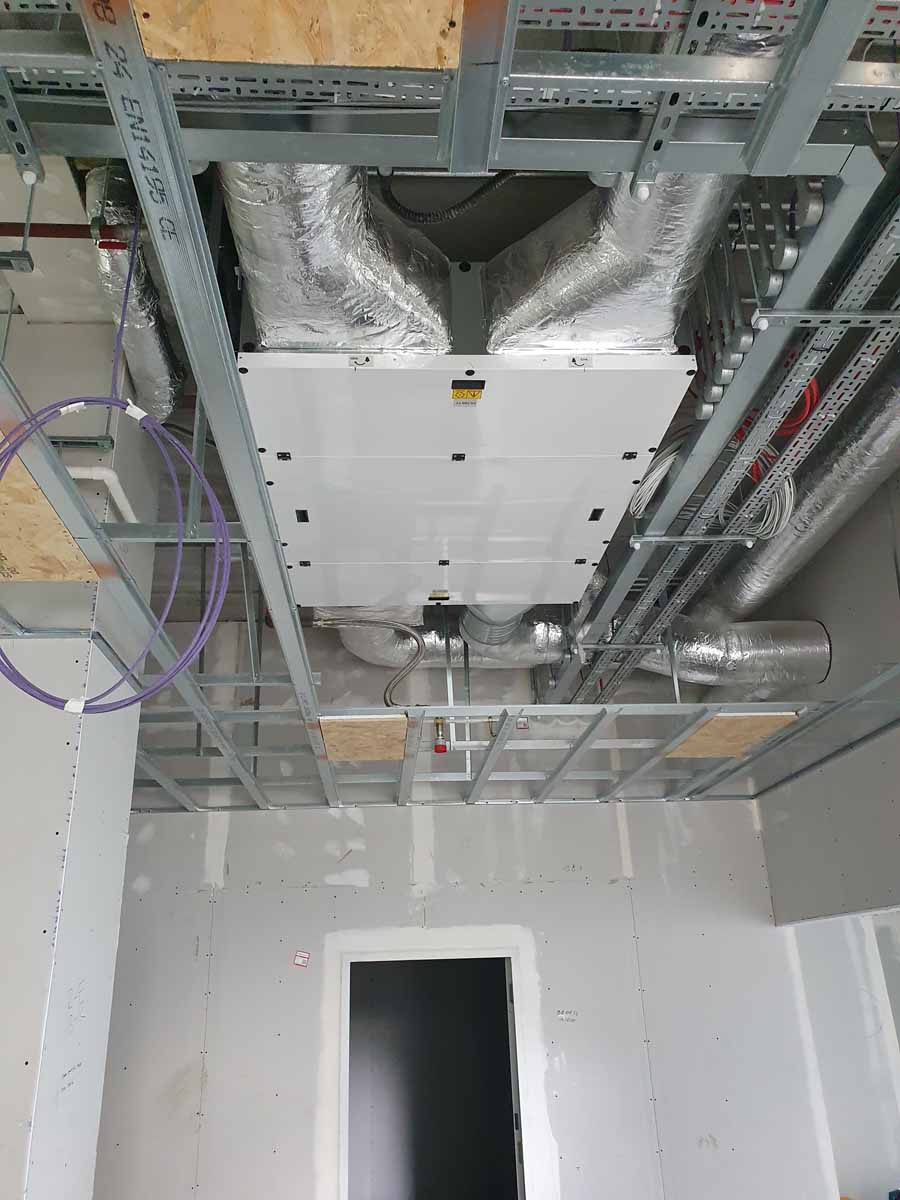
MVHR management suite
MVHR management suite
-
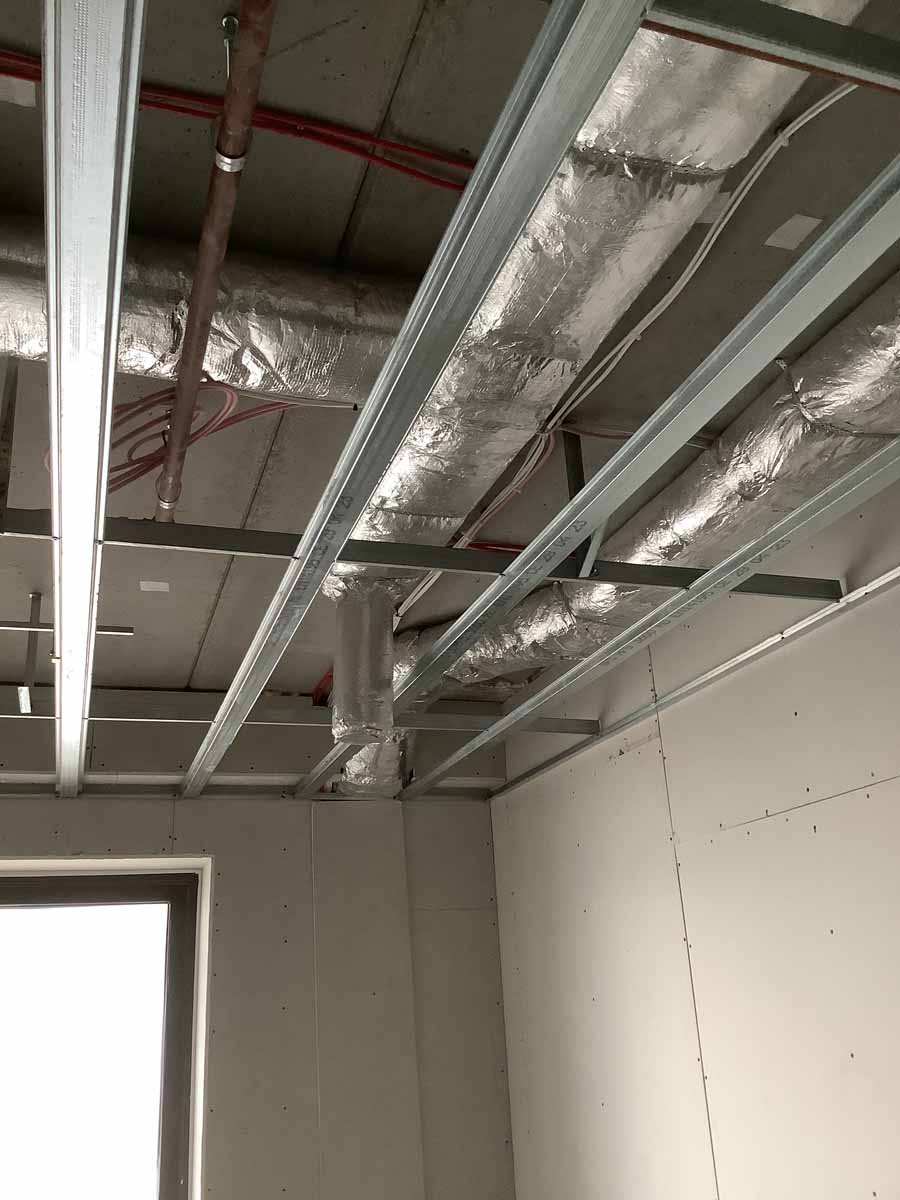
Insulated ductwork in a suspended ceiling
Insulated ductwork in a suspended ceiling
-
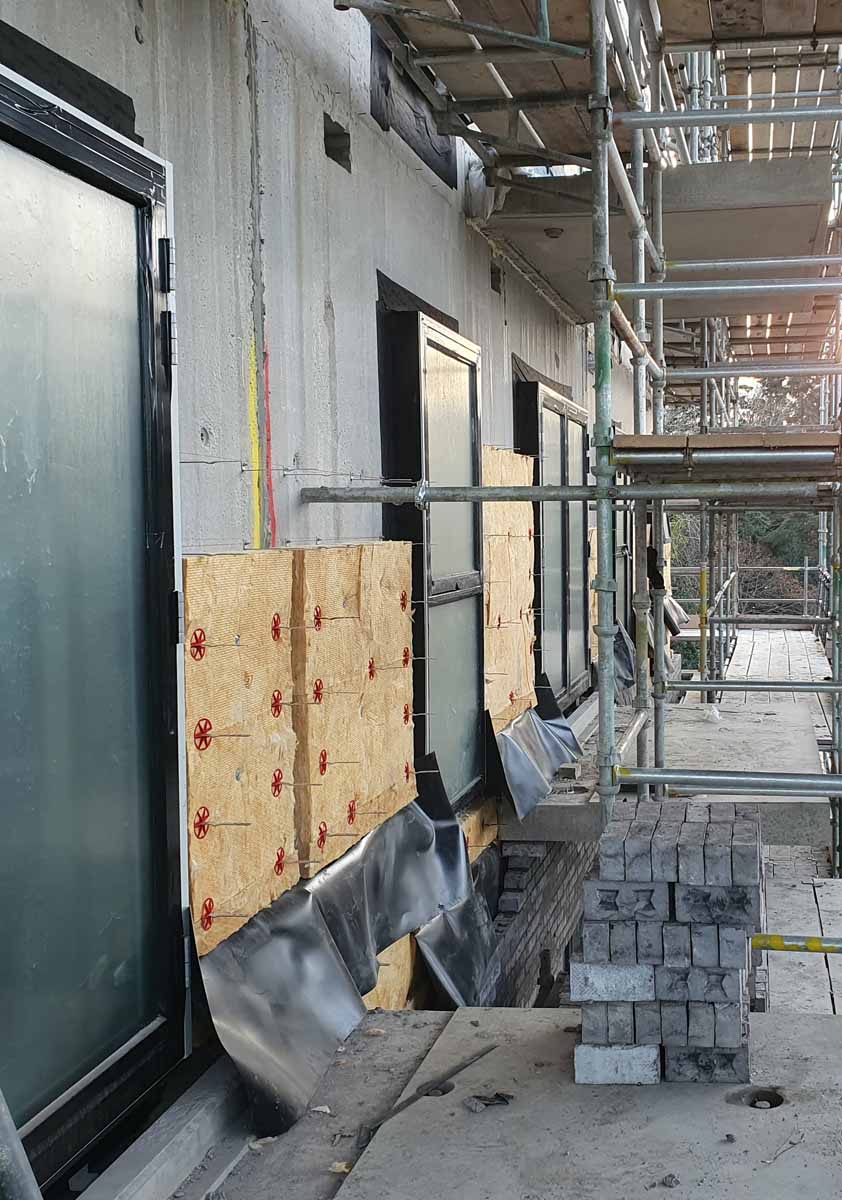
Airtight taped triple glazed NorDan windows sit proud of the blockwork to ensure continuity with the Isover insulation layer
Airtight taped triple glazed NorDan windows sit proud of the blockwork to ensure continuity with the Isover insulation layer
-
Airtight taped triple glazed NorDan windows sit proud of the blockwork to ensure continuity with the Isover insulation layer
Airtight taped triple glazed NorDan windows sit proud of the blockwork to ensure continuity with the Isover insulation layer
-
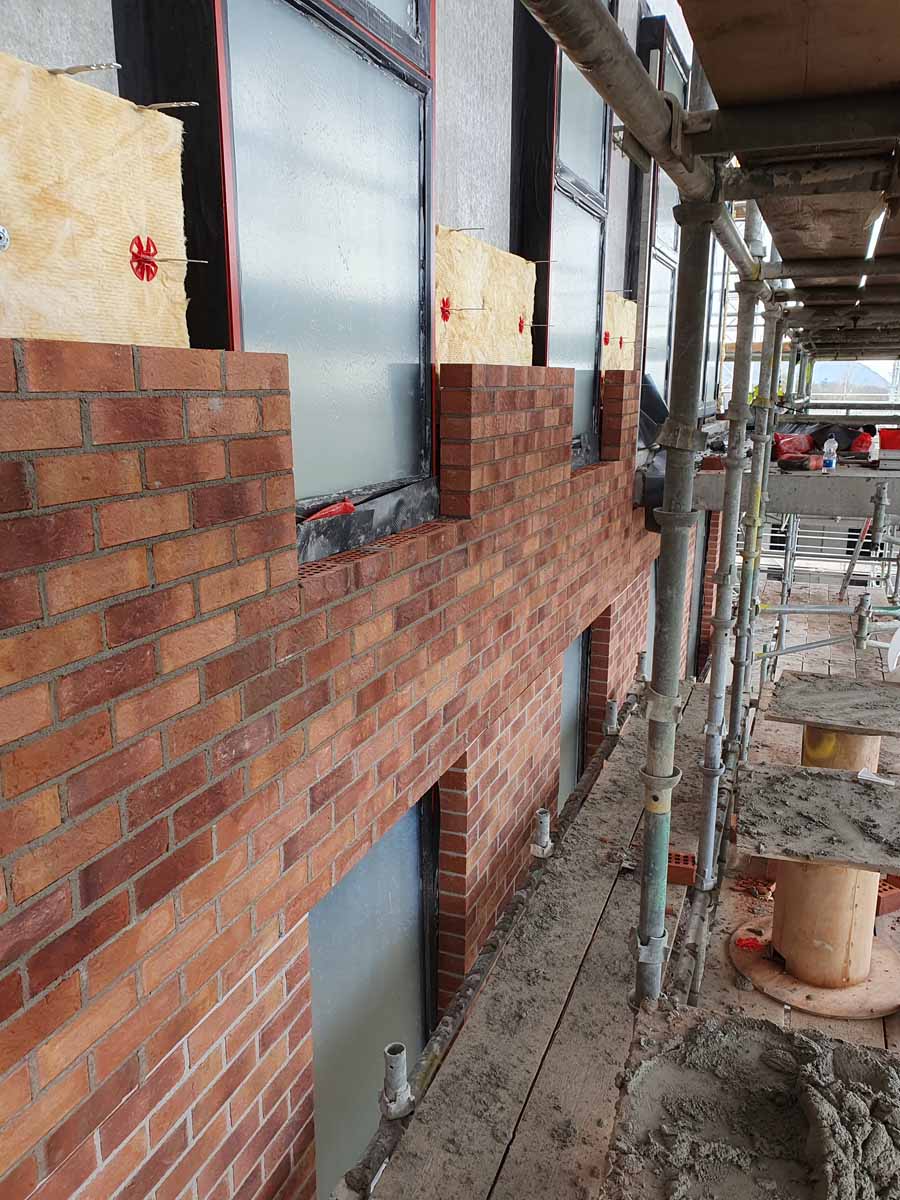
Facade build-up, a brick external leaf is added
Facade build-up, a brick external leaf is added
-
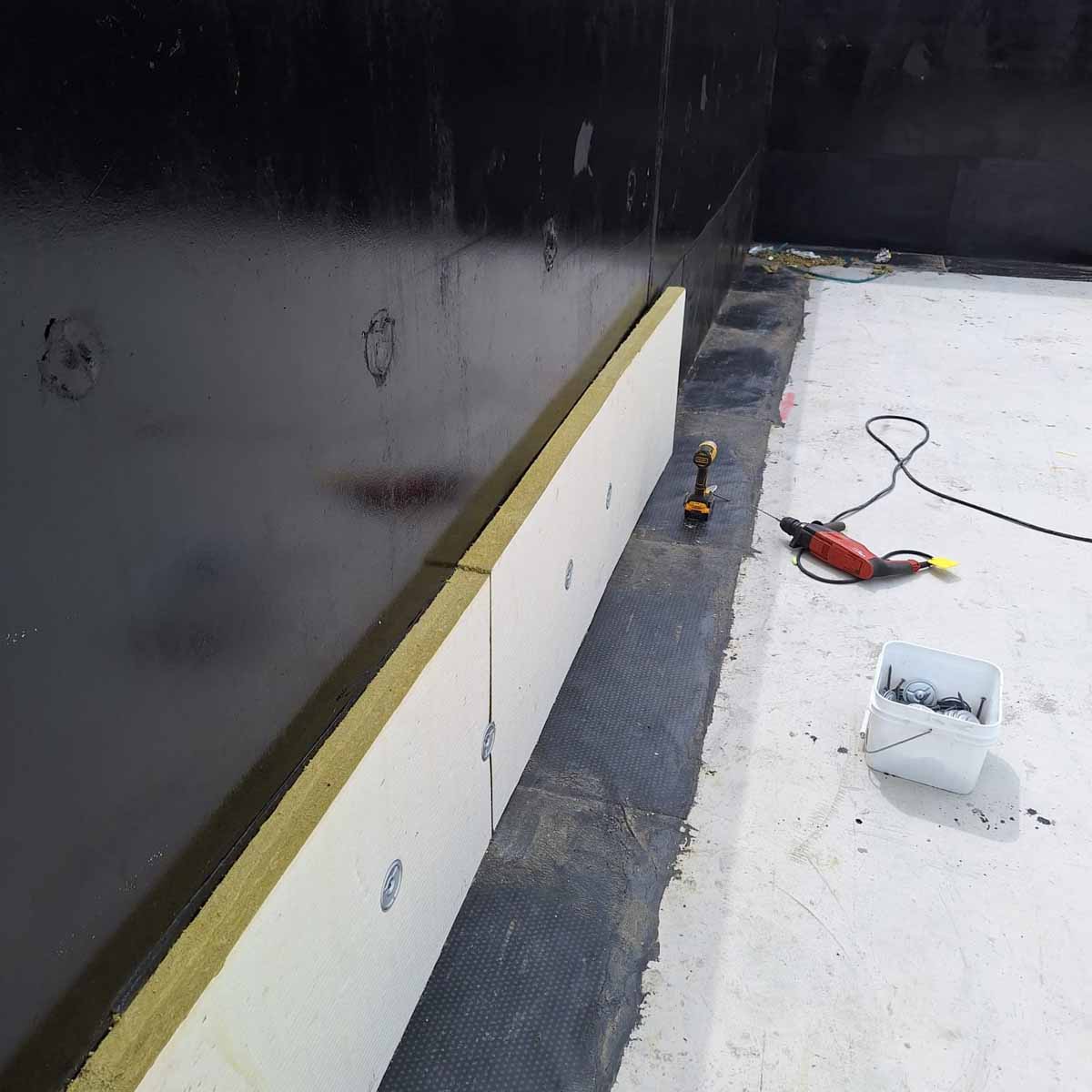
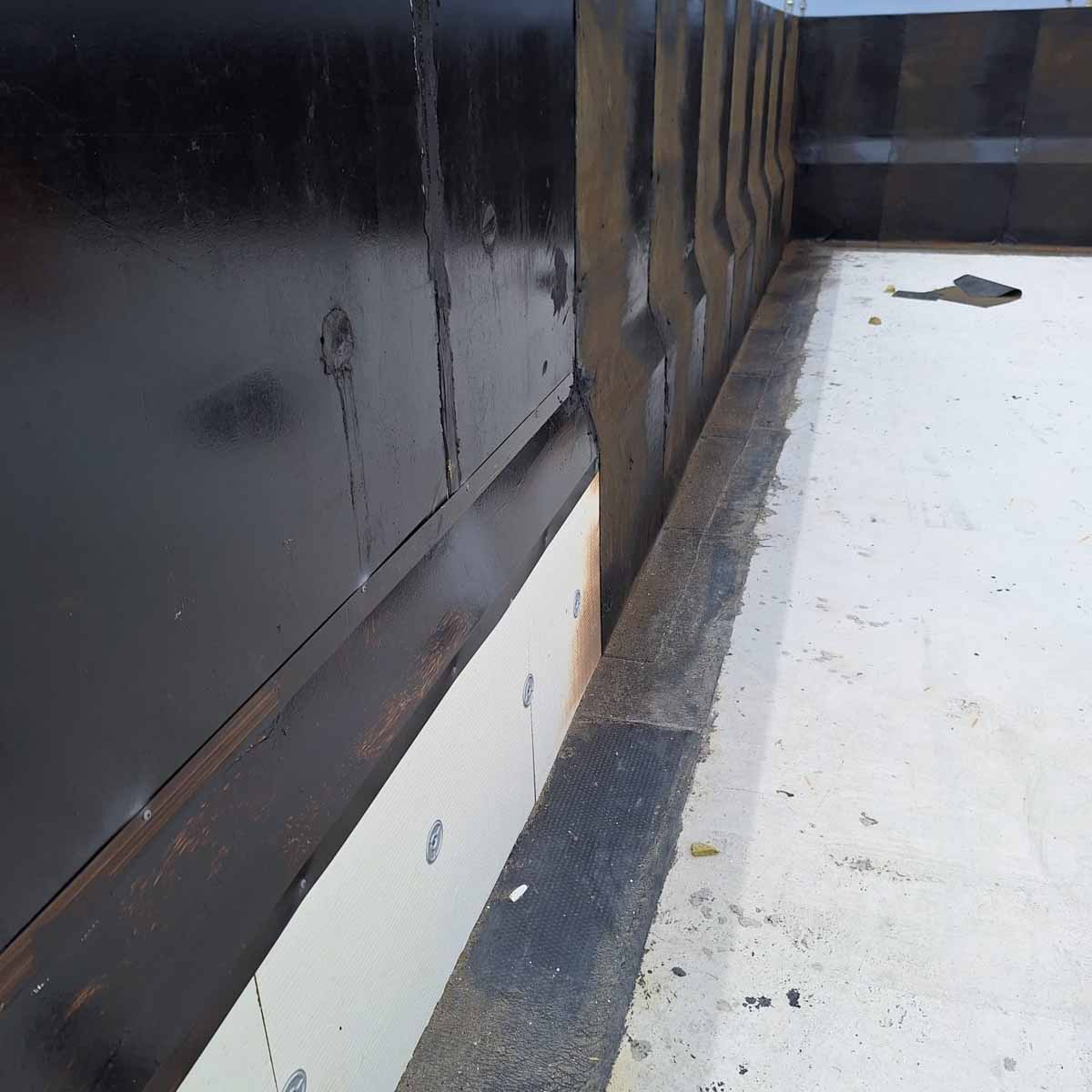
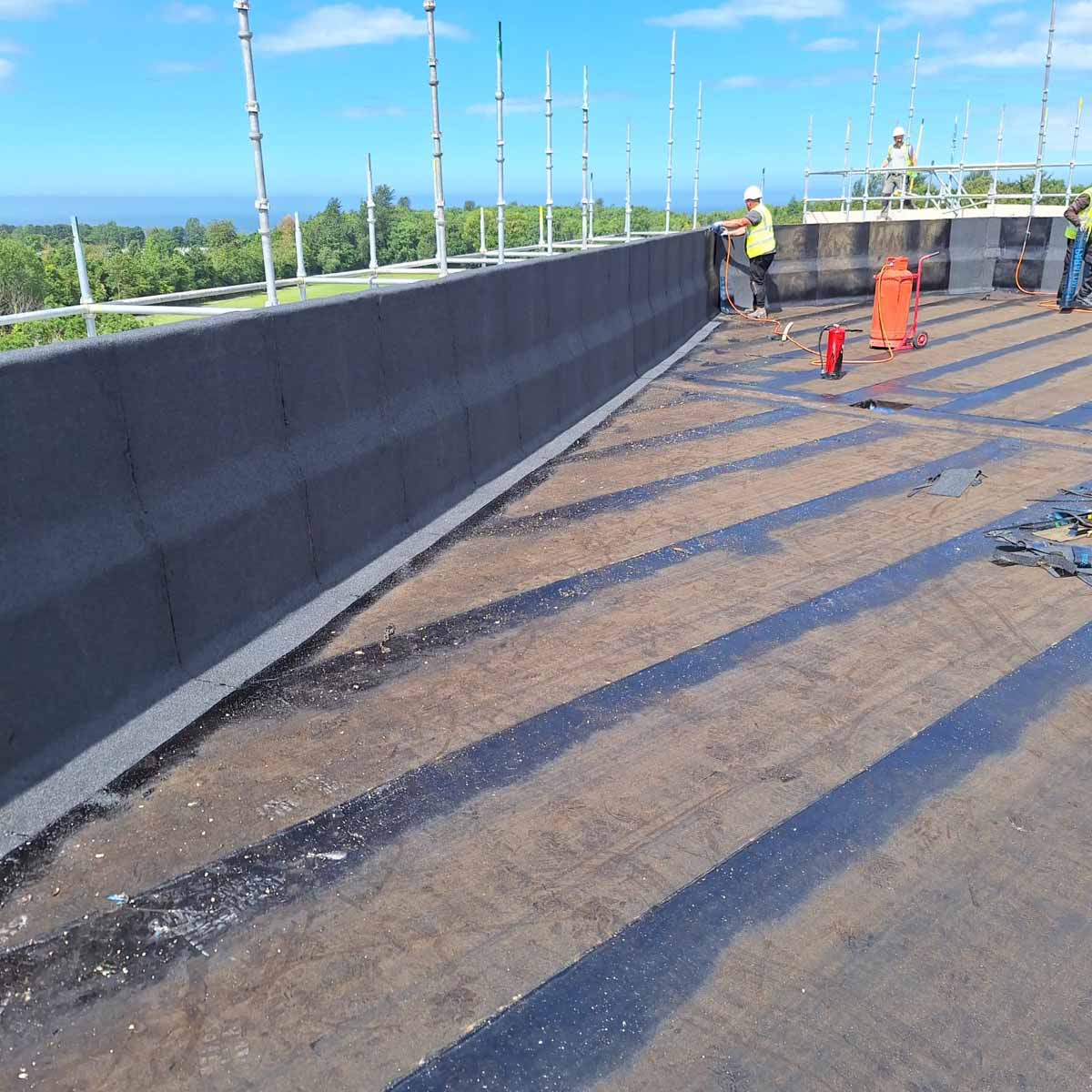
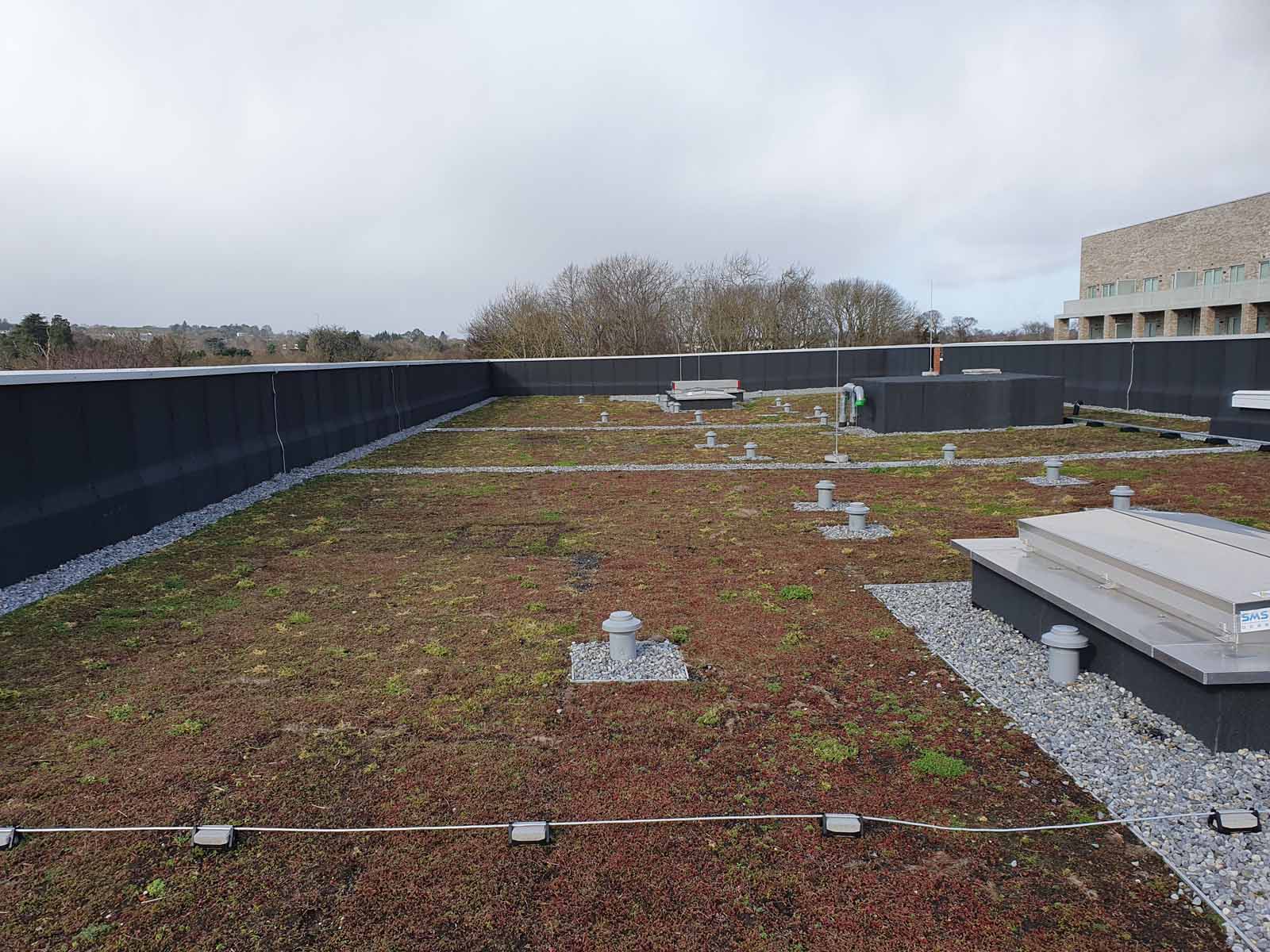
To prevent thermal bridging at the junction of where the external walls meet the roof, the parapet was highly insulated and finished, prior to the sedum layer being installed.
To prevent thermal bridging at the junction of where the external walls meet the roof, the parapet was highly insulated and finished, prior to the sedum layer being installed.
-
To prevent thermal bridging at the junction of where the external walls meet the roof, the parapet was highly insulated and finished, prior to the sedum layer being installed.
To prevent thermal bridging at the junction of where the external walls meet the roof, the parapet was highly insulated and finished, prior to the sedum layer being installed.
-
To prevent thermal bridging at the junction of where the external walls meet the roof, the parapet was highly insulated and finished, prior to the sedum layer being installed.
To prevent thermal bridging at the junction of where the external walls meet the roof, the parapet was highly insulated and finished, prior to the sedum layer being installed.
-
To prevent thermal bridging at the junction of where the external walls meet the roof, the parapet was highly insulated and finished, prior to the sedum layer being installed.
To prevent thermal bridging at the junction of where the external walls meet the roof, the parapet was highly insulated and finished, prior to the sedum layer being installed.
-
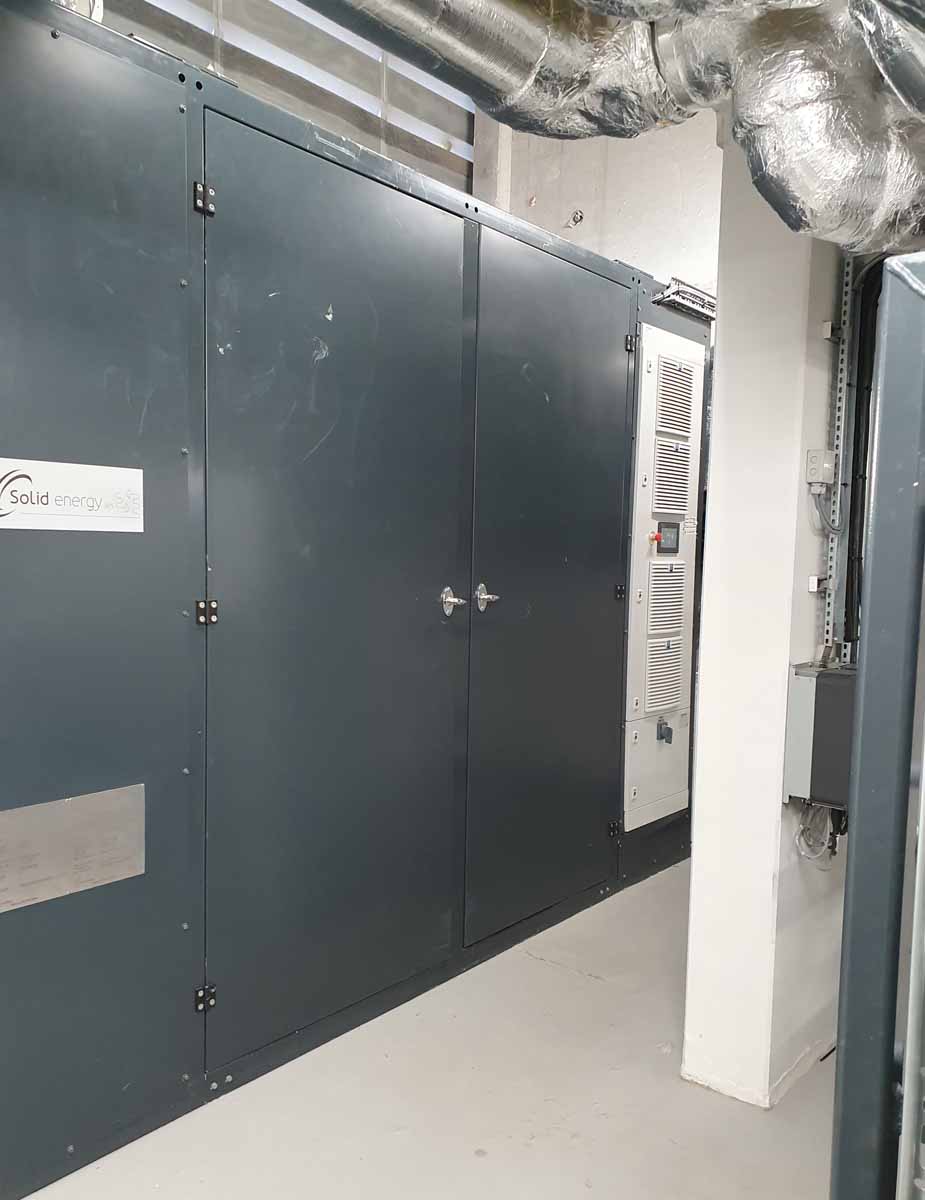
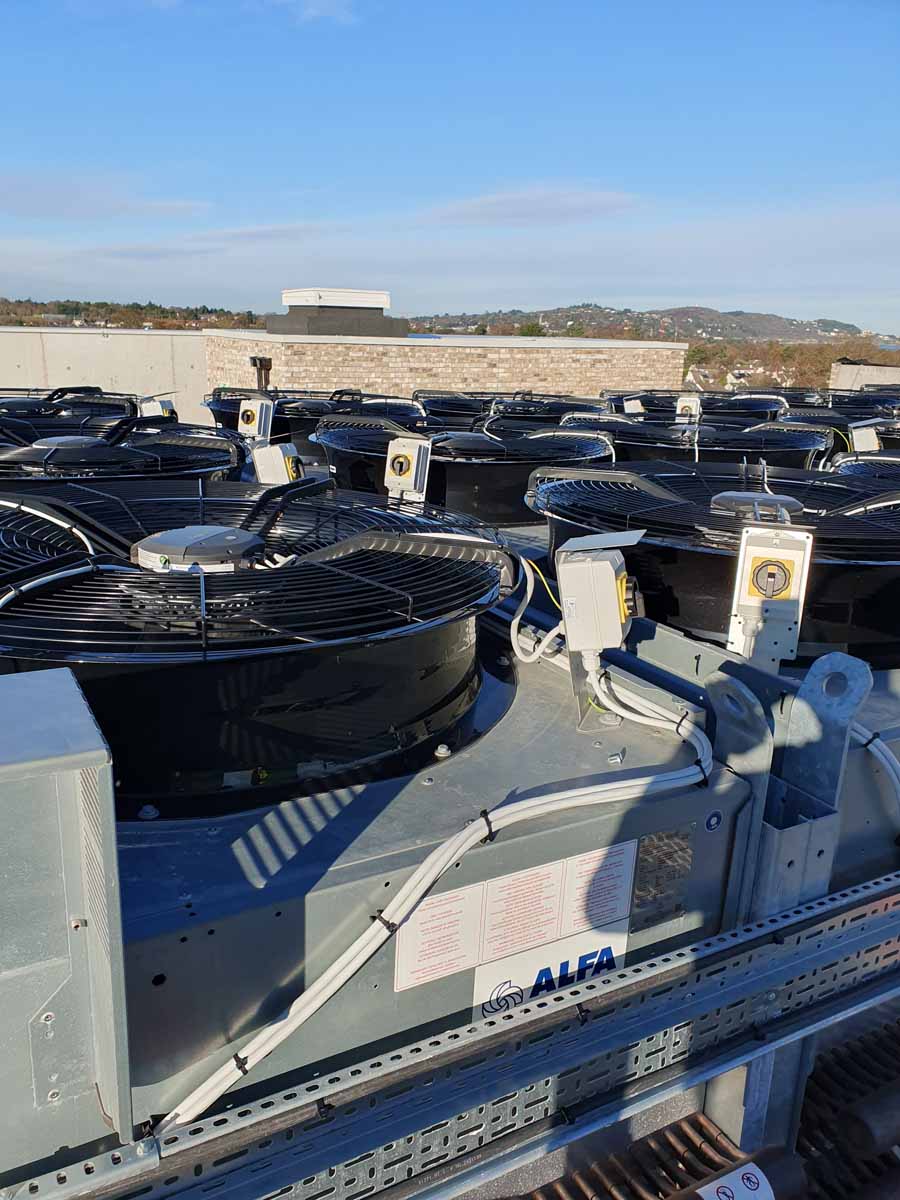
The building's 550 kW Solid Energy air to water heat pump includes condenser units on the roof
The building's 550 kW Solid Energy air to water heat pump includes condenser units on the roof
https://mail.passive.ie/articles/case-studies/king-of-the-castle#sigProId28cbdc08cc
An energy centre on the roof of one of the blocks contains a large custom-built air source heat pump from Unitherm Heating Systems, paired with three 12,000 litre buffer tanks and back up gas boilers. The heat travels from these buffer tanks to individual heat interface units (HIUs) in the apartments and these HIUs provide hot water and supplementary heat for an innovative space heating approach at the consumer end. This is a dry system. You set the stat to 20C, and hot water goes from the HIU to a heater battery in the MVHR, which then elevates the temperature until it hits the desired level. So, with the exception of towel rails in bathrooms, there are no radiators – which offers a welcome space saving in an apartment setting.
While, in recent years, heat recovery ventilation has become common in new homes, the quality of solutions required to meet passive house standard tends to be a cut above for a number of reasons. Consequently, every detail was crucial, from specific fan power and heat recovery efficiency to acoustics and aesthetics.
The onerous space heating demand target of the passive house standard means that every kilowatt hour reduction matters, meaning higher efficiency MVHR units can make the difference between achieving certification and not. Through close consultation with all parties involved, MVHR specialists Versatile proposed its Comfo Q MVHR family, which are all passive house certified. Further enhancing the system are post-heater batteries, meaning that this innovative approach to integrating ventilation and heating enables heat from the heat pump to boost the air temperature as the occupant requires, in any circumstances when the recovered heat alone is insufficient. This can be controlled seamlessly through the MVHR system.
As mentioned, while DLR will be managing the social housing units, the Land Development Agency will hold and manage the majority of apartments. Paul Greene of the LDA is looking forward to seeing how all of these initiatives and innovations will stand up when people start moving in. He’s particularly positive about the build process.
“There was nothing that stumped us at all. We started that job in September 2022, and we finished maybe four or five months ahead of programme at the end, and on budget as well.”
In time and on budget. There’s something you don’t hear very much, especially when it comes to public construction projects. The LDA’s stated purpose is to ‘maximise the supply of affordable and social hot this means that they have to take the long view.
“Everything we’re working on has a sixty-year mindset.” That’s why there’s a certain amount of flexibility implicit in the design. Additional drainage ‘pop-ups’ were installed in some of the amenity spaces in the ground floor so that layouts could be changed to respond to different user needs and/or market conditions. To the same end ‘soft spots’ were incorporated into the walls so that windows or doors could be broken up and installed at a later stage.
“We try to think ahead,” he says.
Heat pump-based group heating, but with a twist
Unitherm Heating Systems supplied the heat pump solution for Shanganagh Castle: a Danish custom manufactured Solid Energy 550 kW air-to-water heat pump which feeds into a communal heating system for all four blocks. The system is backed up by two 750 kW gas boilers.
The Solid Energy air-to-water heat pump was custom manufactured for the job, selected to meet a number of demanding criteria for the project. First, there’s the carbon emissions. Grid electricity is in the middle of a trajectory of significant decarbonisation – which makes a heat pump’s ability to turn a kilowatt of electricity into several kilowatts of heat a particularly effective means of decarbonising heat.
“The heat pump is sized to meet 95% of the apartments heat demands and uses 36,000 litres of buffer vessels to smooth out the demand/ generation curve,” says MosArt associate Shane Kinsella. “Gas boilers pick up any slack and can meet the full loads of the building should the heat pump be offline i.e. for maintenance. The M&E designers did a lot of analysis on the heat pump size and the necessary buffer vessel volumes etc. to ensure that everything was sized appropriately and that the heat pump would run flat out, as much as possible.” The heat pump operates at a fixed flow temperature of 65C, with varying Delta Ts of between 30-35C. To any readers unfamiliar with engineer-speak, Delta T is the difference in temperature between two points. In heating, it’s used in a variety of ways. In this case, it means the difference between the temperature of the hot water flowing from the heat pump, and the cooler water returning from the heating system back to the heat pump. With a fixed flow temperature of 65C, the heat pump has varying Delta Ts: 35C if the water returns to the heat pump at 30C, 34C if it returns at 31C, and so on.
The heat pump provides fixed flow temperatures of 65C to the network system feeding Danfoss heat interface units HIUs which provided hot water (DHW) and space heating to each apartment via towel rails and a heat source to boost the ventilation supply air temperatures if required.
Passive House Plus has heard stories of some projects where heat pumps are included as part of the heating system in some larger buildings to satisfy renewable energy and primary energy targets in building regulations, but where the heat pump only ends up taking a tokenistic role, with the heating system set up to rely on a gas boiler instead. But as Unitherm’s commercial technical co-ordinator Derek Diskin explains, the system at Shanganagh Castle has been designed to call on the gas boilers rarely, if ever.
A critical aspect, Diskin says, is the sizing of the peak energy requirements to meet the building’s heat and hot water load – in a manner that guarantees the residents always have instantaneous hot water on demand via the Danfoss HIU.
To avoid the need for an overly large heat pump, the heat pump delivers a constant 65C flow into three 12,000 litre buffer tanks. “The three buffers were sized to meet peak load periods,” says Diskin. The heat pump can then be charging up those buffers during low system demand like a battery. The gas boilers are really just there as a back-up.
To work effectively, in this application the HIU needs a fixed flow temperature of 55C to be maintained in order to provide the heating and DHW requirements,” he explains. “The heat pump must maintain a steady flow temperature to the buffer and network system.
This particular heat pump delivers a fixed flow of 65C to the buffer. Diskin adds that the type of compressor used—in this case, a screw compressor—is key to ensuring a stable output design temperature. The heat pump system has its own control and instruments; valves and pumps are wired to the control. The controls communicate with each other via Modbus signal and make the entire system function as a unified system.
Selected project team members
Client: Land Development Agency / Dún Laoghaire-Rathdown County Council
Architect: ABK Architects / O'Mahony Pike
Main contractor / project management: Walls Construction
M&E engineer: Homan O'Brien / IN2
Civil / structural engineer: Punch Engineering / DBFL Consulting Engineers
Energy & passive house design consultant: Mosart
Quantity surveyors: AECOM
Landscaping: Brady Shipman Martin
Passive house certifier: ECD Architects
BER assessors: JOT Energy
Airtightness tester / consultant: Building Envelope Technologies
Wall insulation: Isover
Floor insulation: Unilin
Window & doors: NorDan
MVHR: Versatile
Communal heat pump: Solid Energy, via Unitherm Heating Systems Ltd
Photovoltaic supplier: Resolute Group
District heating system operator: Yuno Energy
Project overview
Residential apartment development of externally insulated precast concrete walls. The below details correspond to phase two of the project, blocks A-D, which include 230 apartments across four blocks, totaling 4,398 m² (Block A), 8,038 m² (Block B), 2,796 m² (Block C) and 2,603 m² (Block D). Blocks E-H will include 315 passive apartments built to very similar specs. Typical, apartments include 41m² studios, 47m² 1 bed, 83m² 2-bed, 107m² 3-bed and 134m² 4-bed units.
Site type & location: Urban site, Shanganagh
Castle, Shankill, Co. Dublin
Completion date: September 2025
Budget: Not disclosed
Passive house certification: Passive house Classic – certification pending.
Note that all PHPP figures below are provisional.
Space heating demand: 17.75 – 16.53 kWh/m²/yr (Blocks A-D)
Heat load: 8.9-10.0 W/m² (Blocks A-D)
Primary energy non-renewable: 89.6 - 97.5 kWh/m²/yr (Blocks A-D)
Primary energy renewable: 50.1-54.3 kWh/m²/yr (Blocks A-D)
Heat loss form factor: 1.3 to 1.4
Overheating (PHPP, percentage of year above 25C, modelled, with all windows closed, at all times): Block A: 0.0%, Block B: 0.2%, Block C: 0.0%, Block D: 1.4%
Number of occupants assumed: Block A: 114.5 (Standard) – 61 units Block B: 204.2 (Standard) – 101 units Block C: 69.9 (Standard) – 33 units Block D: 67.2 (Standard) – 35 units
Energy performance coefficient (EPC): All are below 0.300 and comply with NZEB
Carbon performance coefficient (CPC): All are below 0.350 and comply with NZEB
BER: The BERs are not published yet, but we expect all units to be A2/A3. Mostly A2, occasional A3s
Embodied carbon: Not calculated
Measured energy consumption: Not applicable
Energy bills (calculated): Based on a 83m² 2-bed flat, the projected space heating costs are €256/ yr, and the projected domestic hot water costs are €201, with a standing charge of €263 – and a grand total for all heating and hot water of €720/ year. This is based on a unit cost of €0.18c from Yuno Energy per kWh, who will operate the district heating system, and a daily standing charge of €0.72. The figures are based on PHPP calculated values of 17.14 kWh/m²/yr for space heating demand and 13.5 kWh/ m²/yr for domestic hot water demand – namely the estimated totals at the heat meter in the example apartment. In the “In brief” panel at the start of the article a proportion of the standing charge has been included in the space heating costs to avoid giving a misleading impression. Whereas all grid-connected buildings face a standing charge for electricity irrespective of whether electric heating systems are used, in this case the standing charge is tied specifically to the provision of space heating and hot water, so it is reasonable to include it in the projected running costs for heating and hot water.
Airtightness: Typically coming in at 0.4 to 0.5 ACH and 50 Pa so far.
Ground floor: 150 mm reinforced concrete (airtight layer), resting on reinforced concrete ground beam system on piles (due to poor soil loading ability), 100 mm Unilin XT/UF PIR (ʎ=0.022)
Uncorrected U-Value: 0.208 W/m²K Corrected (to ISO 13370): 0.146 W/m²K (Block A)
Walls: 102 mm brick finish, 50mm unventilated cavity, 100 mm Isover CWS32 Slab (ʎ=0.032), 150-200 mm precast concrete wall system (by Flood Precast), 90 mm (compressed from 100 mm) of Isover Spacesaver 44 Roll (ʎ=0.044), 10 mm service cavity, 12.5 mm plasterboard with skim finish. Airtight line along outer face of precast wall. U-value: 0.171 W/m²K
Roof: Extensive green roof system with 30 mm sedum blanket, Diadem DiaMassive 25H drainage board, filtration fleece & protective fleece, Moy Paralon NT4 anti root cap, Moy Paralon Top N underlay, 120mm Paratherm T insulation (ʎ = 0.024), 75 mm concrete structural screed, 200 mm reinforced concrete deck (airtight layer), 200 mm service cavity, 12.5 mm plasterboard with skim. U-value: 0.11 W/m2K
Windows & external doors: NorDan TQ &TL 105 timber aluclad windows, triple glazed argon filled glass units, Typical U-value: 0.86 W/m²K, G-Value = 0.50.
Heating system:Community heating system, featuring a Solid Energy AWB200 air-to-water heat pump (550 kW @ 2C) with 3 x 12,000 L buffer vessels, 2 x Ideal Evomod 750 kW gas boilers (for backup and peak loads), Grundfos pumps, Danfoss Termix VVX heat interface units (one per apartment), Calpex underground distribution pipes. Mixture of heater batteries on supply air and radiators/towel rails.
Ventilation: Zehnder ComfoAir Q350 & Q450 MVHR Units, PHI Certified, 88-91% efficient.
Cooking fumes ventilation: Recirculating cooker hood, 70% manufacturer-declared capture efficiency and 80% heat recovery rate.
Potable water use: Not calculated
Water efficiency measures: Dual flush toilets, 6l/min showers.
Electricity: Block A, B, C, D, F & G – 3.2 kWp – 7 no. AE Solar 480 Wp Panels
Block E & H – 1.28 kWp 3 no. AE Solar 480 Wp Panels No battery storage, connected to landlord distribution boards.
Material impact: Not assessed
Related items
-
 Households feeling the heat of global oil conflict
 -
 Glasgow scheme creates affordable rents fit for the future
 -
 Dungannon social housing sets passive example
 -
 Cambridge retrofit is a study in considered retrofit
 -
 Price regulation promised to address district heating affordability
 -
 A1 rated passive house tackles embodied carbon on challenging site
 -
 Infill proves a 'bubble of pleasantness' for Cork family
 -
 In 2099, it never rains, but it pours
 -
 Modernist masterpiece gets near passive update
 -
 Study: passive house costs as low as 2%
 -
 Fabric or heat pumps first? AECB conference heads to Manchester to unpick the debate
 -
 EU Electrification Action Plan to accelerate heat pump transition