
- New build
- Posted
Ballymore scheme brings low-cost comfort to private market
With 35,000 homes under their belt, one of the UK and Ireland's most prolific developers has just completed its first passive house scheme - aided by an innovative airtightness approach.
Click here for project specs and suppliers
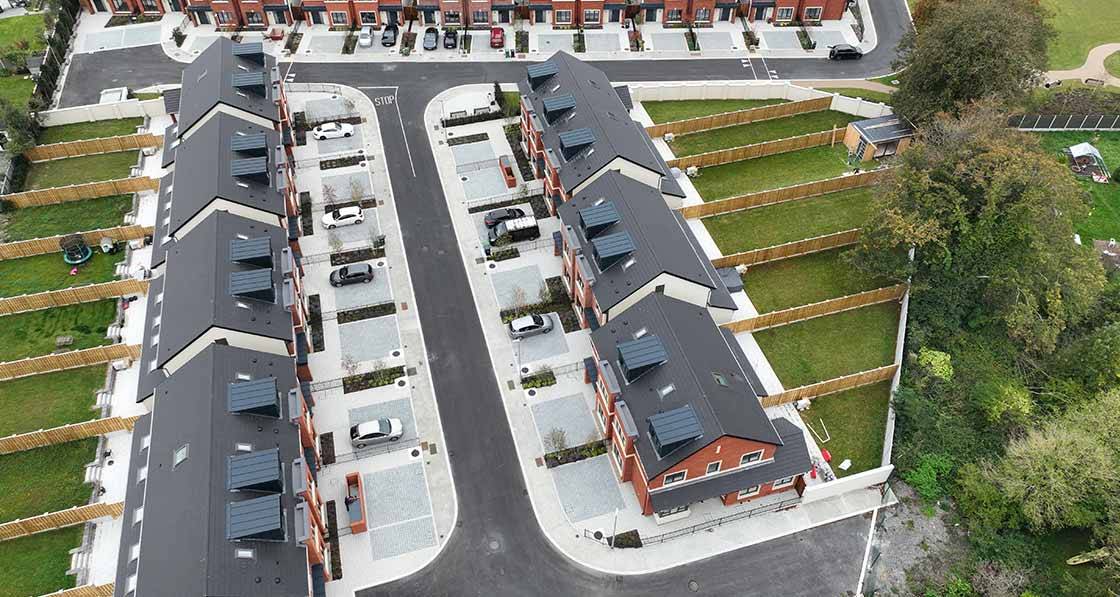
Development type: 30-unit residential development comprising three-storey semi-detached houses and two terraced blocks of three units each
Method: Timber frame construction with atomised airtight and air source heat pumps
Location: Portmarnock, Co. Dublin
Standard: Passive house classic
Heating costs: €214/year. (Calculated annual space heating costs. See In detail panel for more information).
When Charlie Conlan describes Ballymore's Drumnigh Oaks development in Portmarnock as "a boutique compared to the usual 200 units," he's being modest. The 30-home project represents something more significant than its small scale suggests: a serious attempt by a major developer to demonstrate that passive house standards can work commercially in the mainstream housing market.
The development, which completed construction recently, has become a testing ground for sustainable construction techniques that Conlan, Ballymore's sustainability designer, hopes will eventually become standard practice across the company's portfolio. But the project has also exposed fundamental flaws in how Ireland measures and values energy efficiency in homes — and how regulatory barriers may be inadvertently blocking sustainable innovation.
"We're trying to raise the bar across the board and onboard new technologies, practices, software, and so on," Conlan said. "That's part of the innovation team's mandate, and once it graduates, it will become standard practice."
The project's origins reveal something important about how sustainability innovations can emerge in the commercial development sector. Don McMahon, Ballymore's residential construction director, explains that designing to passive house standard wasn't part of the original vision.
"We went in for planning on this development, but the concept of passive house wasn't initially considered," McMahon said. "After the grant of planning, Charles was one of the main drivers, along with Patrick, our MD."
This approach – effectively a design retrofit, with detail design having to work around the restrictions imposed by the approved form, orientation and layout – certainly created challenges. Rather than designing from scratch for optimal passive house performance, the team had to adapt existing plans to meet the exacting standards.
"If you started from a blank page, you would design something that would be fundamentally easier to construct," he said.
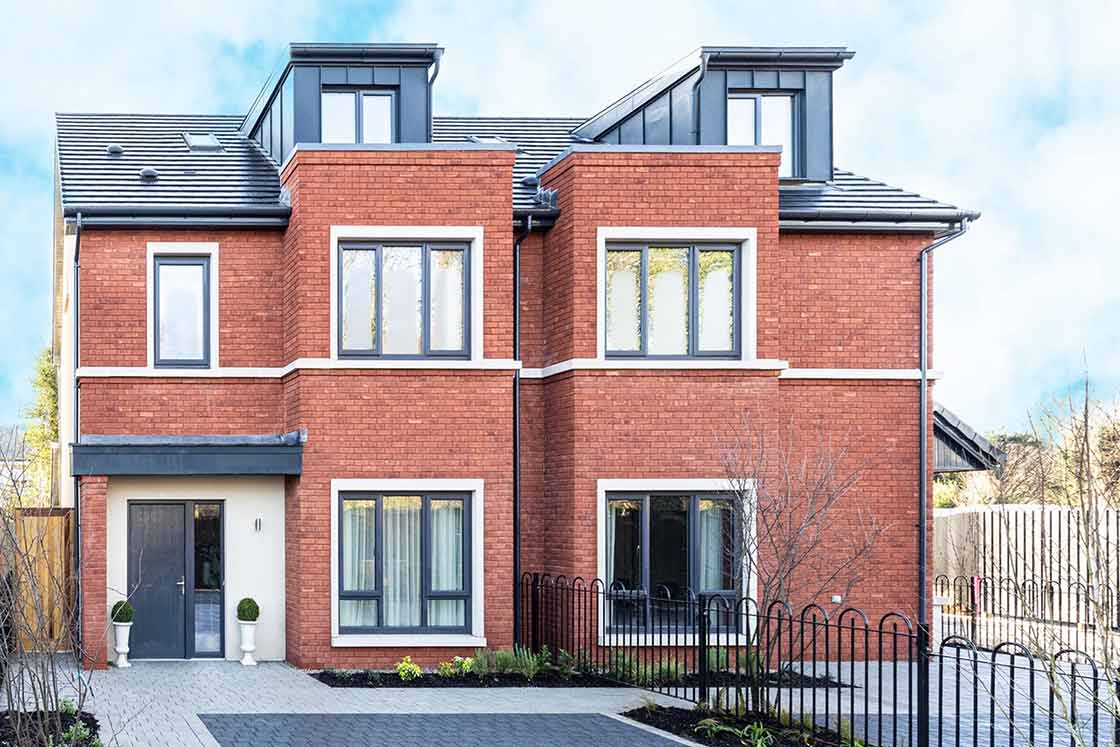
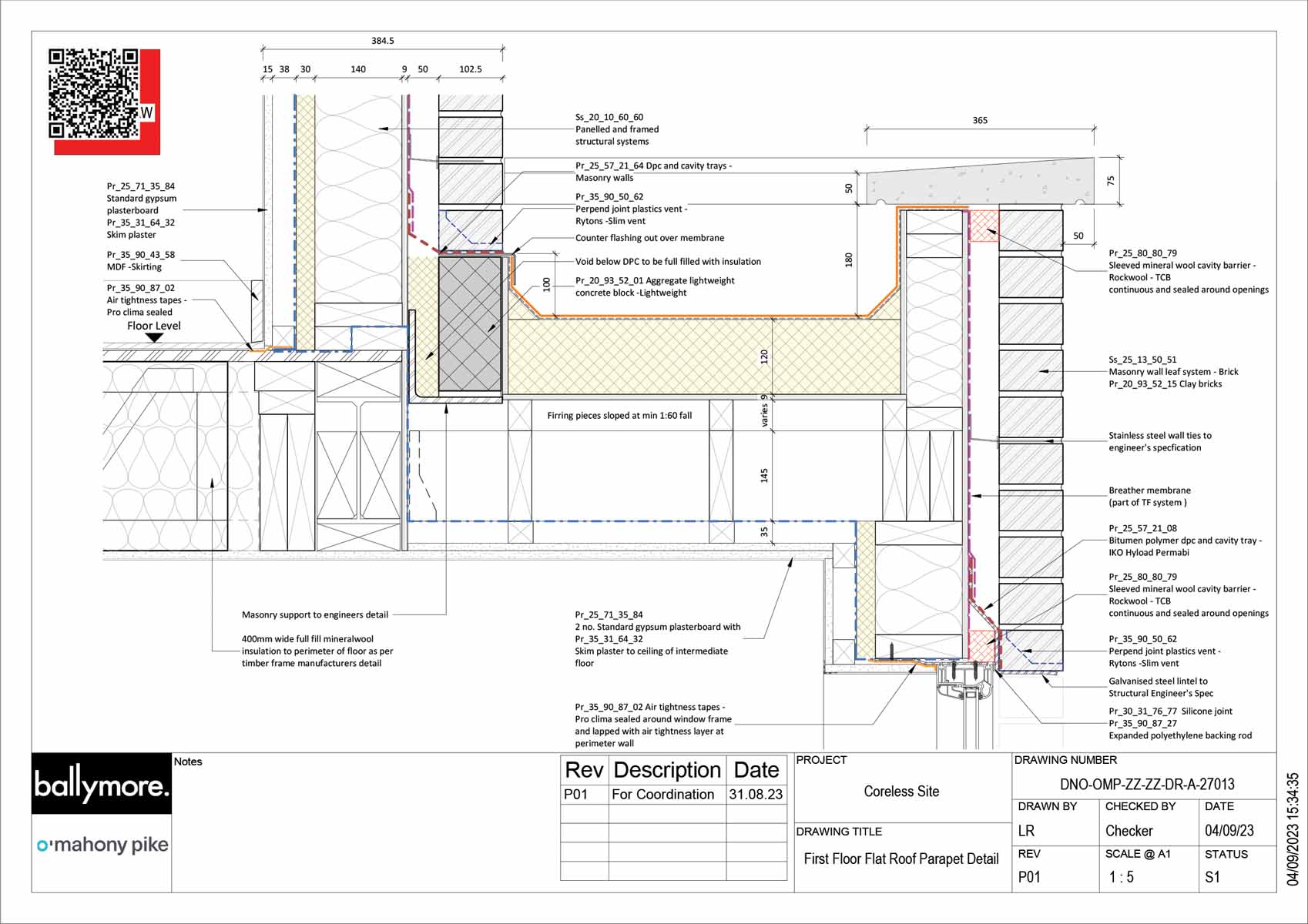
A quick glance at the homes reveals the extent of the challenge. Bay windows, lean-tos, parapets and a mix of roof types posed a number of challenges in terms of detailing airtightness and thermal bridging.
But the strategic thinking behind choosing this particular project was clear, McMahon said. "If you look at the scale at which we're delivering houses, it's interesting to see if they can be delivered as passive houses at scale. We have developments that range from 125 to 400 homes. This was a development of 30, so it was ideal in terms of ticking the boxes for a test".
Peter McCaughey, managing director at IJM Timber Frame, puts the scale in perspective. "This was a pilot for Ballymore. We could have picked something easier to pilot. We're producing about 1,500 units this year, so in those terms, it's small, but it's a big step for developments. I think great vision is being shown," he said.
Technical innovation under pressure
This article was originally published in issue 51 of Passive House Plus magazine. Want immediate access to all back issues and exclusive extra content? Click here to subscribe for as little as €20, or click here to receive the next issue free of charge
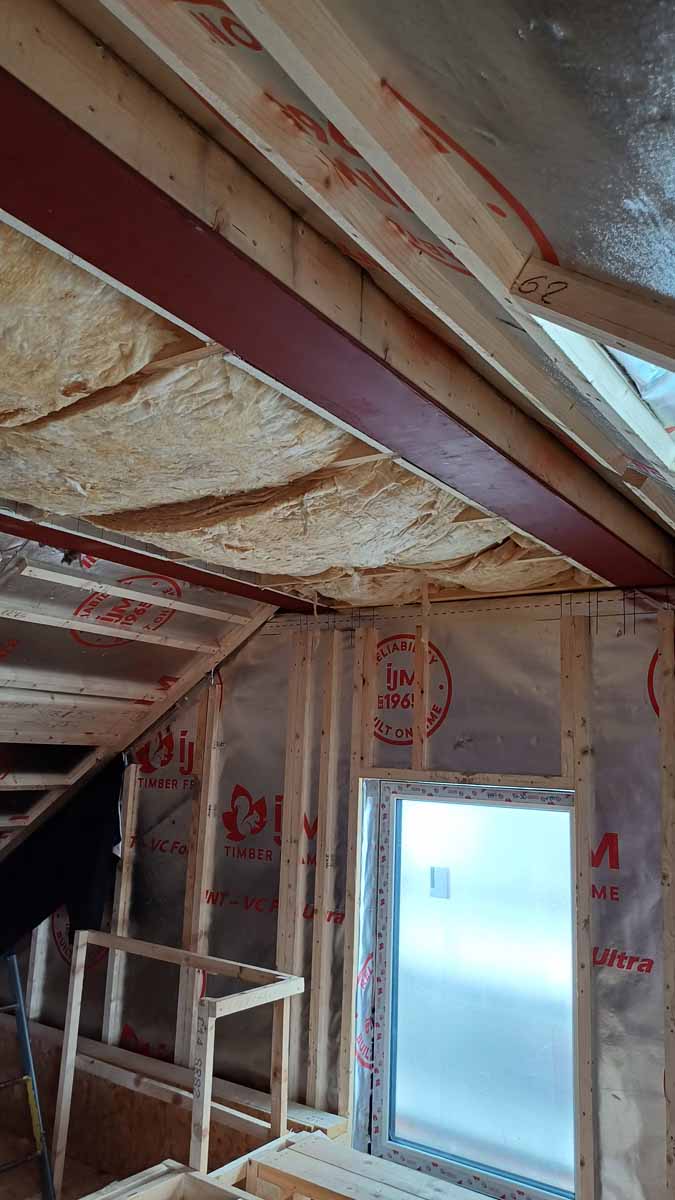
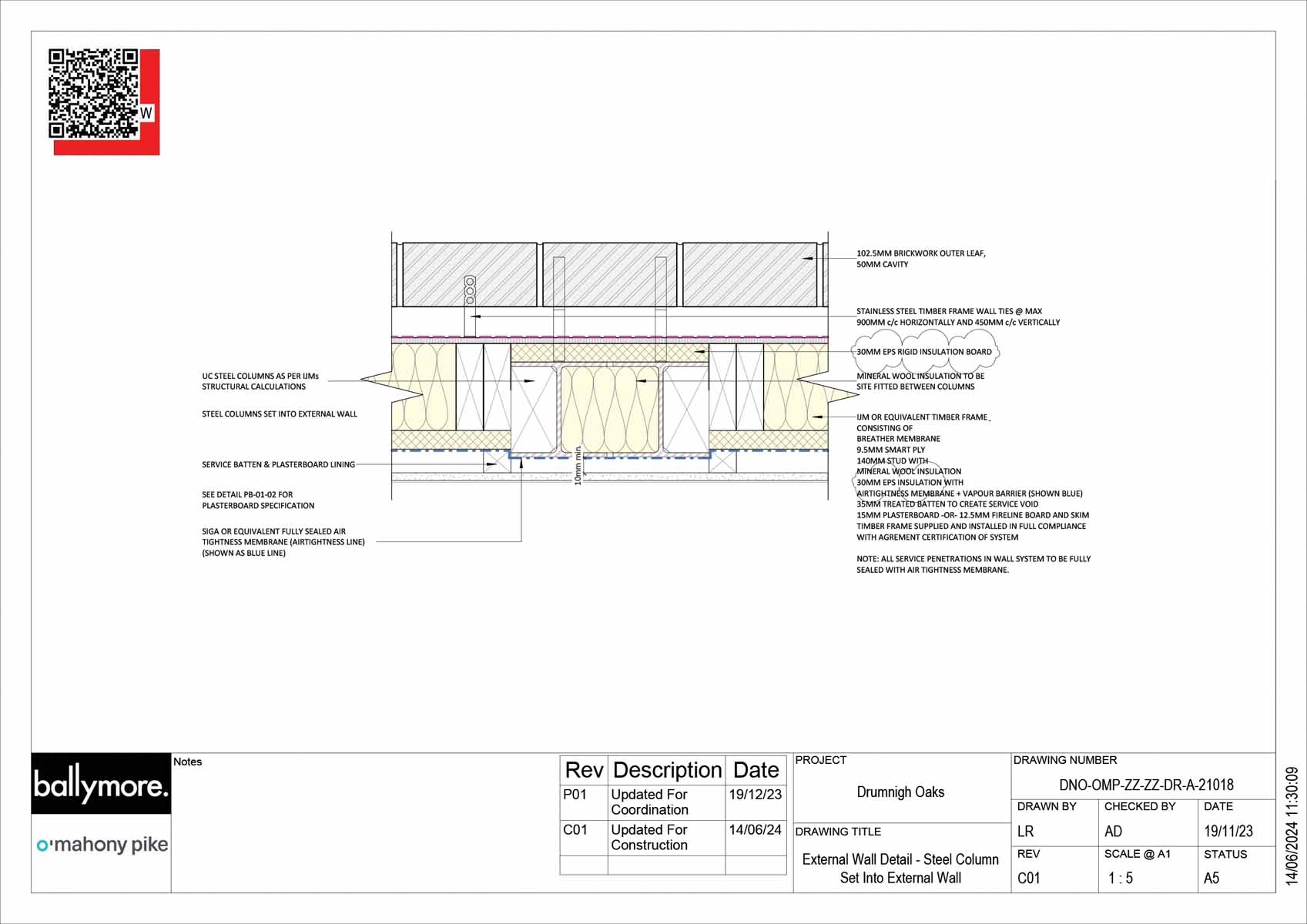
The Portmarnock site presented unique challenges for a passive house development. The 30 units comprise mainly three-storey semi-detached houses alongside two terraced blocks of three units each. The timber frame construction required careful attention to thermal bridging, particularly where steel portal frames were used for rear lean-to extensions.
"Insulation was packed into the steel sections," Conlan explained, describing how thermal bridges were addressed.
McCaughey confirms that structural steel remains problematic: "Structural steel is normally problematic, causing a cold bridge for a start, which we will try to mitigate, of course."
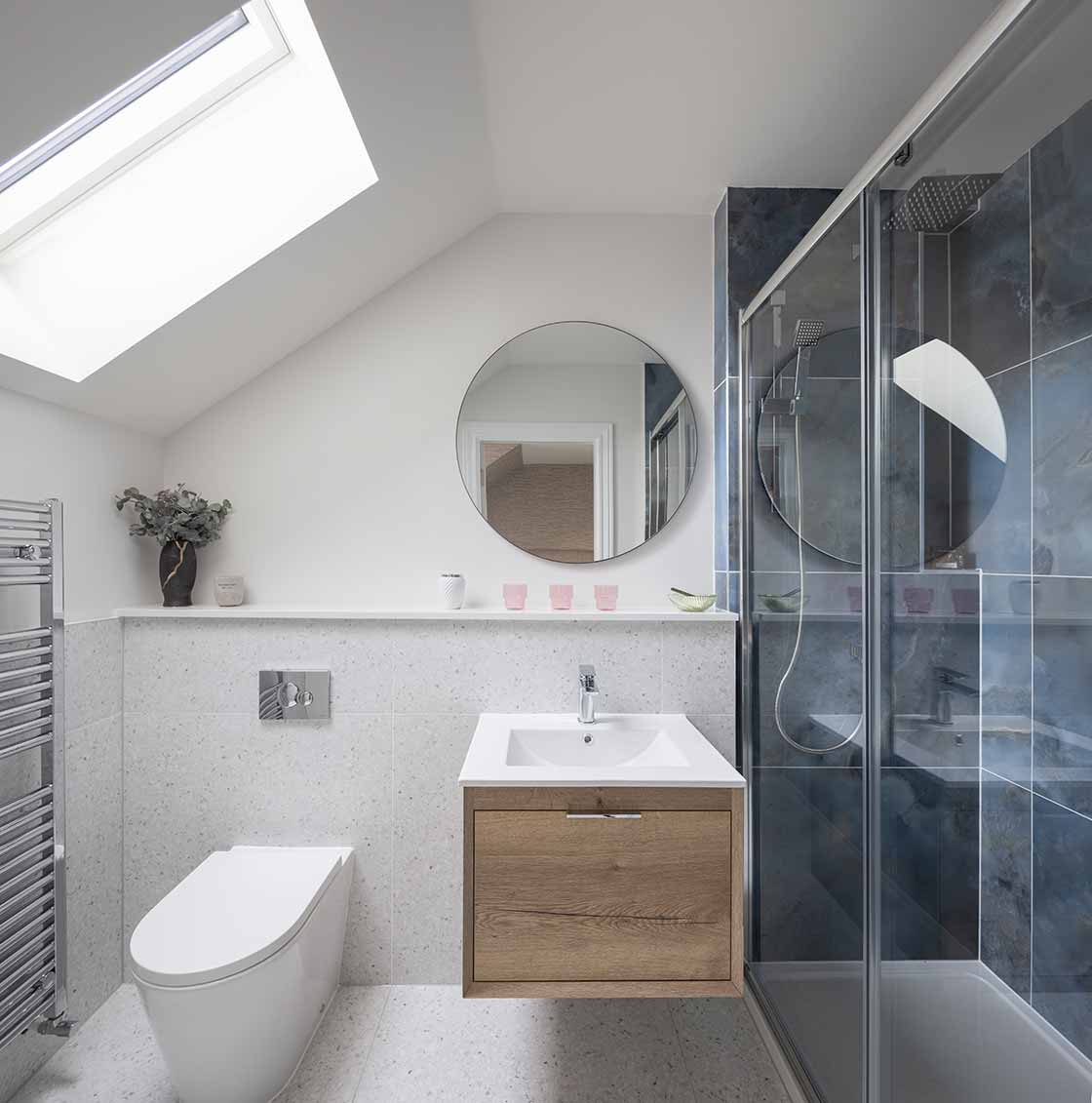
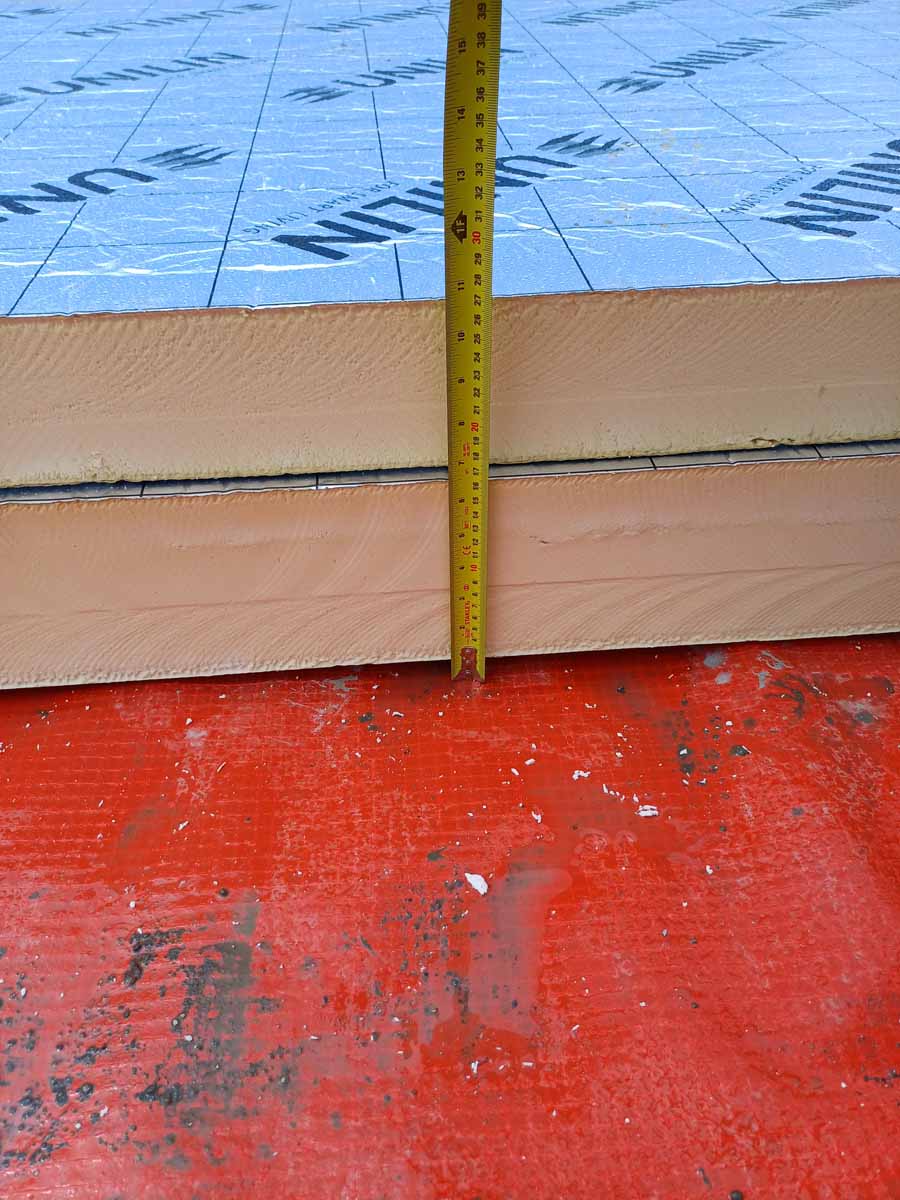
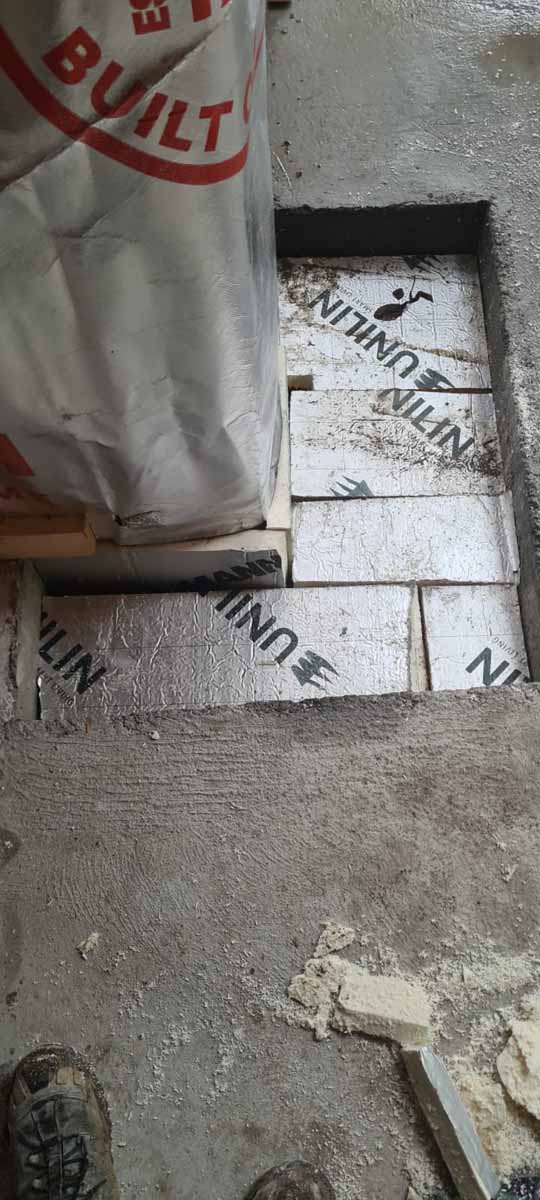
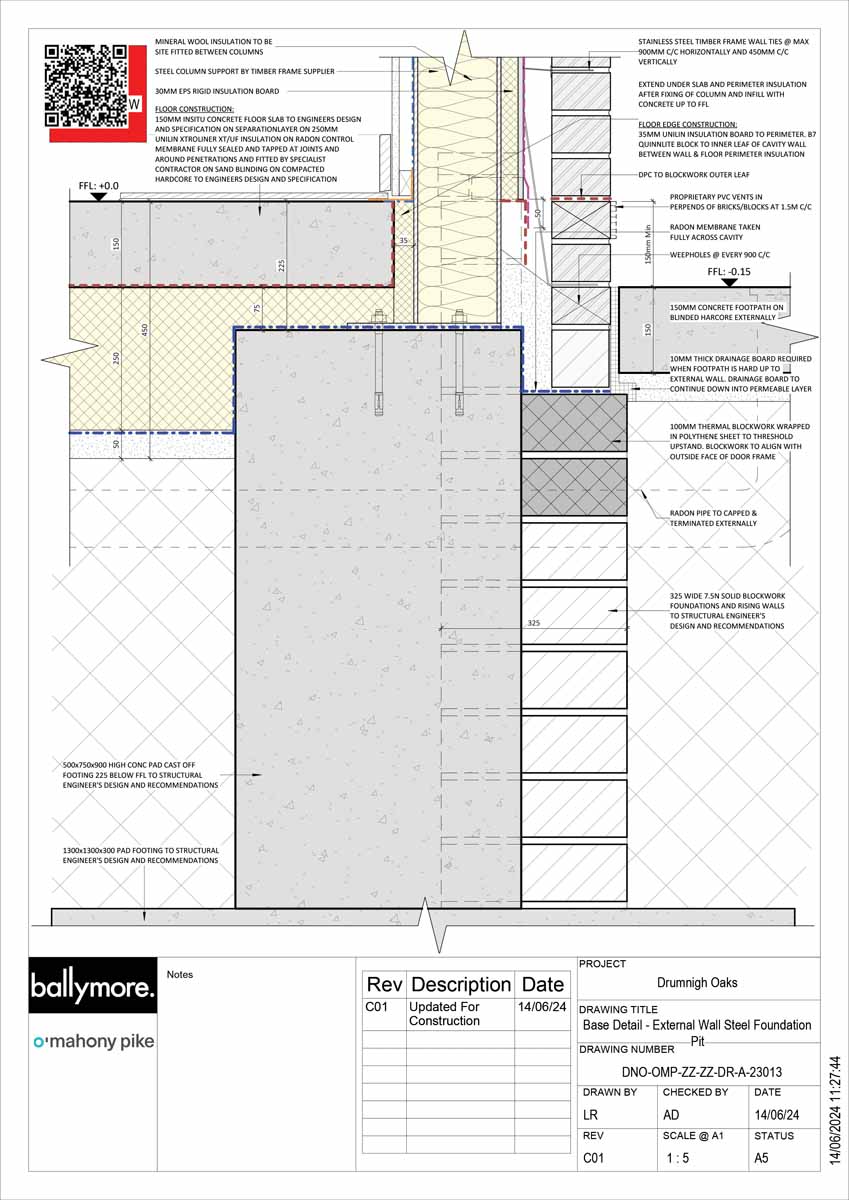
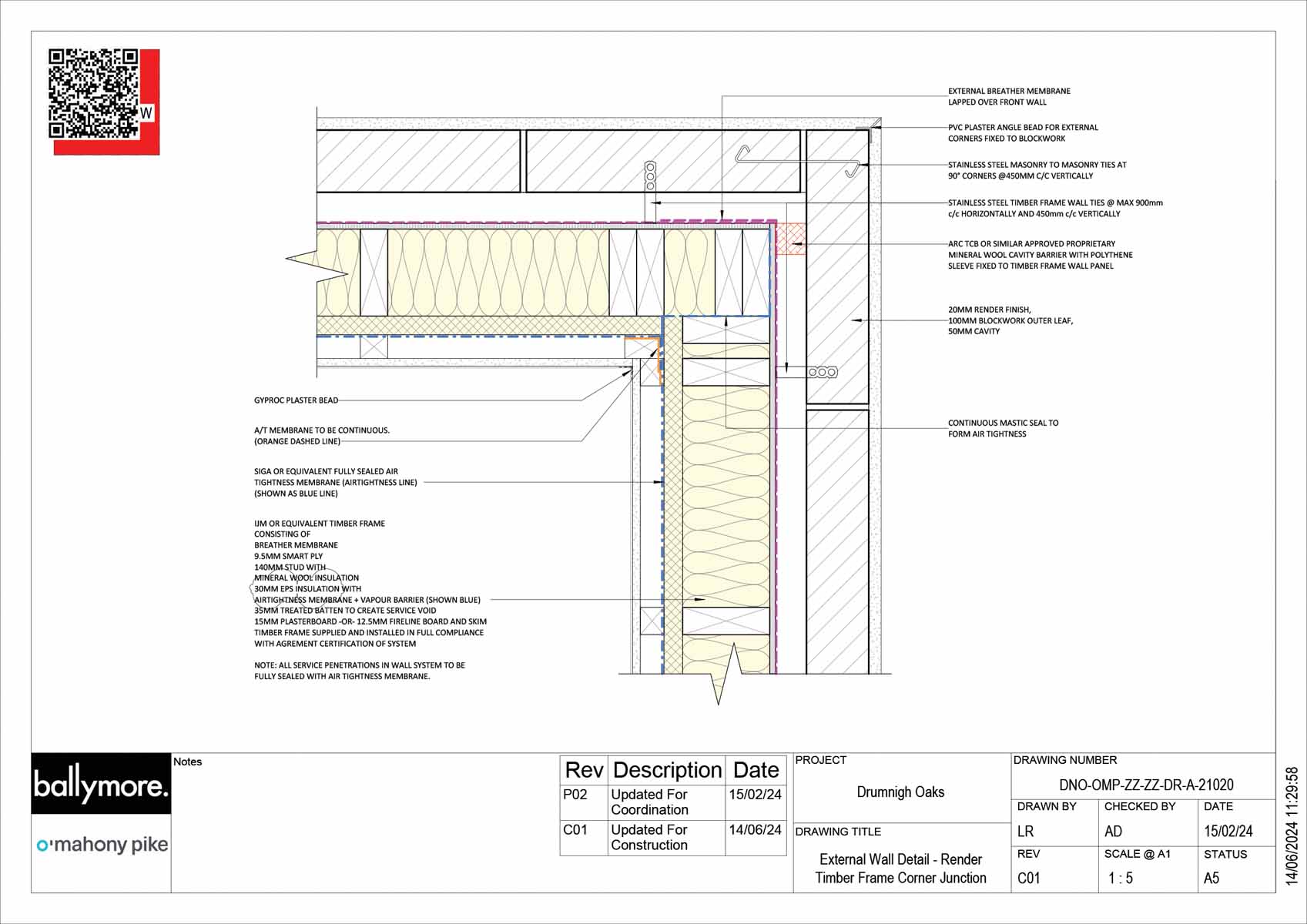
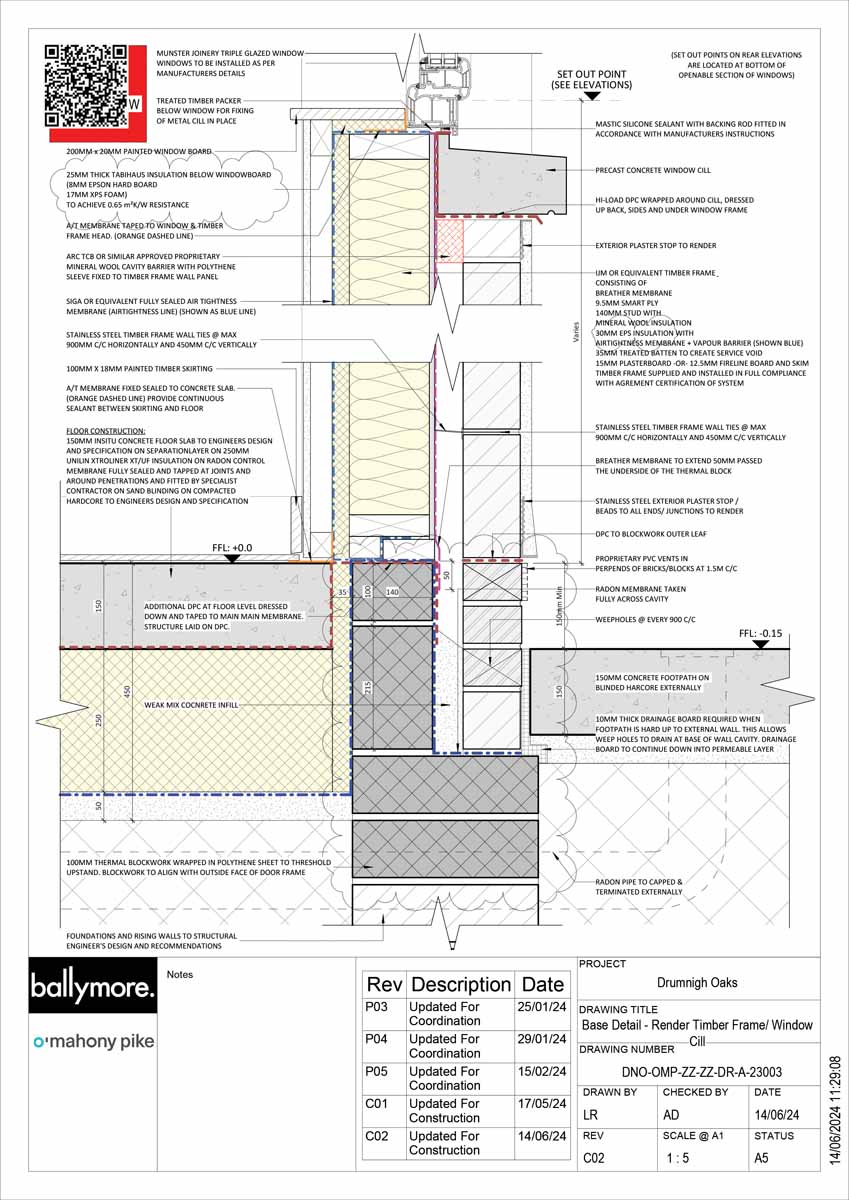
The building fabric specification included a 150 mm concrete slab on a 250 mm Unilin Xtroliner XT/UF PIR insulation layer, with polythene-bound thermal blocks to form the rising walls -- combined with 35 mm of PIR to the upstand, underneath the IJM timber frame wall. But it was airtightness that proved to be the most critical factor.
"The fact is that airtightness for us was probably the largest factor in achieving the passive certification," McMahon said. "The timber frame lent itself to doing that."
McCaughey said a factory-controlled approach provides advantages: "A lot of the airtightness is dealt with in the factory, but then it's the joints. The biggest issues, I would say, are things like the base that the timber frame is going onto: Is it adequately level? Is it square?"
-
 250 mm of Unlin Xtroliner XT UF insulation
250 mm of Unlin Xtroliner XT UF insulation
250 mm of Unlin Xtroliner XT UF insulation
-
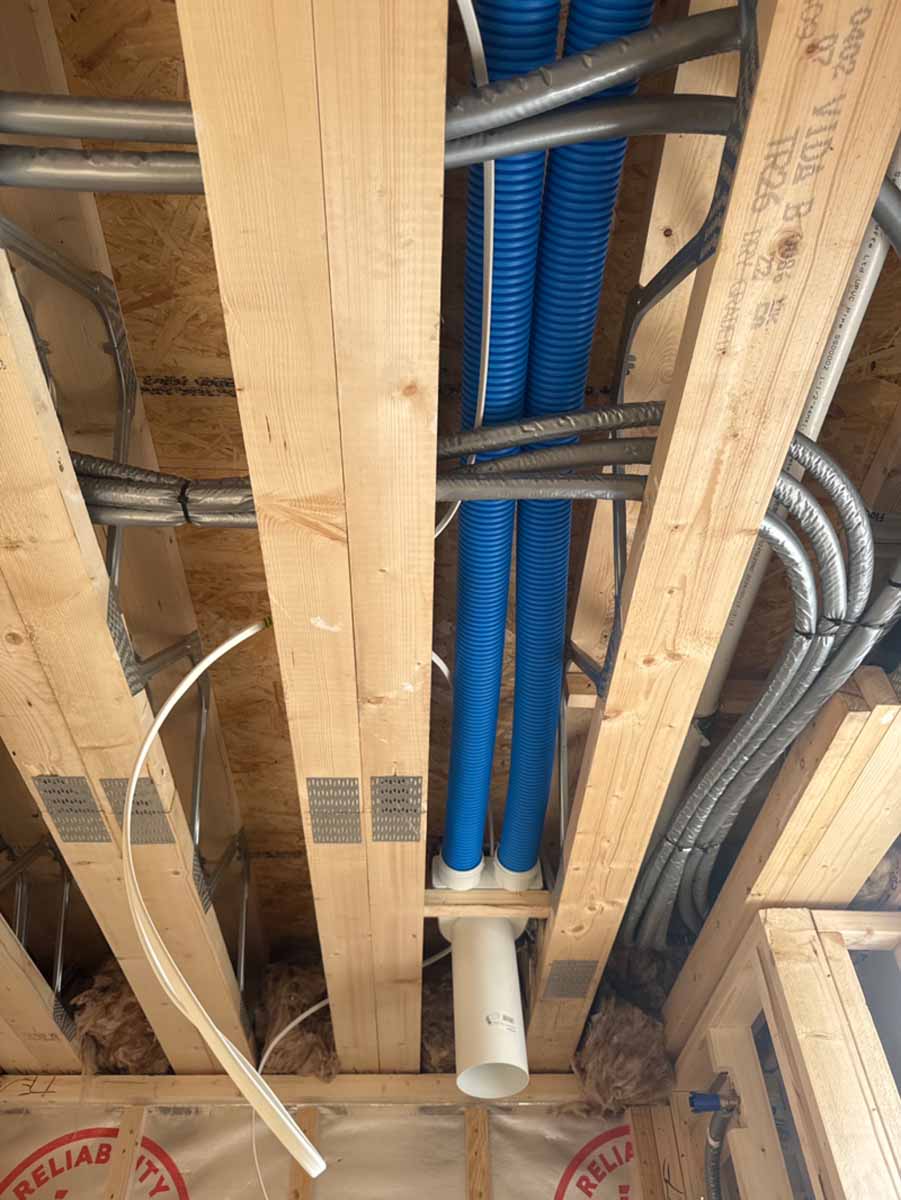
MVHR ductwork and services in metal web joist
MVHR ductwork and services in metal web joist
-
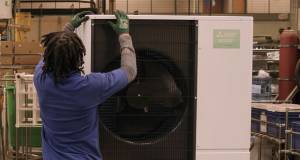
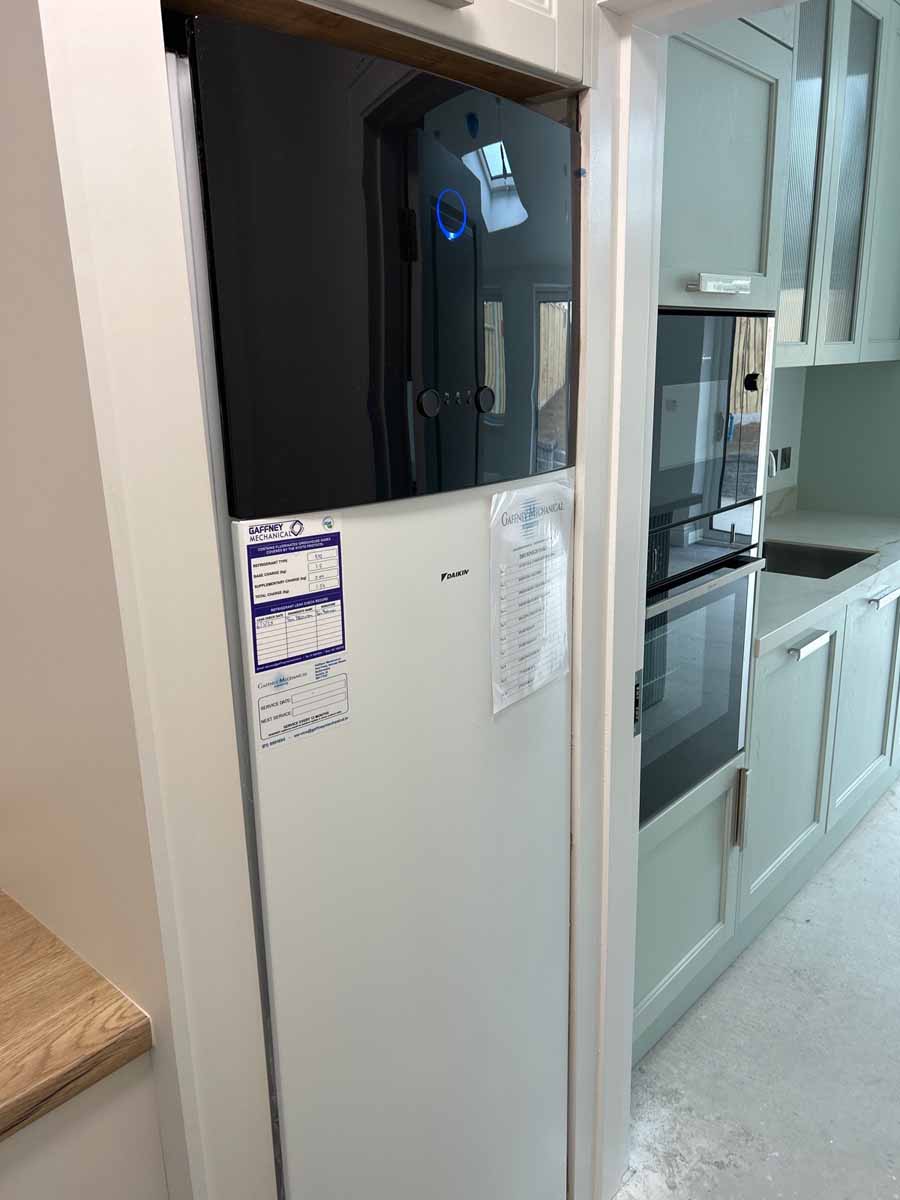
The MVHR system is supplemented by a Daikin Altherma air source heat pump in each house, including an outdoor unit and indoor unit
The MVHR system is supplemented by a Daikin Altherma air source heat pump in each house, including an outdoor unit and indoor unit
-
Radon barrier on sand blinding and rising walls – consisting of two courses of Kilsaran K-Block Thermal Lightweight blocks; As passive house certification requires evidence to be provided demonstrating the designed insulation levels have been achieved, measurements showing insulation thickness are common in passive house projects
Radon barrier on sand blinding and rising walls – consisting of two courses of Kilsaran K-Block Thermal Lightweight blocks; As passive house certification requires evidence to be provided demonstrating the designed insulation levels have been achieved, measurements showing insulation thickness are common in passive house projects
-
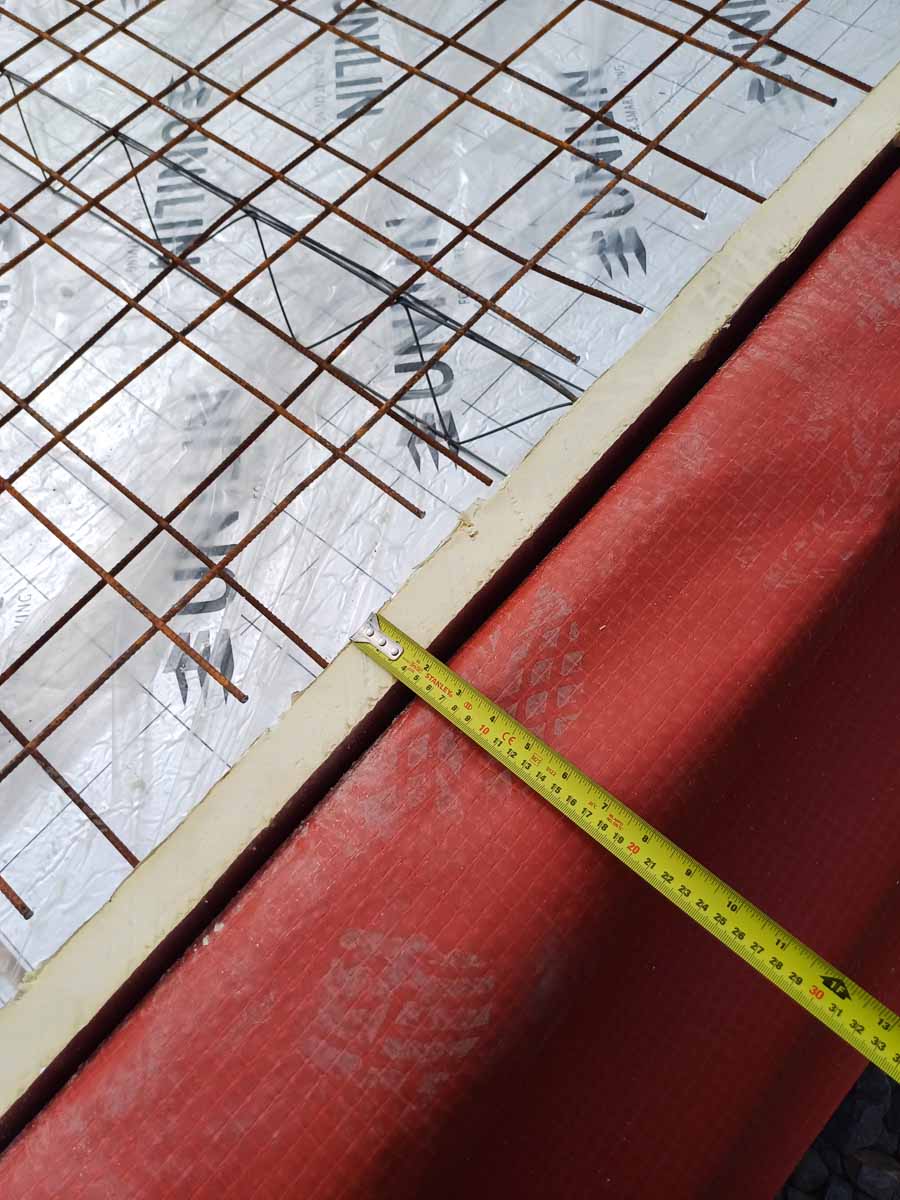
40 mm insulation to upstand of thermal block rising walls
40 mm insulation to upstand of thermal block rising walls
-
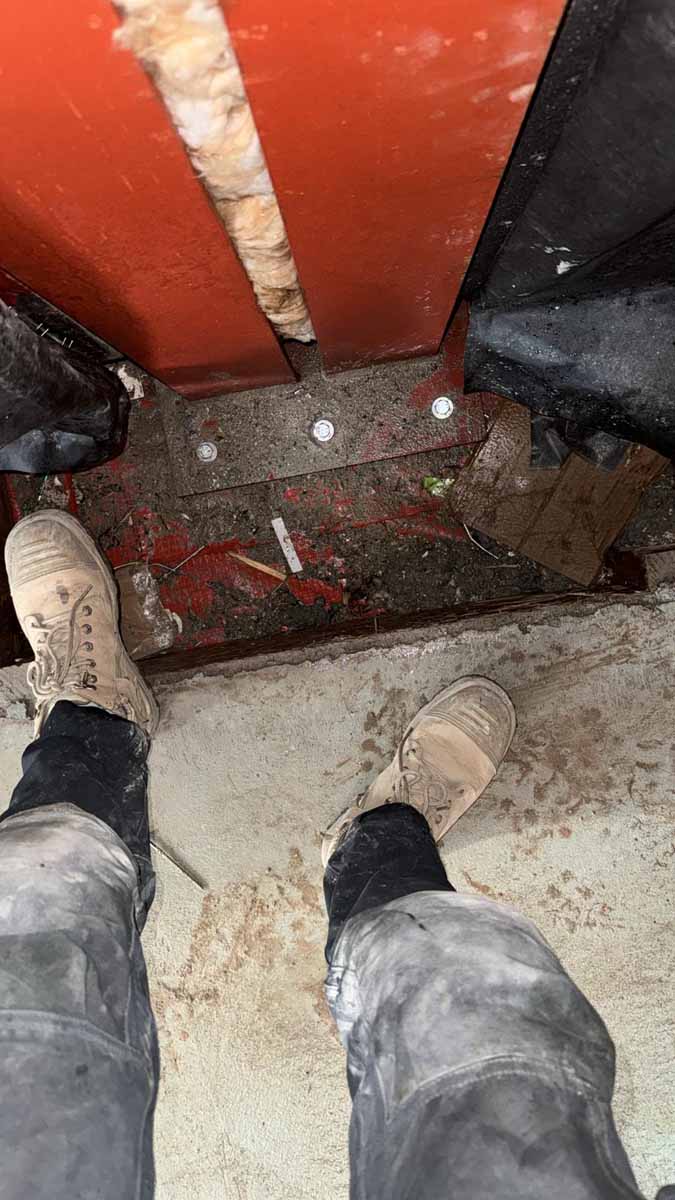
Mineral wool insulation fitted into steel beam
Mineral wool insulation fitted into steel beam
-
A void in slab to accommodate extra insulation at the base of the portal frame
A void in slab to accommodate extra insulation at the base of the portal frame
-
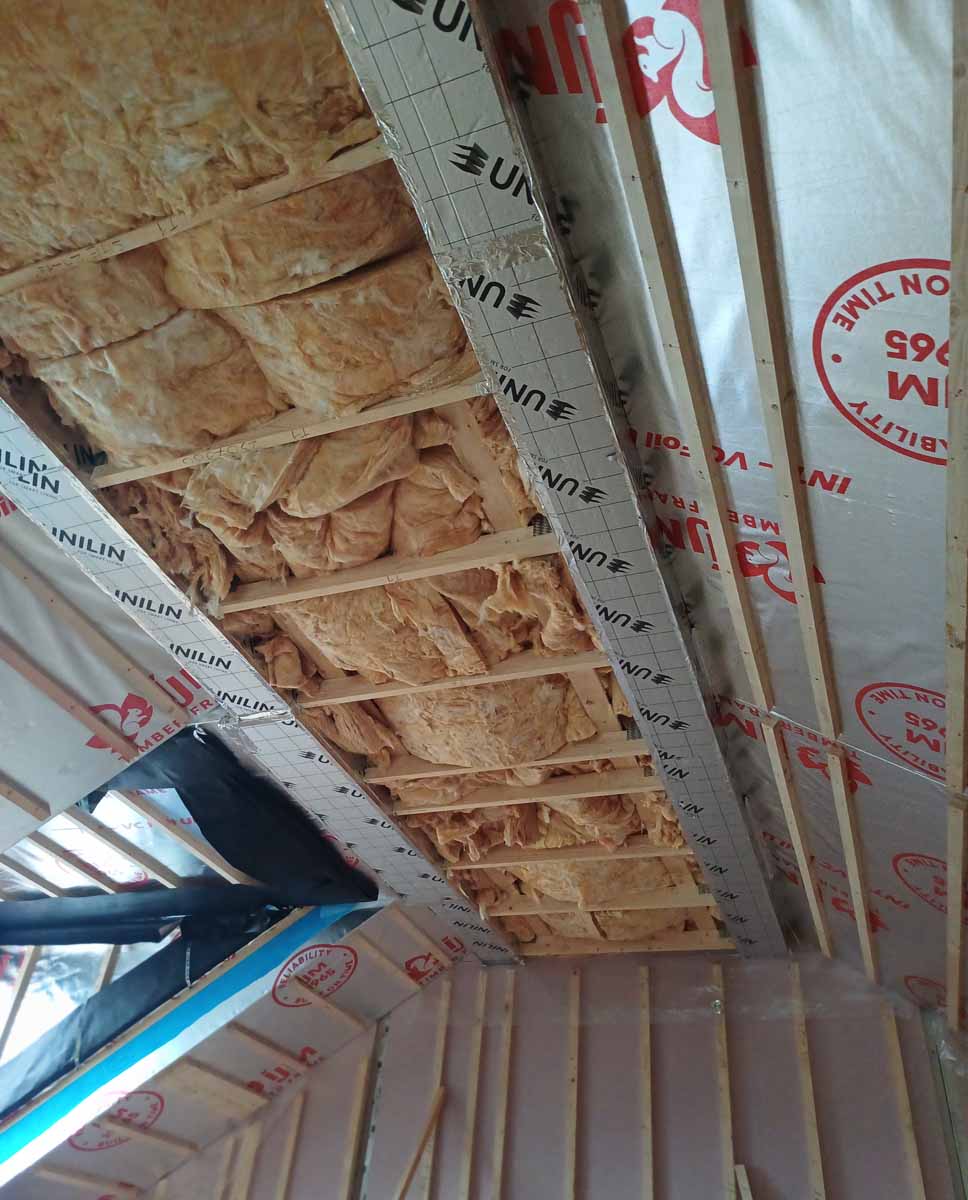
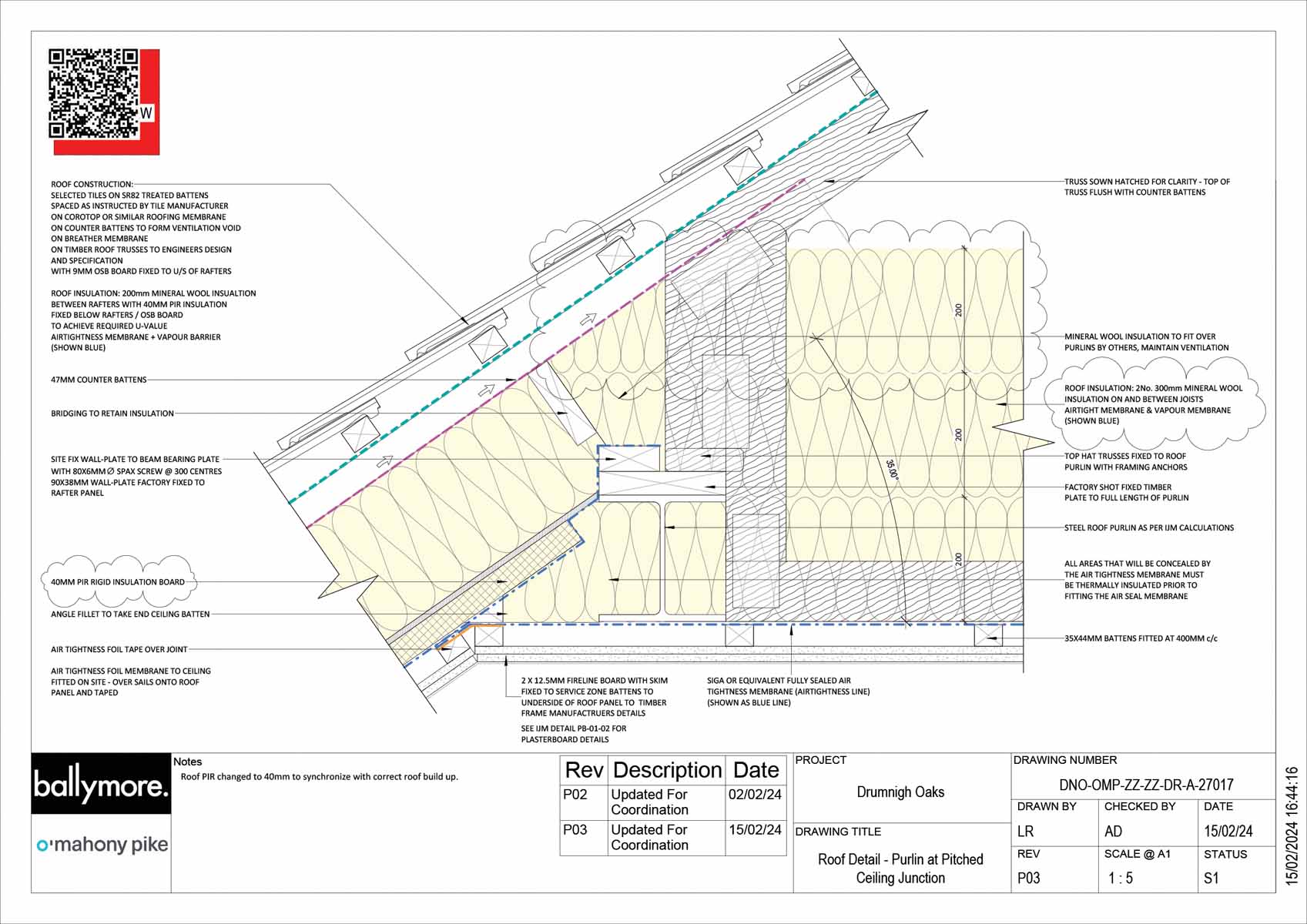
Steel purlins were a structural element which posed a thermal bridging issue, and were wrapped in PIR insulation
Steel purlins were a structural element which posed a thermal bridging issue, and were wrapped in PIR insulation
-
Steel purlins were a structural element which posed a thermal bridging issue, and were wrapped in PIR insulation
Steel purlins were a structural element which posed a thermal bridging issue, and were wrapped in PIR insulation
-
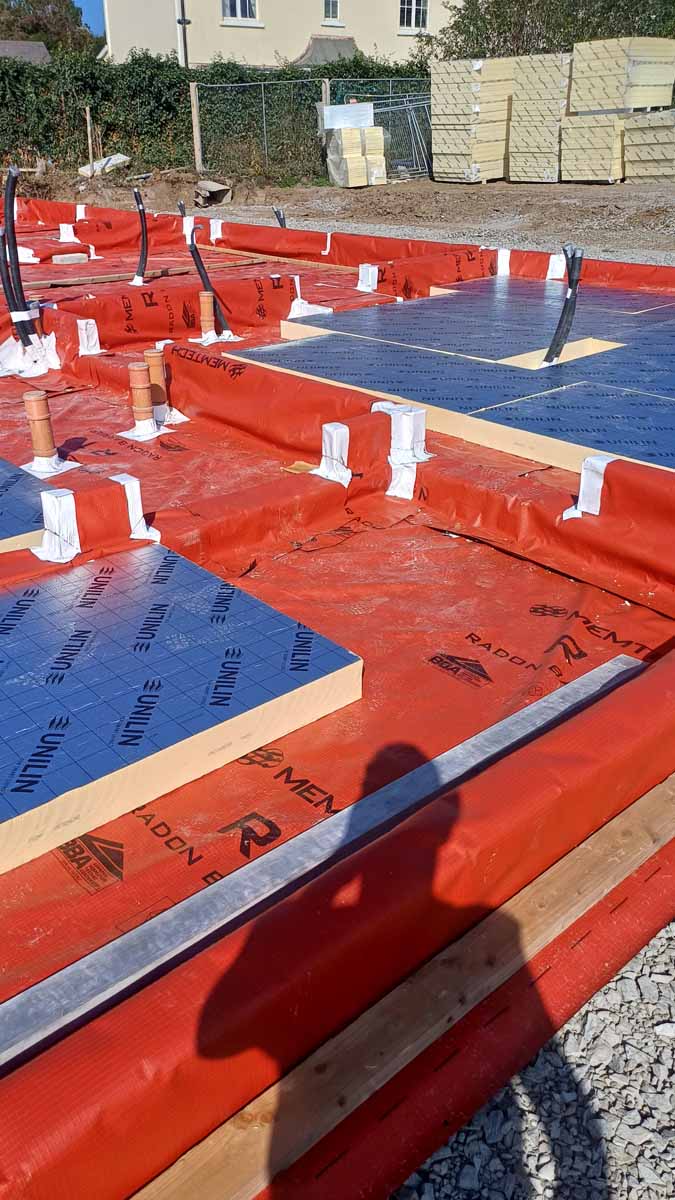
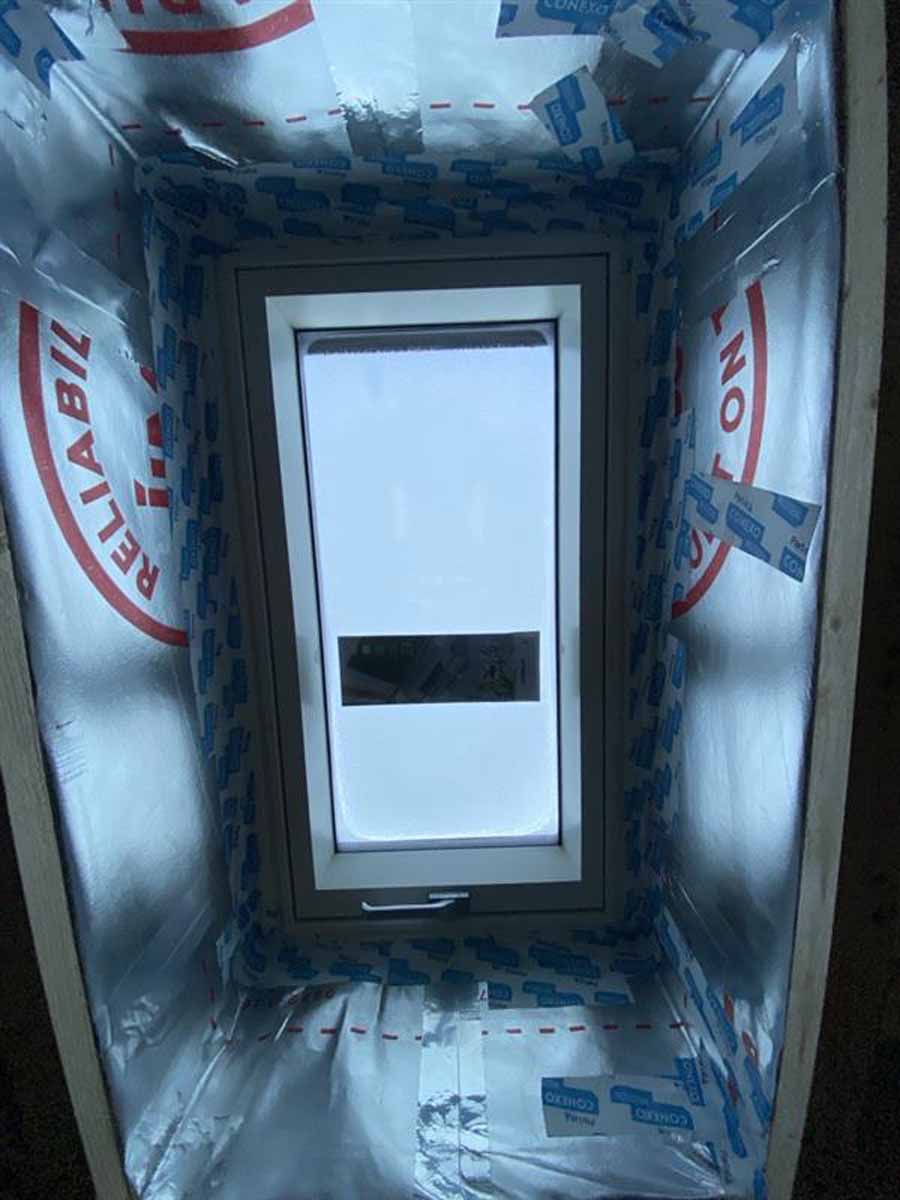
Airtightness taping to Fakro roof window;
Airtightness taping to Fakro roof window;
https://mail.passive.ie/magazine/new-build/ballymore-scheme-brings-low-cost-comfort-to-private-market#sigProIde718a9bb3a
Atomised airtightness
Although most of the heavy lifting on airtightness was done in the factory, the challenges posed by the complexities of design of these homes – bay windows, parapets, lean-tos and multiple roof types made hitting the passive house target of 0.6 air changes per hour at 50 Pascals particularly challenging – until Ballymore came across an innovation to get them over the line. "We came across an atomiser that puts a product into the atmosphere when the house is pressurised, and it migrates to weaknesses in the membrane," McMahon explained.
That problem-solving product is AeroBarrier, an airtightness system developed in North America and now gaining a foothold in the UK and Ireland, which was introduced to Ballymore by passive house consultants Mosart.
The system, represented on this side of the Atlantic by sister companies Aeroseal UK and Aeroseal Ireland, works by introducing a fine mist of water-based acrylic sealant into a pressurised building.
The system pressurises the building and releases a fine mist of water-based sealant, which is drawn to gaps and forms a durable film, sealing cracks from visible to pinhole size. Progress is monitored in real time and stops automatically once the target airtightness is reached. Greenguard Gold certified, AeroBarrier has been tested worldwide and significantly improved airtightness on the project, helping the homes meet the passive house target of 0.6 air changes per hour at 50 Pascals.
While Ballymore had already achieved low air leakage rates with the IJM system, the effects of adding AeroBarrier brought them over the line in terms of the passive house target of 0.6 air changes per hour at 50 pascals. "Our results were 0.7 or 0.8. After 45 minutes, we were at 0.1," McMahon said.
The heating strategy relies primarily on retention of heat – first through high performance building fabric, and second through a Vent Axia Sentinel Econiq mechanical ventilation with heat recovery (MVHR) system, which recovers heat from warm, stale air exhausted from bathrooms and kitchens and passes it onto incoming fresh air. This is supplemented by a Daikin Altherma air source heat pump in each house, which distributes heat via radiators and makes hot water. "Very little heat is needed outside of the MVHR," Conlan said.
The rating system disconnect
However, this highlights a critical disconnect between technical performance and market recognition. Ireland's Building Energy Rating (BER) system, which homeowners use to assess energy efficiency, fails to capture the true benefits of passive house design – in part because it enables homes to achieve seemingly excellent scores for homes which fail to achieve anything close to the kinds of comfort levels baked into the passive house standard.
The energy model behind BERs assumes that the living space in a home – which typically makes up circa 20 per cent of the total floor area – is heated to 21C, with the remainder of the home heated to 18C. This translates to an average of 18.6C. What’s more the home is only assumed to be heated to these levels for eight hours per day. During the 16 other unheated hours per day, the temperatures can drop significantly.
One hypothetical NZEB-compliant new home analysed by Wain Morehead Architects say the unheated hours dropping to down to less than 15.6C, and a 24 hour average of just 16.5C.
The passive house standard, on the other hand, assumes a far higher comfort level: a whole house average of 20C, 24 hours a day, seven days a week.
While passive houses have been shown to perform in line with the standard’s ultra-low space heating energy use target, the same cannot be said for BERs. A 2021 study found that homes with higher BER scores (meaning As and Bs) used on average of 39 to 54 per cent more energy more energy for heating, hot water, ventilation and lighting than calculated.
"The BER is the only thing that homeowners are aware of," Conlan said. "But it's not a good tool for measuring performance. A passive house is far less energy intensive than a normal house, but they could both be [classified as] A2."
The danger, he said, is that this can create a market dynamic where genuine energy efficiency improvements aren't recognised by the system buyers rely on. "Our houses could have got an A1 if they had solar panels, as could a lot of other houses, but ours are a lot more energy efficient, whereas the other one could be leaking energy," Conlan observed.
McCaughey said that consumer demand for high-performance buildings is limited by upfront cost considerations.
"The bottom line is that regulation will drive the change. Public demand or need is very difficult to create because there's always an added cost, and when that is built into the cost of regulation, everyone across the board will apply that regulation.
"When you look at that price point, this isn't going to cost you anything to run. It's a bit like electric cars: electric cars are a no-brainer, but people will consider the upfront cost."
Market momentum building
We're confident that we can do any typology to passive house; it's just a matter of getting the recipe right.
Despite these market challenges, the performance benefits are substantial. The homes achieve dramatic improvements in air quality alongside significant energy savings. "The air quality benefits are dramatic," Conlan said, referring to the continuous fresh air supply provided by MVHR systems.
More significantly, the project appears to be influencing broader market behaviour. McMahon notes that "given the recent planning changes in Dublin, a number of developers are trying a passive scheme for their apartment structures."
The project's broader significance lies in its role as a learning exercise for Ballymore's innovation team, though.
"When we're doing these pockets of innovation, we are trying to learn," Conlan said.
The collaboration with IJM has also been systematic: "Ballymore brought Mosart down to the factory. We're due to do another review of the manufacturing process to see what we can try to build in to make achieving the airtightness better and easier," McCaughey said.
McMahon said that the development shows that technical challenges are surmountable: “The design, mechanical and electrical, the envelope — that can all be done." The team worked with O'Mahony Pike architects to solve the design constraints imposed by retrofitting passive house standards to existing plans.
"We haven't done apartments to passive standard yet," Conlan said. "Houses will have more nuance than apartments, whereas apartments will typically have stricter cost constraints. But we're confident that we can do any typology; it's just a matter of getting the recipe right."
Seen this way, Drumnigh Oaks experiment raises some important questions about Ireland's approach to sustainable development. While the technical achievements are significant, the project highlights how regulatory frameworks and market mechanisms may be hindering rather than supporting genuine sustainability improvements.
A timber frame partner prepared to quantify embodied carbon
Conlan is in the process of commissioning whole life carbon calculations on the project – a task which will be made substantially easier by IJM electing to do much of the heavy lifting.
With some of IJM’s clients starting to seek to quantify about embodied carbon, McCaughey embraced the challenge, working with his structural engineer son Sean to produce three separate Environmental Product Declarations using One Click LCA – one for each version of the company’s main wall types with U-values of 0.13, 0.15 and 0.18 W/m2 K.
These EPDs give independently verified embodied carbon scores from cradle to factory gate, in kilogrammes of CO2 per square metre of wall. The EPDs also include calculations for transport to site and the erection process itself. Given that IJM transport and erect the insulated timber frame system for their buildings, this means the EPDs can include more accurate data rather than generic defaults.
In the process of obtaining the EPDs, the McCaugheys identified an issue: a value per m2 is a useful reference, but variations to accommodate project- specific details limited their applicability. The steel portal frames and associated thermal bridging detail for lean-tos at Drumnigh Oaks are a case in point.
The route IJM took to obtaining an EPD has enabled the company to use the same process, the same materials data, and the same calculation framework to generate project-specific embodied carbon calculations.
The detailed material quantification feeds directly into the company's manufacturing resource planning (MRP) and enterprise resource planning (ERP) systems for procurement and project management, meaning that the data used for carbon calculations is also used for purchasing and inventory.
The net effect is very positive. Life cycle assessments by IJM on the package they provided for Drumnigh Oaks led to a total of under 285 tonnes of CO2e in total, including manufacture, transport and assembly – an average per house of just 58 kg CO2e/m2. This total ignores the fact that over 834 tonnes of CO2e are sequestered in the timber and OSB in those homes. According to LCA rules, that stored CO2 will either be regarded as being released into the environment at the buildings’ end of life, or will pass on to the next use if the timber is reused or recycled – meaning it’ll leave the boundary of the calculation rather than showing a benefit here.
The larger a home is, the better its embodied carbon score will tend to look when measured in tonnes per square metre. While the homes at Drumnigh Oaks aren’t obscenely large they’re not small, coming in at 152 to 159 m2. It’s also worth noting what IJM’s package includes: the insulated wall and roof systems, excluding the block rainscreen and roof finish. These items, along with the concrete foundations, windows and building services would invariably drag the total up substantially. But an average of 58 kg CO2e/m2 is nonetheless impressive.
Selected project details
Developer, main contractor & project management: Ballymore Group
Architect: O'Mahony Pike Architects
M & E engineer: JAK Consulting Engineers
Civil / structural engineer: O'Connor Sutton Cronin
Energy consultant: Mosart
Mechanical contractor: Gaffney Mechanical
Electrical contractor: WW Electrical
Airtightness products: Partel / Aeroseal Ireland
Airtightness tester/consultant: Building Envelope Technologies
Timber frame & wall insulation: IJM
Roof insulation & additional wall insulation: Baker Insulation
Floor insulation: McKenna Groundworks
Thermal blocks: Kilsaran
Brick and blockwork contractor: DC Nevin & Sons Ltd
Windows and doors: Munster Joinery
Roof lights: Fakro, via Tradecraft
MVHR: Vent Axia, via Lindab
Heat pumps: Daikin
Fit-out: Bespace
Roofing: NBR Roofing
Drainage / paving: Castle Paving
Landscaping: Murphy & Sheanon
In detail
Building type: 30-dwelling residential scheme (semi-detached and terraced houses). Brick clad timber frame with enhanced insulation, airtightness, MVHR and air-to-water heat pump.
Site type & location: Suburban site, Portmarnock, Co. Dublin
Completion: August 2025
Budget: Not disclosed
Passive house certification: Passive house classic certification pending
Space heating demand (PHPP): ≤14 kWh/m²/yr
Heat load: 10 W/m²
Primary energy non-renewable (PHPP): 80 kWh/ m²/yr
Primary energy renewable (PHPP): 60 kWh/m²/yr
Heat loss form factor (PHPP): 2.71
Overheating (PHPP): 1.7% of year above 25C
Number of occupants assumed: 3 to 4 per dwelling
Energy performance coefficient (EPC): 0.179
Carbon performance coefficient (CPC): 0.114
BER: All A2 (as low as 25.18 kWh/m²/yr)
Environmental assessment method: N/A
Air quality index: An annual average score of 33 AQI (above the moderate pollution threshold of 20 AQI), based on Portmarnock, using the Plume Air Quality Index -- peaking at 101 AQI (very high pollution) at a stage during winter 2024/2025.
Measured temperature: Pending, after first six months of lived-in data
Air quality context: Urban site away from the road in a residential area under a flight path
Acoustic test results – separating walls between dwellings: 66 dB airborne sound
Embodied carbon
The whole life carbon assessment is still being carried out. In the meantime, cradle-to-practical completion figures have been produced for the timber frame package, based on LCA info for the IJM wall and roof system used, counting the fabric of the timber panels including all insulations and membranes used, and the steel used.
Measured energy consumption: N/A
Energy bills (measured or estimated): Calculated total space heating cost of €214.25 per year. This is based on a house with 151 m² TFA, and PHPP-calculated final electricity demand for space heating of 7 kWh/m²/yr. (In other words, this is calculated energy use by the heat pump to deliver space heating, and it may be a conservative estimate given the efficiency of the heat pump).
The costs are based on the Electric Ireland - Home Electric+ SST Saver 30% tariff from September 2025. The calculations assume the heat pump is programmed to run 50% of usage at night rate (€0.1362 cent) and 50% at day rate (€0.26919 cent) with no usage during the 5-7pm peak rate (€0.27651 cent). On the same basis, the calculated total hot water cost is €183.64. All figures are VAT inclusive, but do not count standing charges, as these are levied on the building irrespective of heating choice -- and choosing electric heating over gas in fact removes a gas bill additional standing charge.
Airtightness: An average of 0.24 ACH at 50 Pa
Thermal bridging: ψ-values modelled in PHPP; several junctions optimised. Final construction details were tweaked on site to ensure buildability. Using rigid insulation and mineral wool insulation and thermally broken windows.
Ground floor: (Top to bottom) 150 mm in situ concrete floor slab to engineers design and specification; separation layer; 250 mm Unilin Xtroliner XT/UF insulation; radon control membrane fully sealed and taped at joints and around penetrations and fitted by specialist contractor; sand blinding; compacted hardcore to engineers design and specification. Two courses of Kilsaran K-Block Thermal Lightweight blocks wrapped in polythene in rising wall, with 35 mm Unilin PIR to upstands. U-value: 0.086 w/m²k
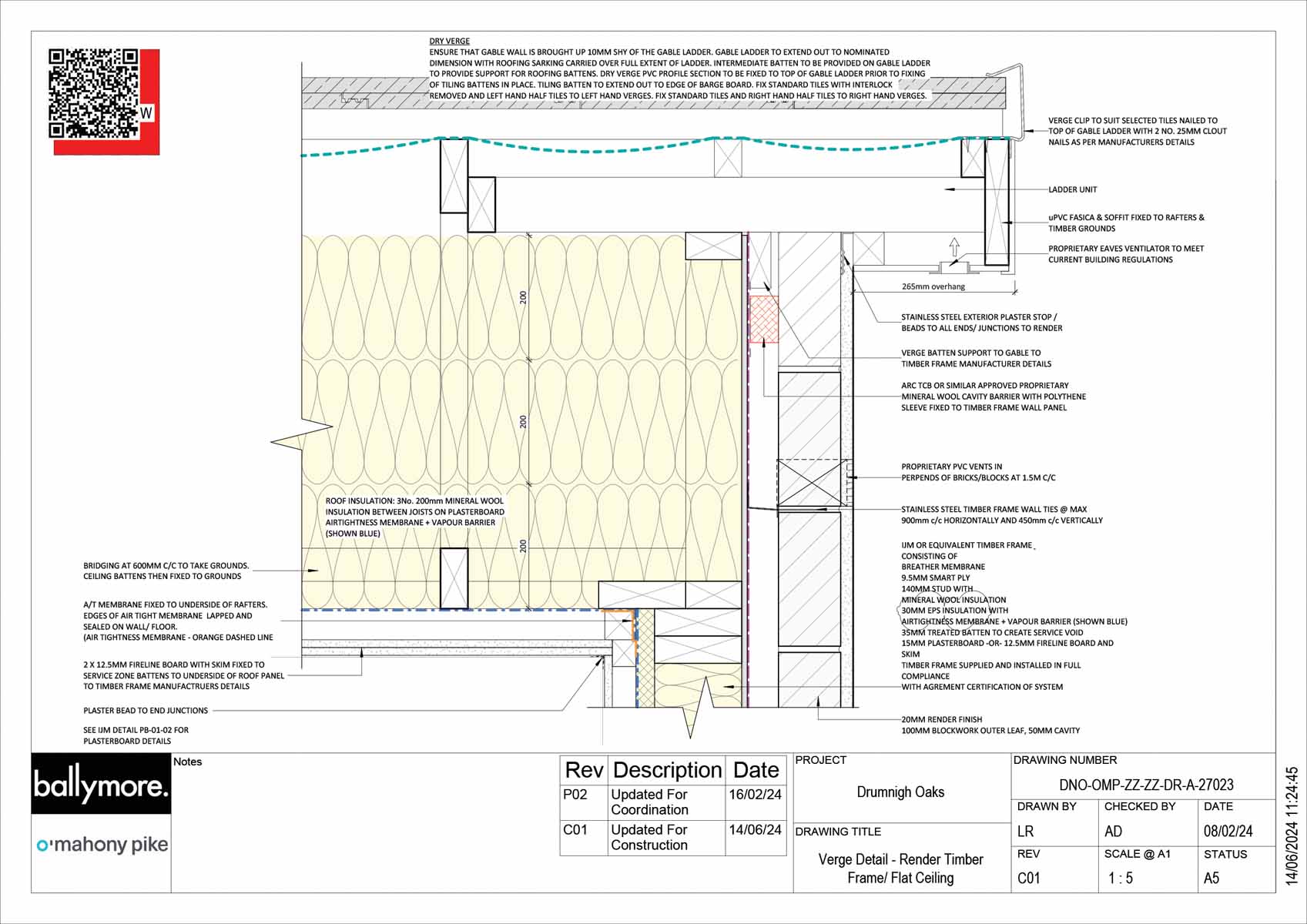
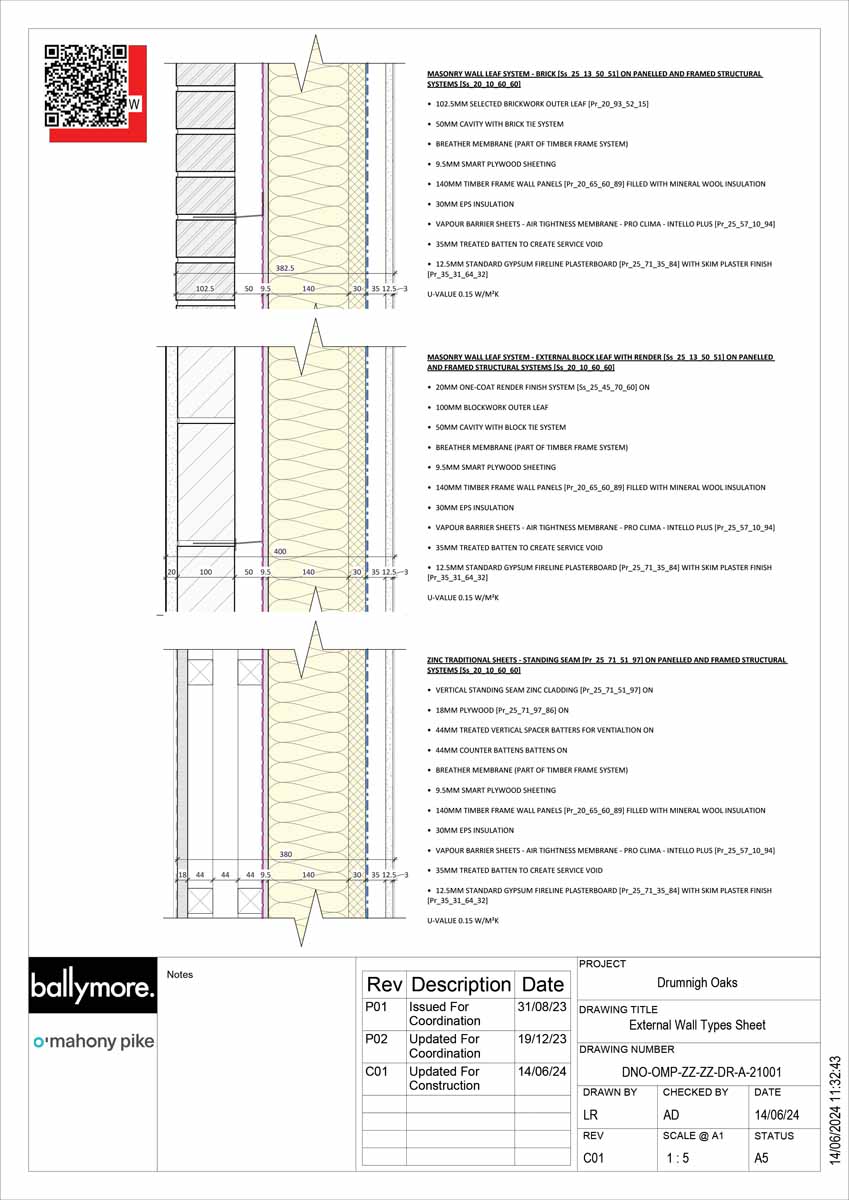
Walls: IJM EcoWall timber frame system with brick cladding, comprising (Outside in) 102.5 mm brickwork outer leaf; 50 mm cavity; breather membrane; 9.5 mm Smartply; 140 mm stud with mineral wool insulation; 30 mm EPS insulation with airtightness and vapour control layer; 35 mm treated batten to create service void; 15 mm plasterboard or 12.5 mm Fireline board and skim; with two coats of water-based paint. U-values: 0.175 - 0.189 W/m²K
Main roof detail
(Top down) Selected tiles on sr82 treated battens spaced as instructed by tile manufacturer; roofing membrane; counter battens to form ventilation void; breather membrane; on timber roof trusses; 9 mm OSB board fixed to underside of rafters; 200 mm mineral wool insulation between rafters with 40 mm PIR insulation fixed below rafters/OSB board to achieve required U-value; airtightness membrane + vapour barrier. U-value: 0.143 W/m²K
Dormer roof, flat ceiling and ridge achieved U-values respectively of 0.154 W/m²K; 0.111 W/m²K and 0.076 W/m²K, using mineral wool in thicknesses of up to 600 mm.
Windows & external doors: Munster Joinery PassiV Future Proof triple glazed windows (Uw ~0.73 W/ m²K frame; Ug 0.47 W/m²K) with Planitherm One glazing; g-value 0.37. Doors Uw 1.0.
Roof windows: Fakro U8 Thermo rooflights, U-value 0.5 W/m²K
Heating system: Daikin Altherma 3 air-to-water heat pumps, (EcoDesign & EN14825 compliant) with integrated 230L domestic hot water cylinder, and radiators with a flow temperature of 45C.
Ventilation: Vent Axia Sentinel Econiq MCP MVHR units, Passive House Institute certified with an efficiency of up to 86%.
Potable water use: 120 litres per person per day using the DEAP water calculator
Water efficiency measures: Aerated taps
Image gallery
https://mail.passive.ie/magazine/new-build/ballymore-scheme-brings-low-cost-comfort-to-private-market#sigProId19c1b83235