
- Upgrade
- Posted
Accessible Manchester retrofit delivers comfort and low bills
An award-winning retrofit demonstrates that universal design and ultra-low energy performance are powerful allies, not competing priorities.
Click here for project specs and suppliers
Development type: Deep retrofit of 1980s bungalow.
Method: Fabric-first approach with external wall insulation, timber frame extensions, and mechanical ventilation with heat recovery (MVHR)
Location: Suburban Manchester
Standard: CarbonLite Retrofit certified
Space heating cost: £42/month
(total energy bills – see In detail panel for more)
When homeowner Steve discovered a neglected 1980s bungalow during the pandemic, he faced a dilemma.
Born with significant physical differences, the computer programmer and Team GB Paralympian needed a home that would work for him long-term while addressing the rising energy costs that plagued his previous flat.
What emerged from this personal challenge would become the 2025 Exemplar Sustainable Buildings Awards winner for retrofit projects—a transformation that proves accessibility and sustainability can be mutually-reinforcing design principles.
Working with Hannah Dixon at Manchester practice Progress in Practice, the Ward Grove project is achieving exceptionally low metered energy use while delivering comprehensive accessibility features. The calculated energy use intensity – which in this all-electric house means the energy imported from the grid, as measured at the meter – is just 38 kWh/m²/yr.
The result is a home where Steve pays just £42 monthly for energy bills and declares simply: "It is a fantastic house."
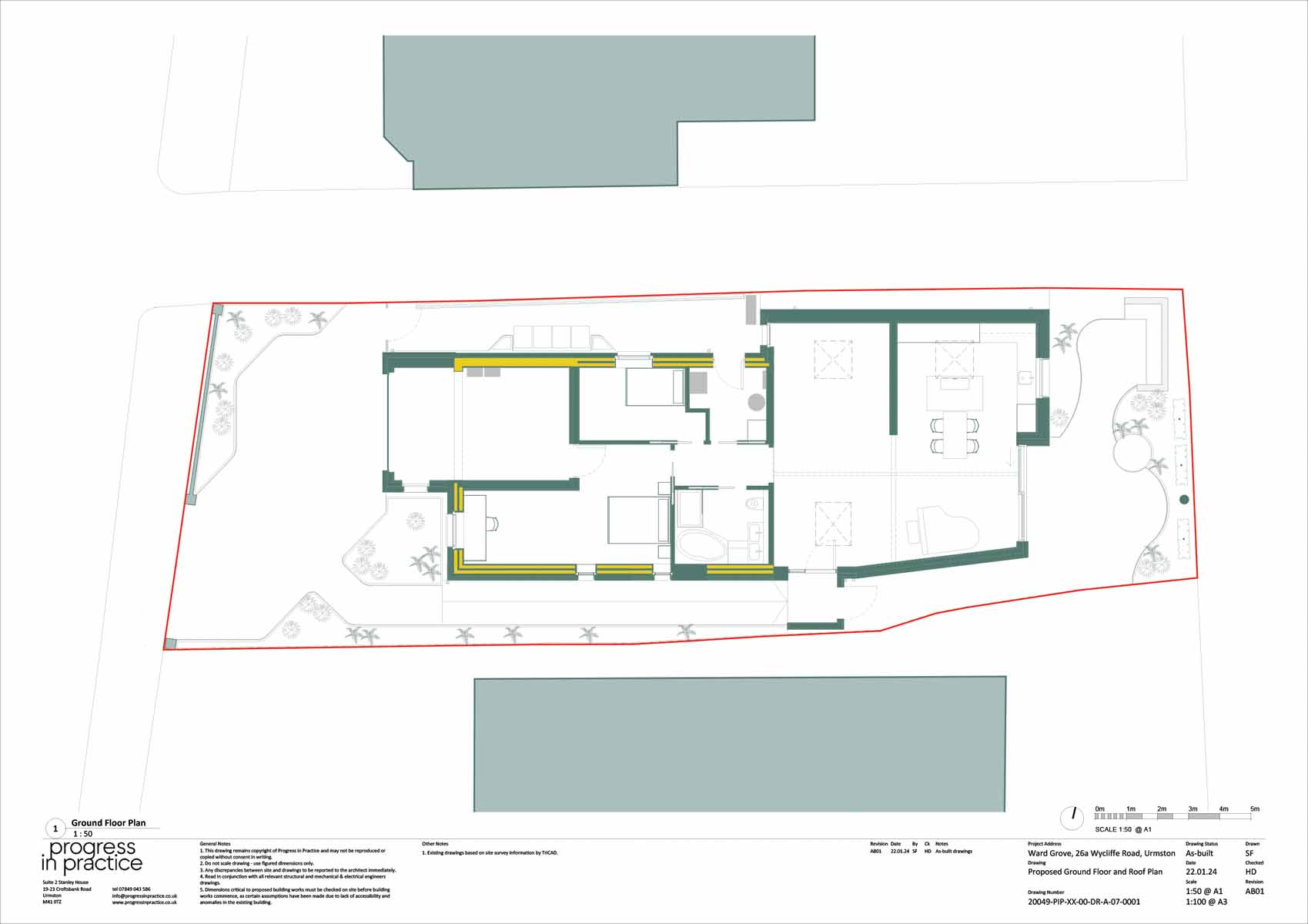
The project's success lies not in choosing between accessibility and environmental performance, but in recognising how thoughtful design can deliver both. Every decision — from the internal garage access that keeps Steve dry when transferring from his car, to a heating system design that eliminates obstacles in the form of radiators — demonstrates how user-centred design can naturally align with sustainable building principles.
Universal design as environmental strategy
This article was originally published in issue 51 of Passive House Plus magazine. Want immediate access to all back issues and exclusive extra content? Click here to subscribe for as little as €20, or click here to receive the next issue free of charge
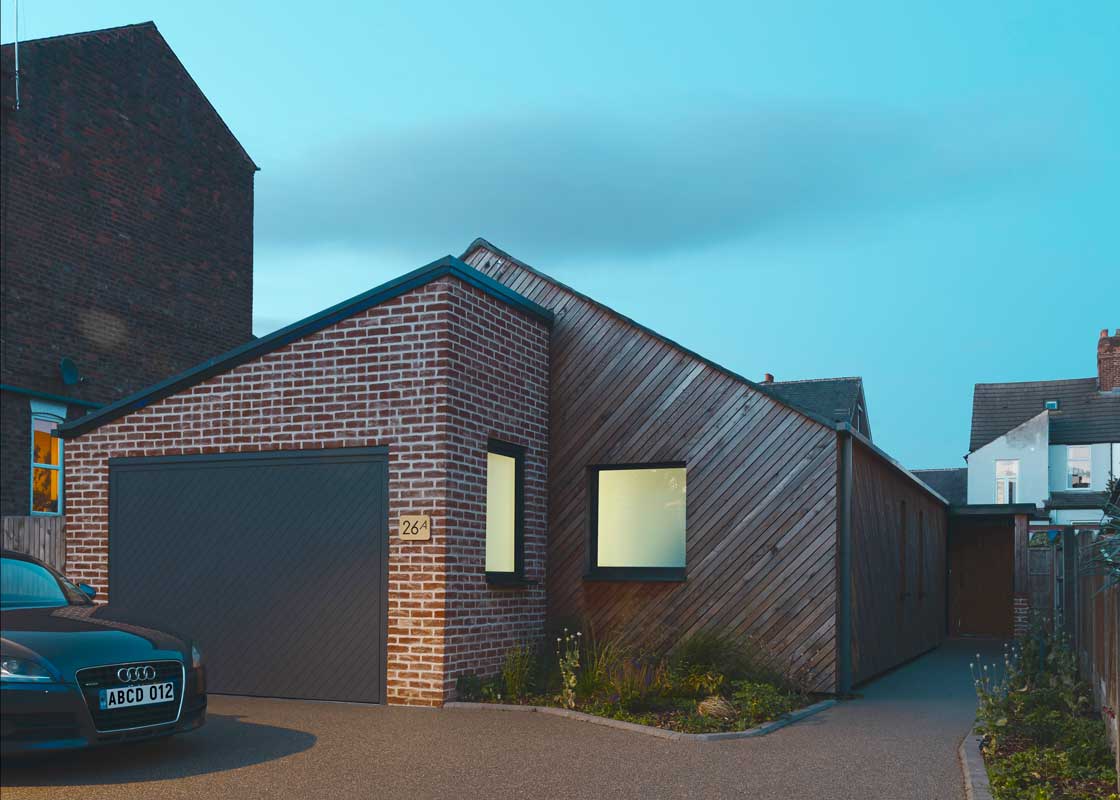
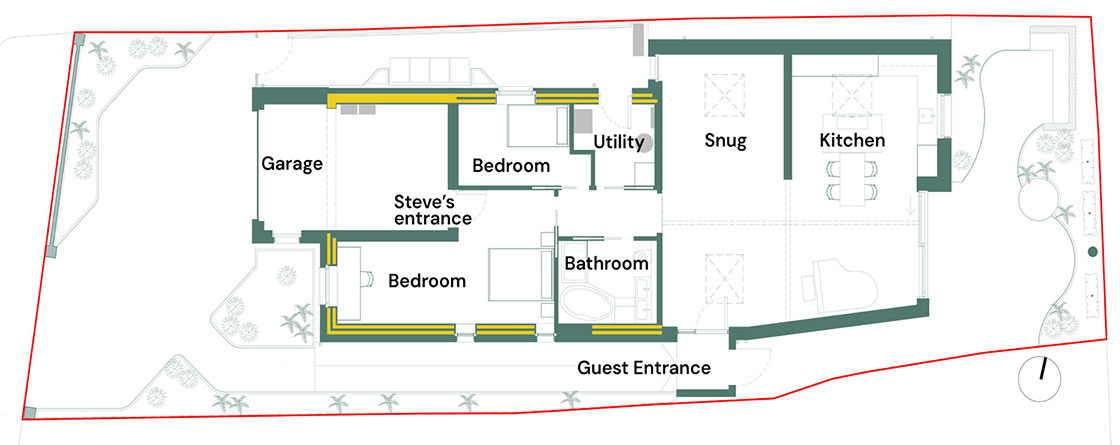
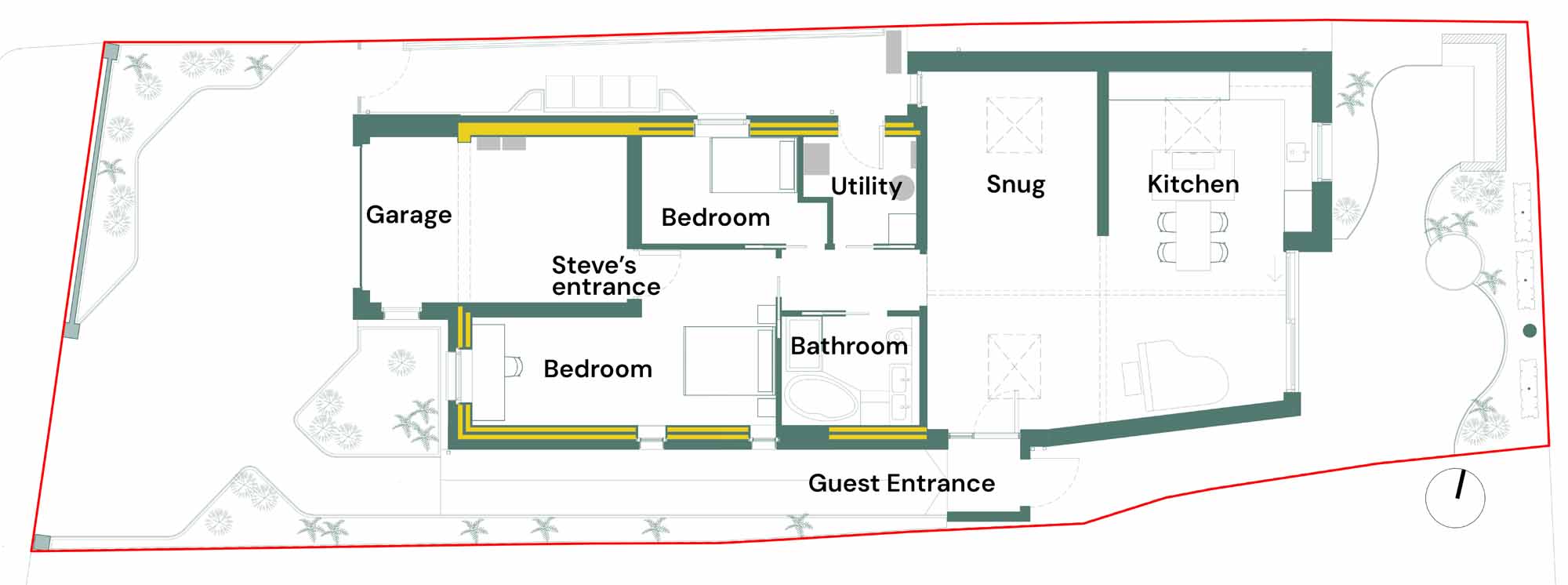
The accessibility requirements that initially seemed like design constraints became catalysts for innovative solutions. Steve's need for an internally connected garage, allowing weather-protected access to his vehicle, required careful integration with the building's thermal envelope. Rather than compromise the insulation strategy, the design team used this as an opportunity to demonstrate how accessibility features could enhance rather than undermine performance.
"The main area accessibility had an impact on was the garage," says Hannah Dixon, architect and director of Progress in Practice.
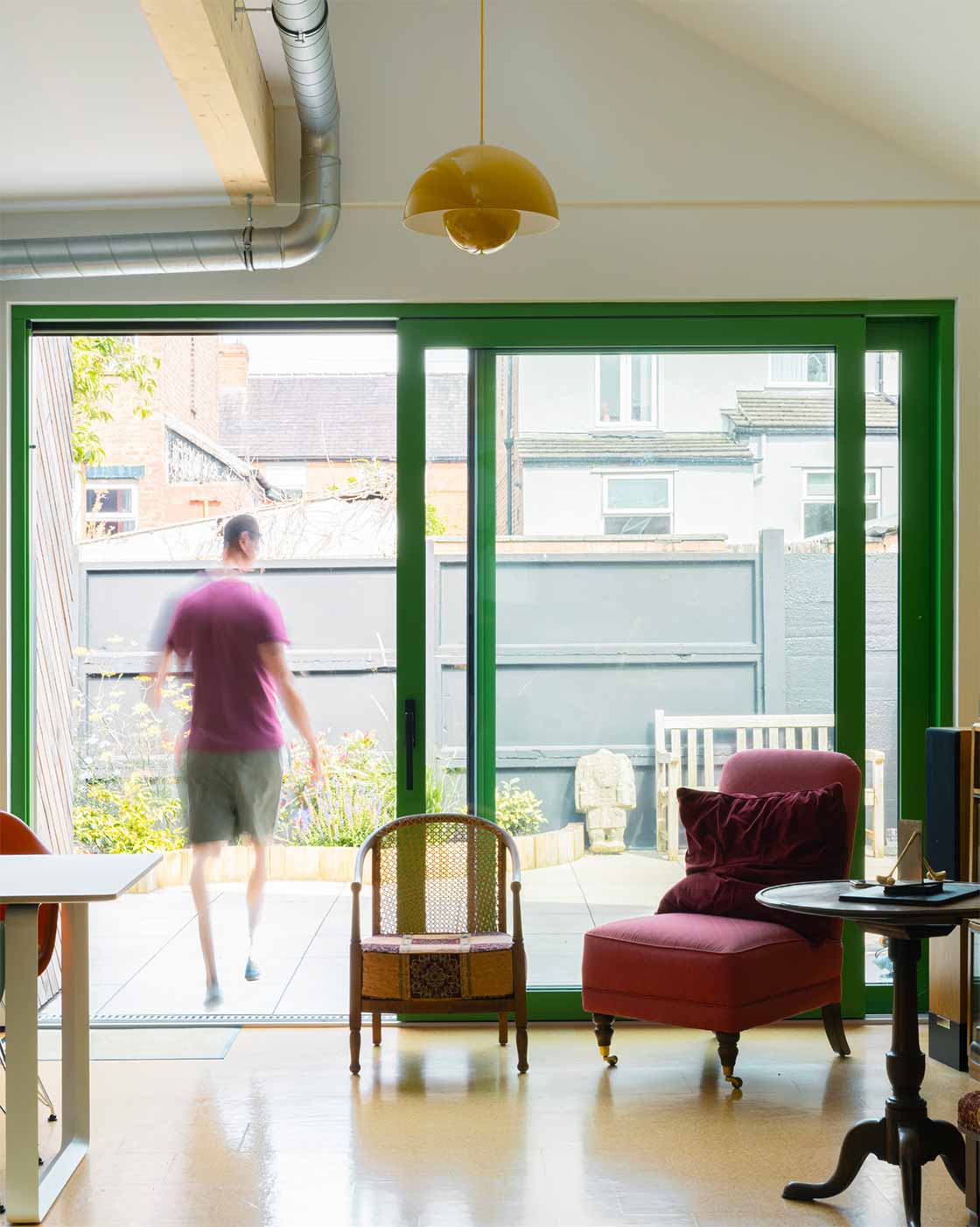
The integration required sophisticated detailing to maintain the continuous insulation layer whilst providing the step-free access Steve required. The solution involved new timber frame construction with wood fibre insulation, ensuring no thermal bridging whilst creating the spatial flow needed for wheelchair accessibility. Interior accessibility features were crucial. Pocket doors sliding into walls eliminate the swing space of traditional doors, creating more efficient room layouts whilst requiring no effort to operate.
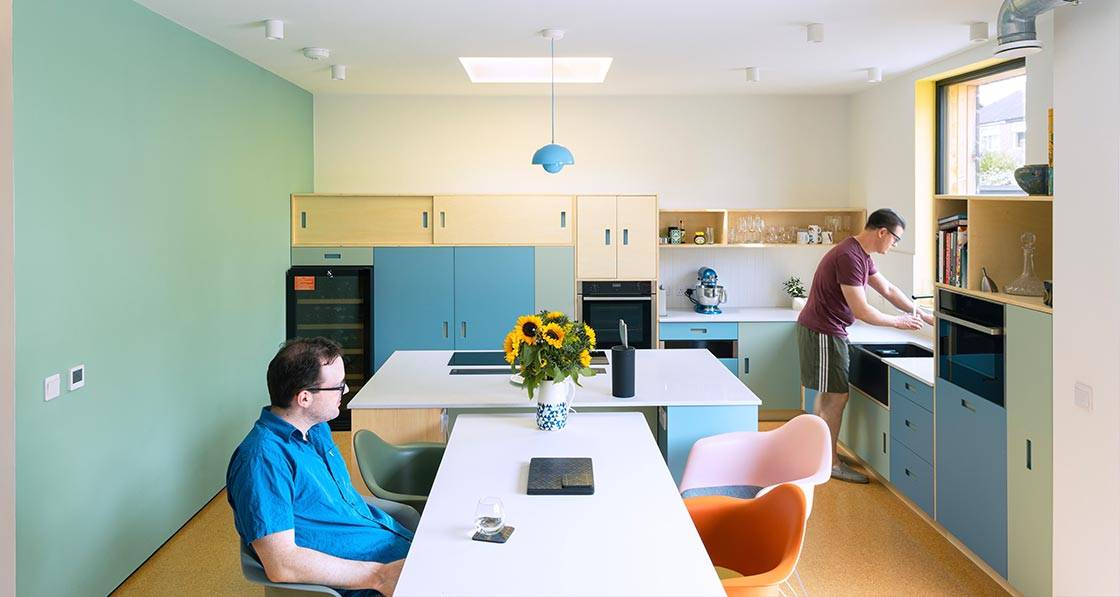
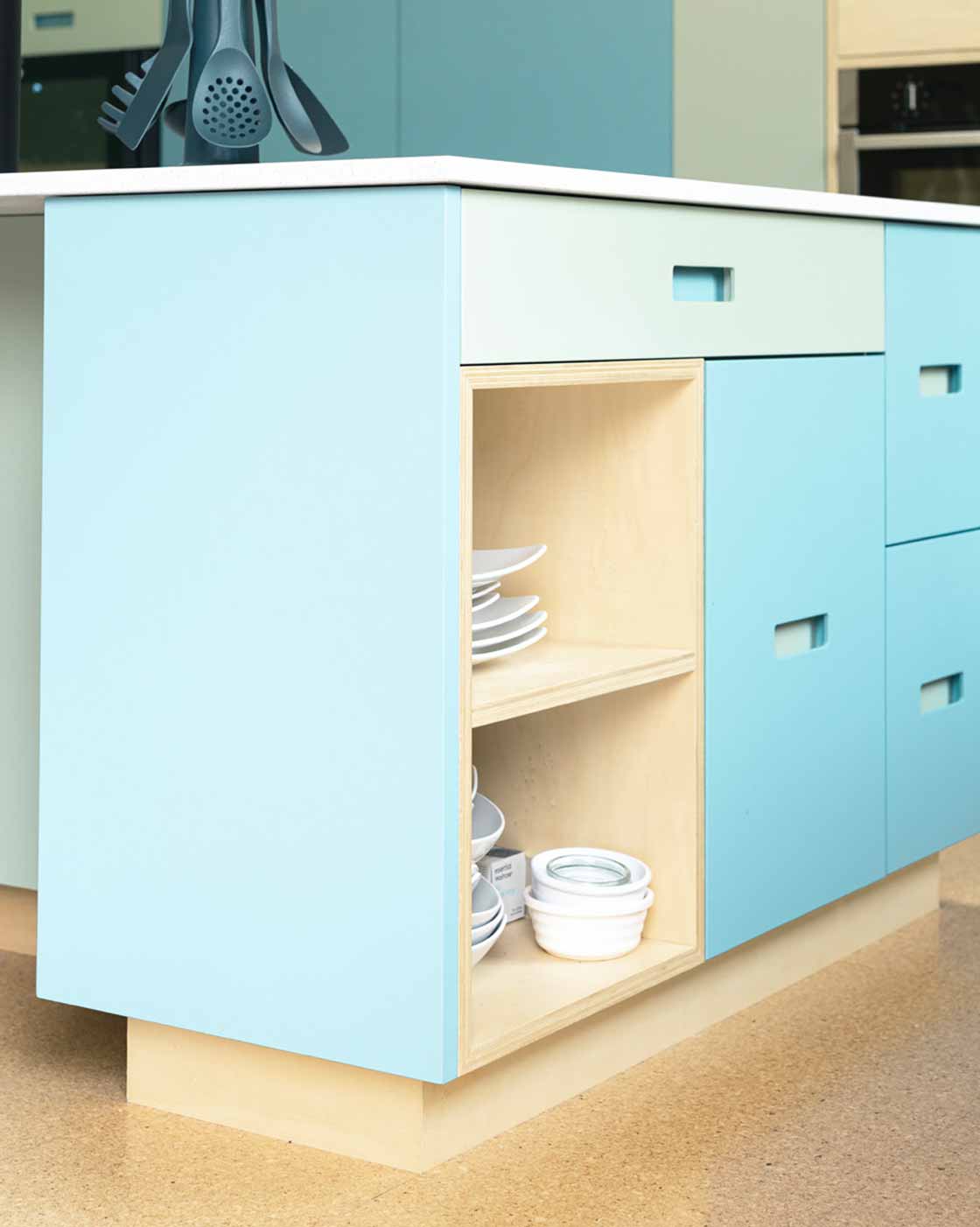
Steve's lowered kitchen worktops — 80 cm rather than the standard 90 cm — reduce material use whilst providing the ergonomic access he needs, while a stepped approach to his bath eliminated a ‘high jump’ entry that he wanted to avoid.
The underfloor heating distribution proved particularly effective for accessibility. Unlike traditional radiators that can obstruct movement and create uncomfortable hot spots, the even temperature distribution provides consistent comfort throughout the space, delivered through a screed finished with a Granorte cork floor.
Integrated thinking
The underfloor heating proved particularly effective for accessibility by eliminating the obstacles of radiators.
The transformation of this 1980s bungalow into a certified CarbonLite Retrofit demonstrates how ambitious performance targets can be achieved within existing building constraints.
The original property, unoccupied for several years with "dated finishes, direct electric heating system, and all of the usual terrible glazing," presented the typical challenges of its era whilst requiring comprehensive accessibility modifications.
Dixon's team approached the retrofit with a fabric-first strategy, applying external wall insulation to the existing brick cavity walls whilst constructing new elements in timber frame with wood fibre insulation.
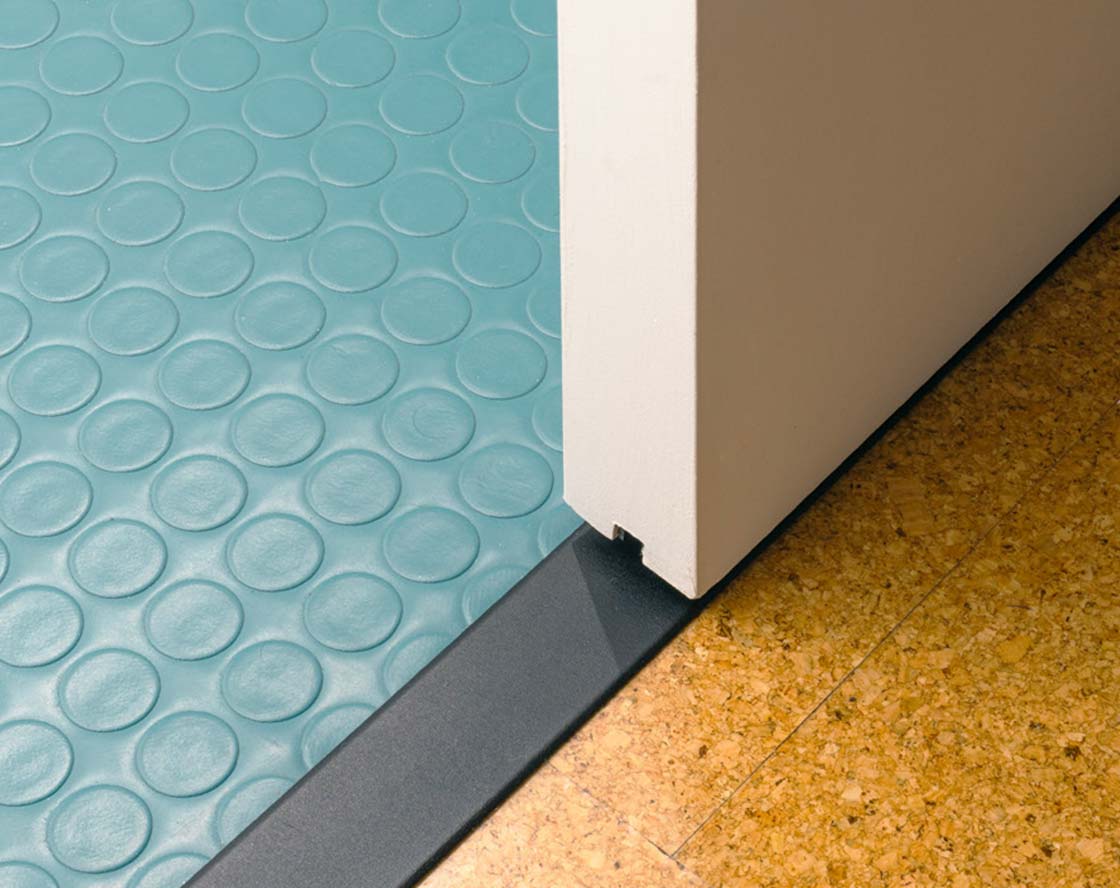
This was part of a conscious choice to use natural materials – including cellulose insulation, cork flooring, and healthy interior finishes.
"We try to use natural materials," Dixon says, noting that fire regulations provided the primary constraints rather than thermal performance requirements. Efforts to reduce embodied carbon also informed the spec, including the glulam beams. “This was initially specified by structural engineer as steel, but changed to glulam for embodied carbon reasons,” says Dixon. “It also looks lovely. The builder initially suggested switching back as a cost saving, but actually the glulam turned out to be cost neutral.”
A pragmatic approach to integrating non-standard low carbon materials was necessary, Dixon explains, for a simple reason. “We had to balance this with trying to design the details in a way that is reasonably familiar to most builders, as we didn’t know at the time who was going to build it,” she says. The project's innovative approach initially faced scrutiny during the planning process, requiring specialist intervention to justify the design rationale. Planning consultant Emma Jones of Acer Town Planning was brought in after some early pushback from the local authority during pre-application discussions.
-
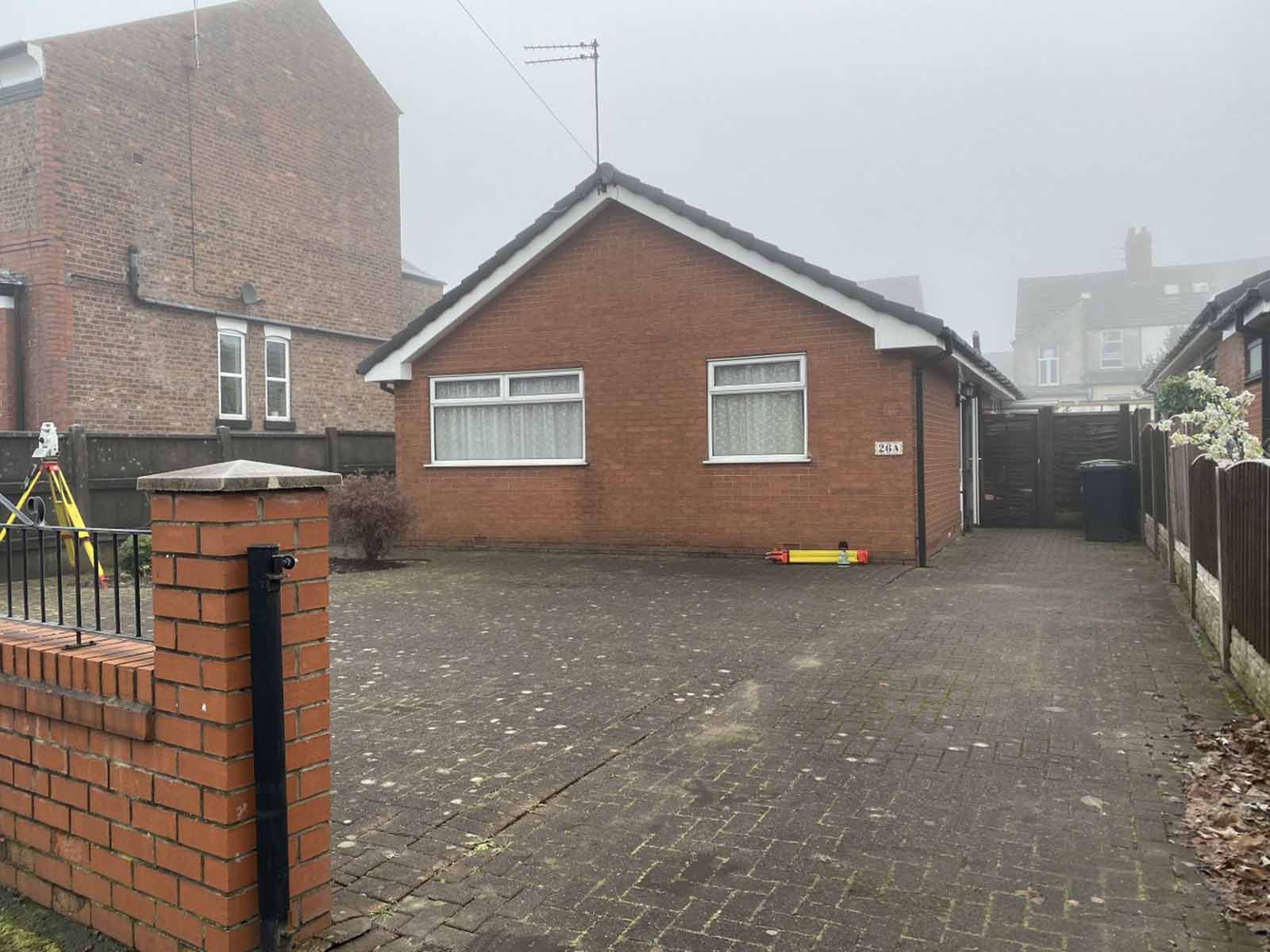
 Front of house before
Front of house before
Front of house before
-
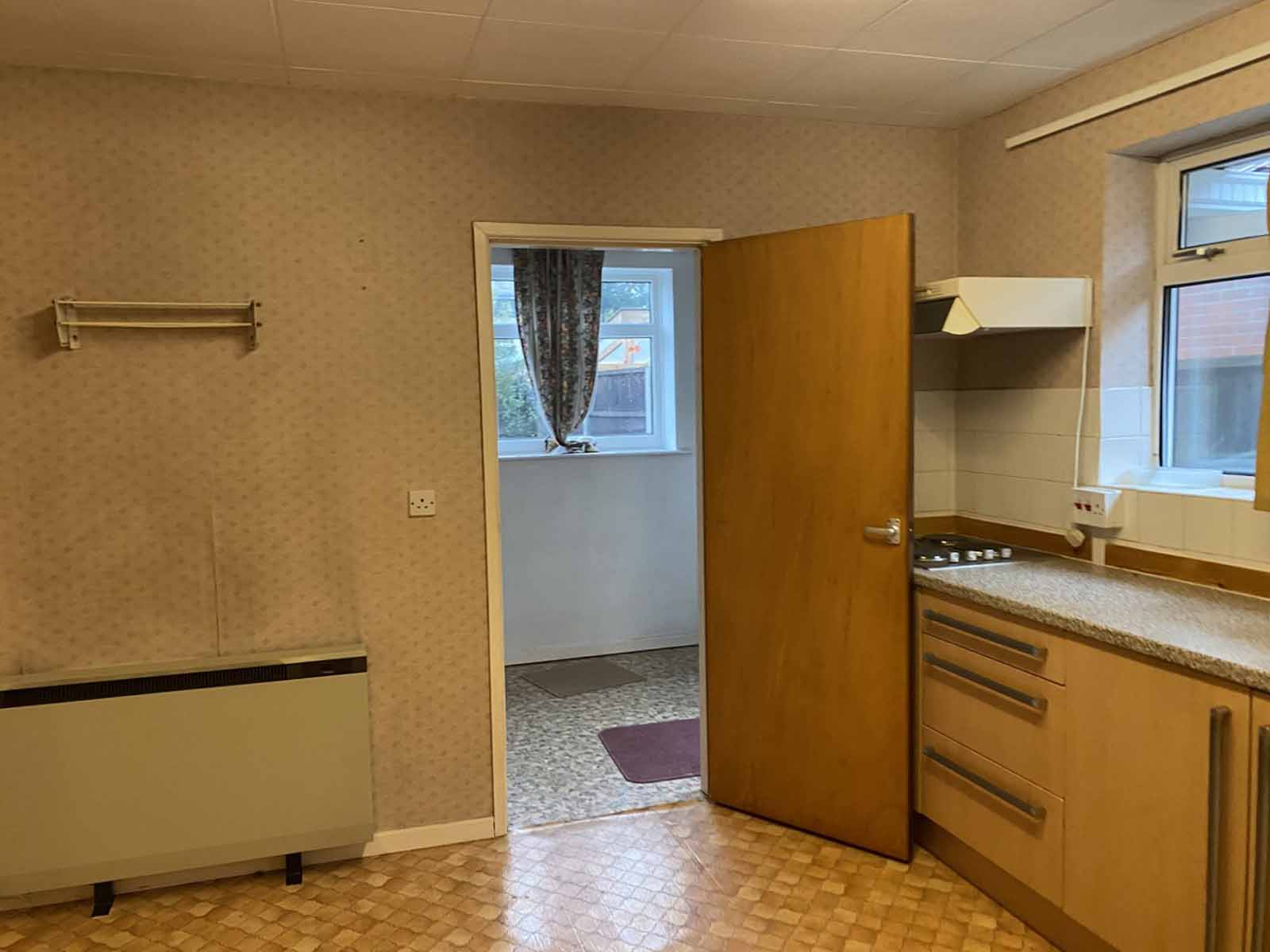
Interior kitchen before
Interior kitchen before
-
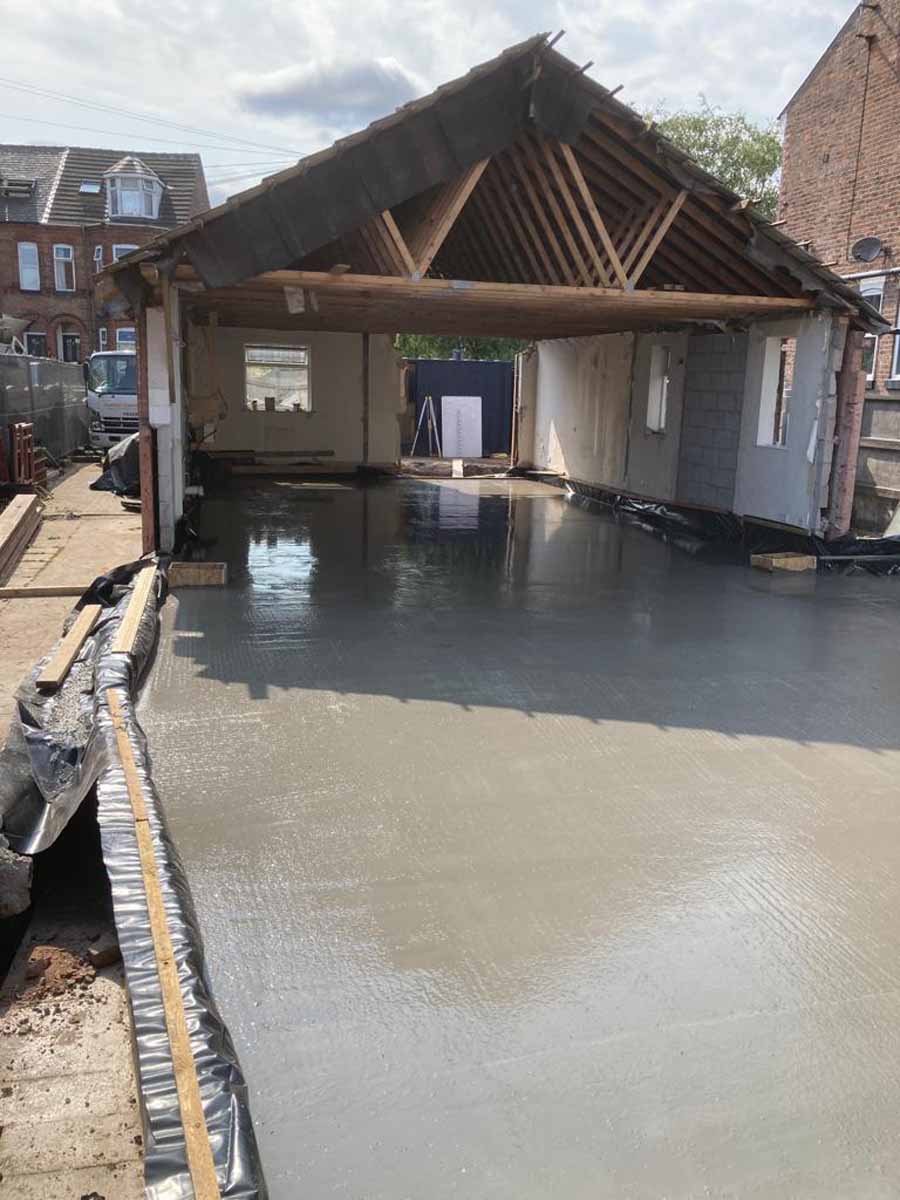
New slab throughout. Insulation is to go above, followed by underfloor heating within a wet screed and cork flooring – delivering a comfortable, warm surface for a client who will spend more time closer to the ground
New slab throughout. Insulation is to go above, followed by underfloor heating within a wet screed and cork flooring – delivering a comfortable, warm surface for a client who will spend more time closer to the ground
-
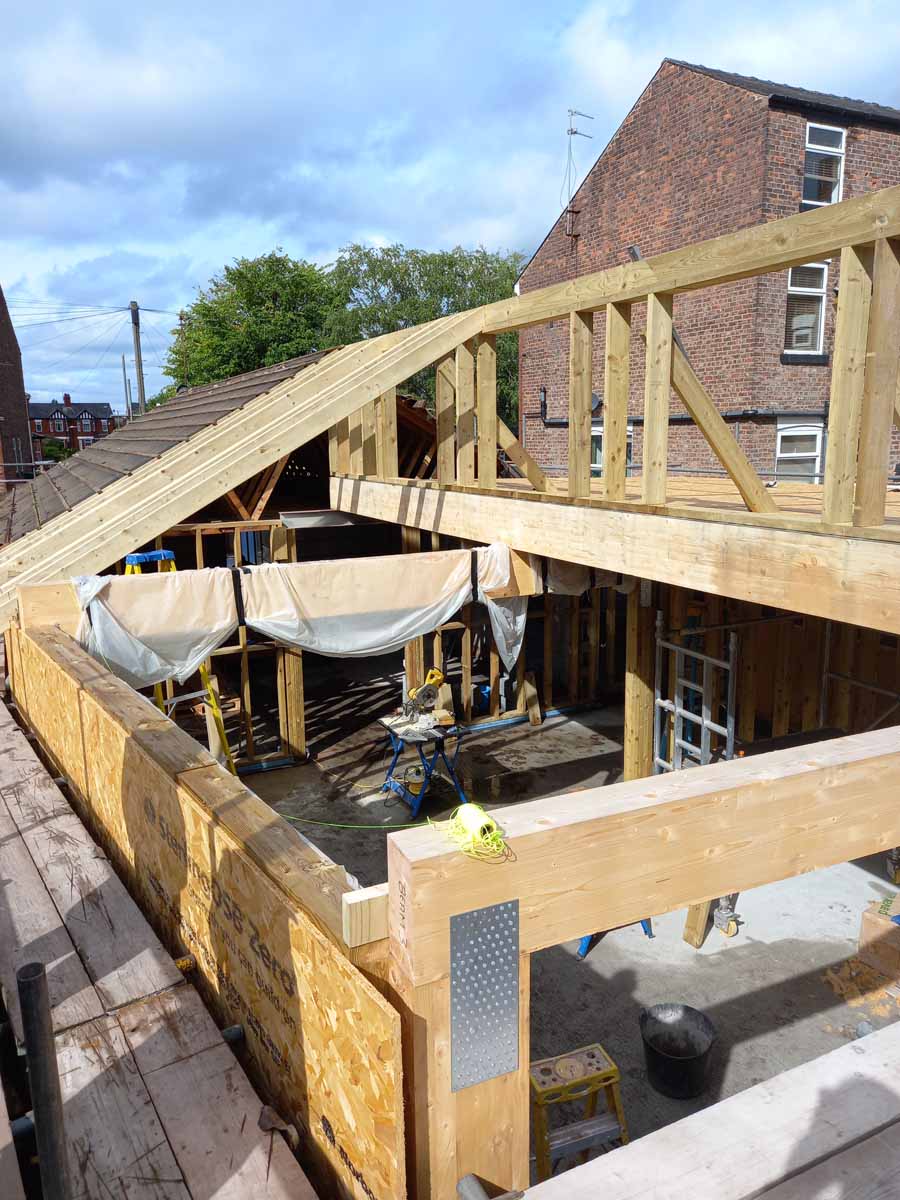
Primary glulam structure going in – which ended up being cost neutral compared to the steel beam proposed by the structural engineer
Primary glulam structure going in – which ended up being cost neutral compared to the steel beam proposed by the structural engineer
-
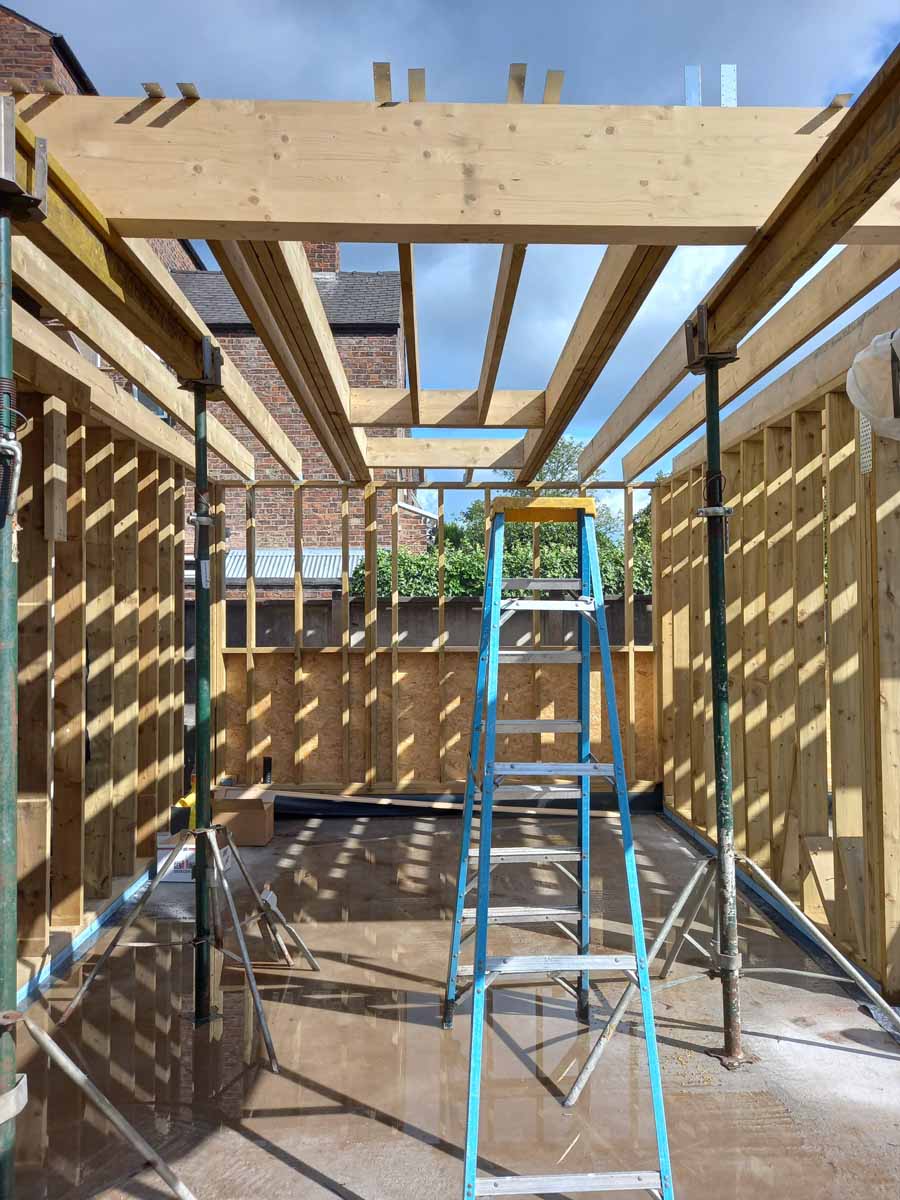
Timber frame in progress, with studs sitting on Marmox blocks, prior to the insulation layer going in
Timber frame in progress, with studs sitting on Marmox blocks, prior to the insulation layer going in
-
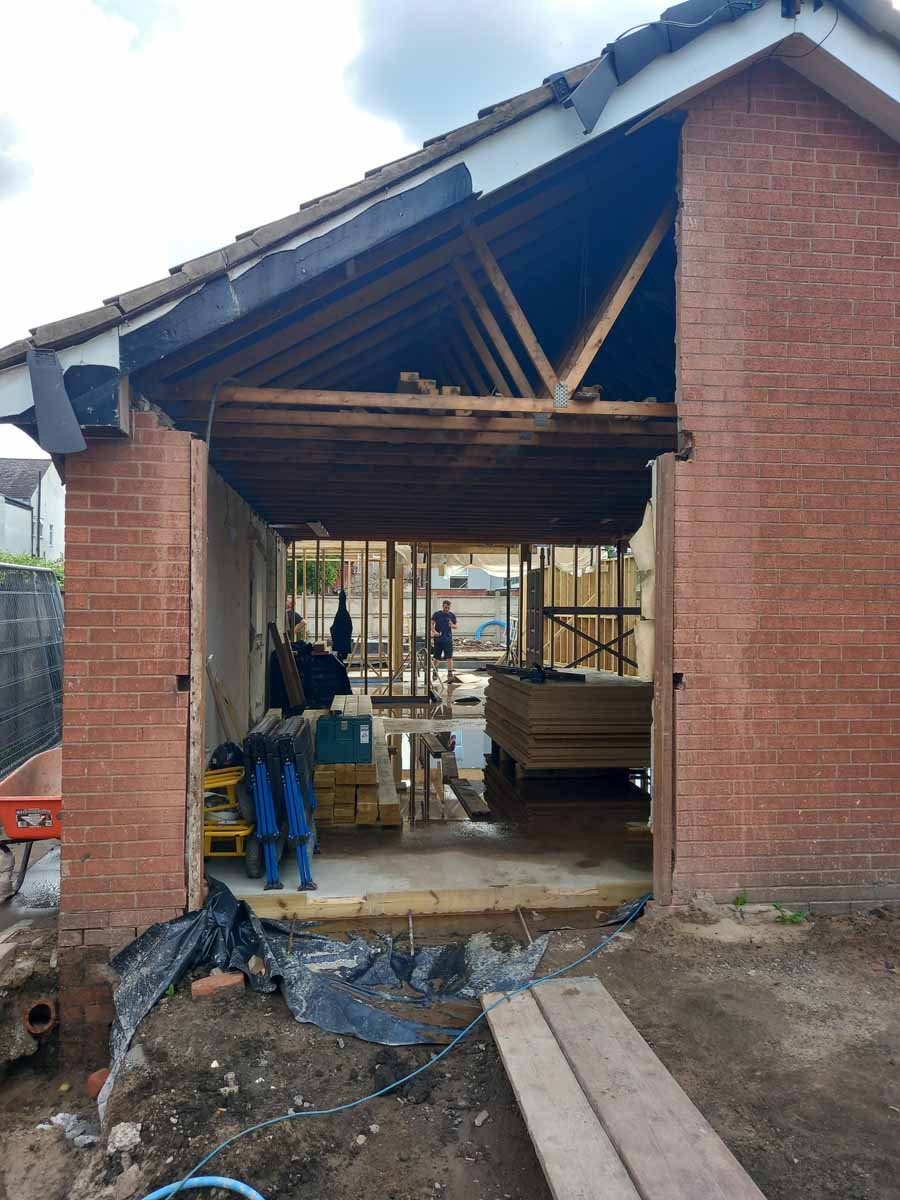
View into house from front, where integrated garage is going in – a core part of the brief for a client coming in and out of the car with a wheelchair in the Manchester weather
View into house from front, where integrated garage is going in – a core part of the brief for a client coming in and out of the car with a wheelchair in the Manchester weather
-
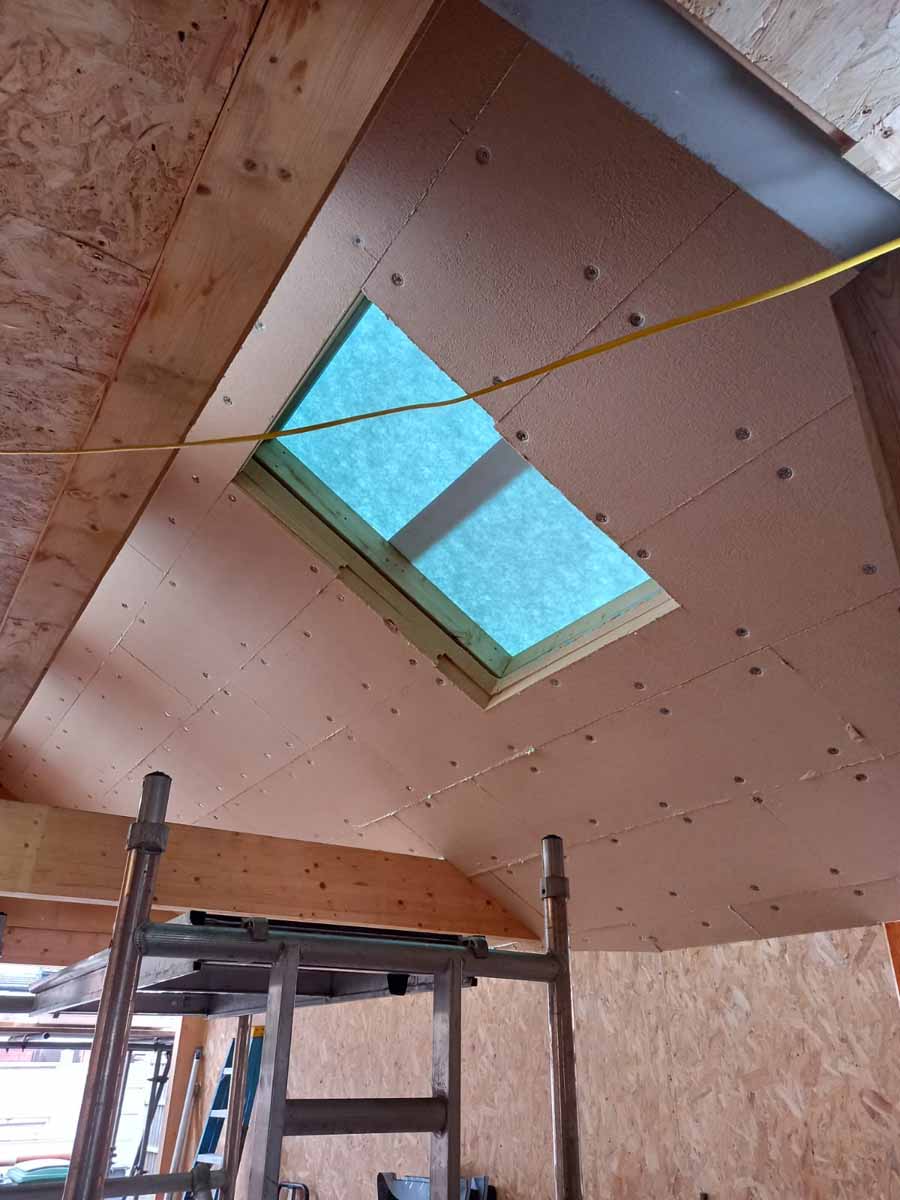
Wood fibre insulation to roof
Wood fibre insulation to roof
-
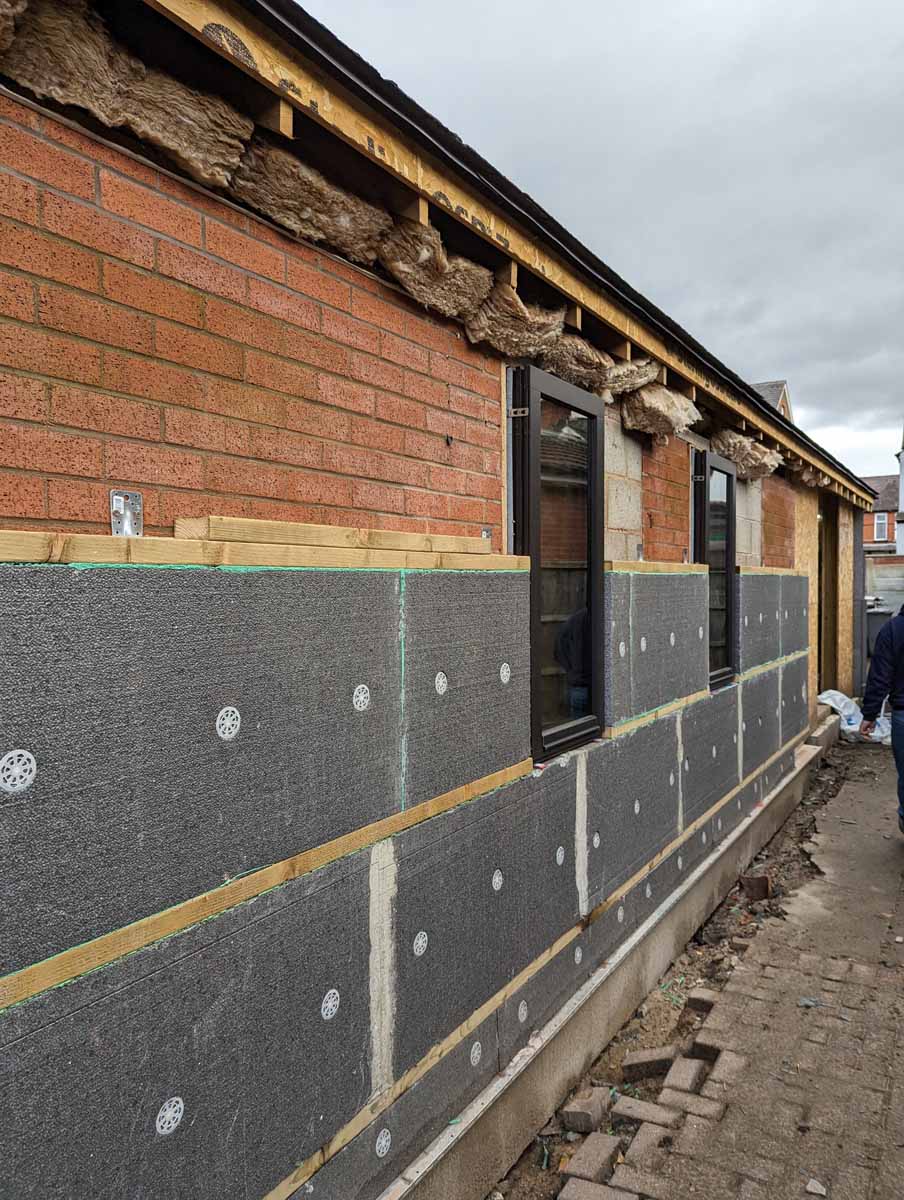
The inner layer of the two layer external insulation, with battens between the EPS for fixings for timber cladding. The outer layer, yet to be added in this photo, is continuous EPS. Mineral wool at the head of the wall joins the EPS to the cellulose insulation in the loft. XPS insulation is taken as far as possible below DPC.
The inner layer of the two layer external insulation, with battens between the EPS for fixings for timber cladding. The outer layer, yet to be added in this photo, is continuous EPS. Mineral wool at the head of the wall joins the EPS to the cellulose insulation in the loft. XPS insulation is taken as far as possible below DPC.
-
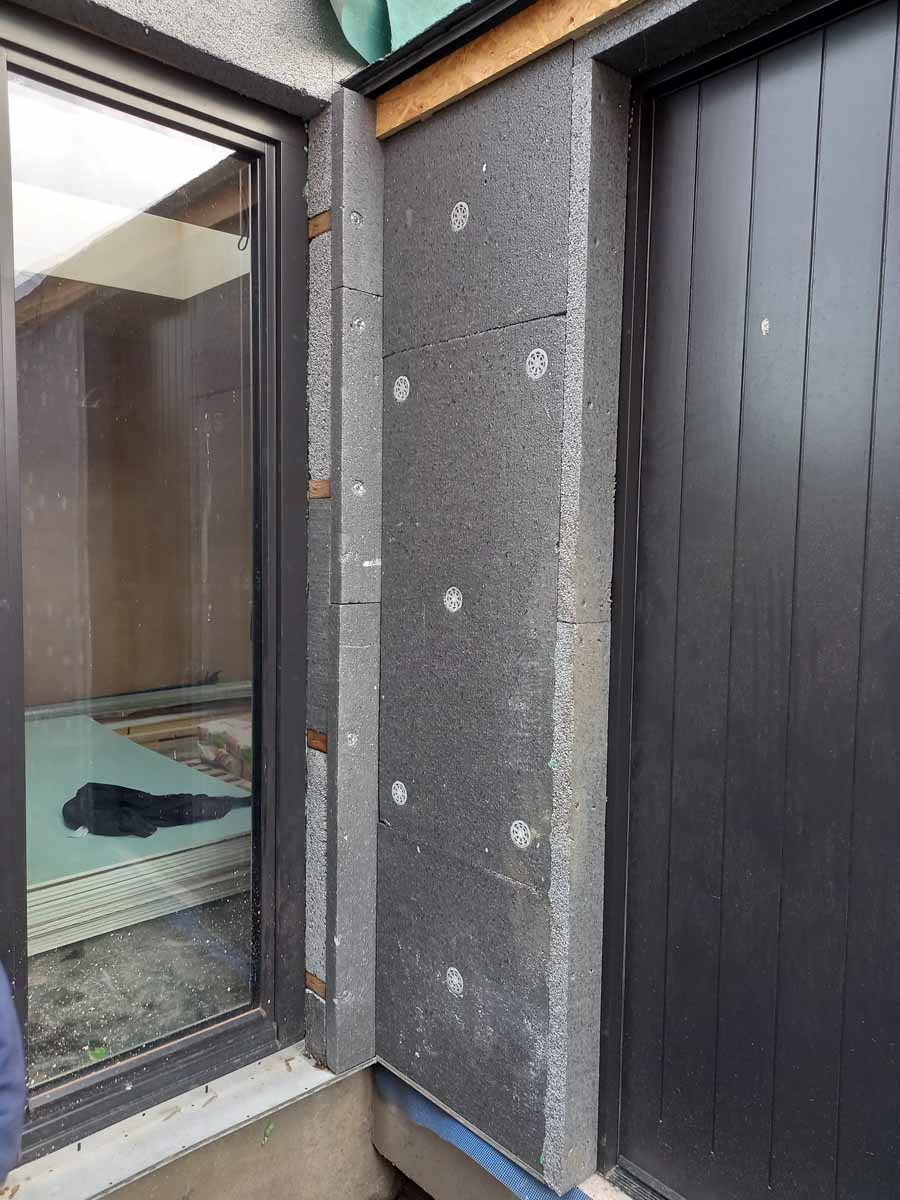
Viking triple glazing and high performance doors. EPS insulation wraps around reveal to meet frame. Window on left insulation in progress. Door on right insulation fitted
Viking triple glazing and high performance doors. EPS insulation wraps around reveal to meet frame. Window on left insulation in progress. Door on right insulation fitted
-
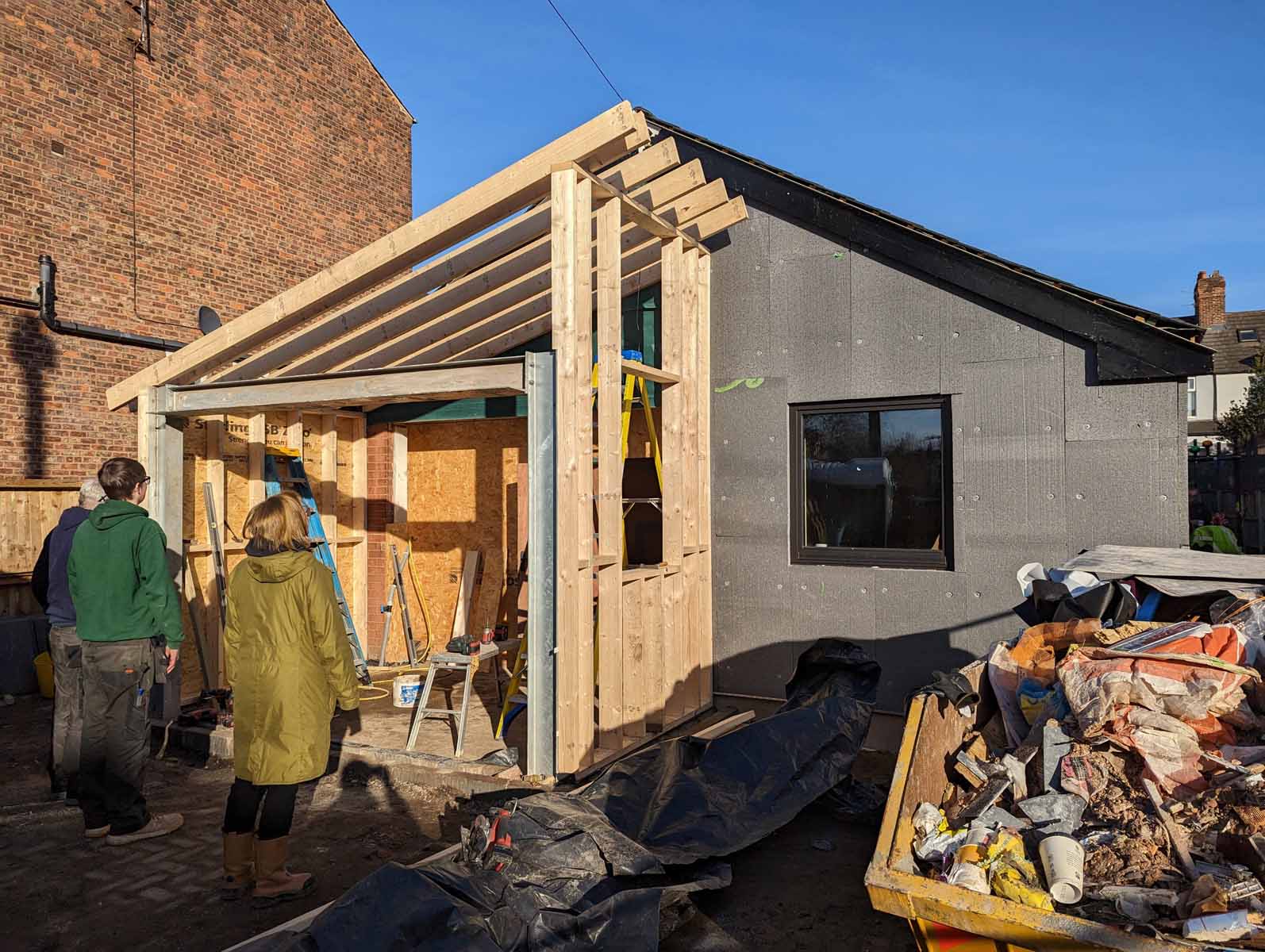
Insulated house with triple glazing (to the right), uninsulated garage (to the left)
Insulated house with triple glazing (to the right), uninsulated garage (to the left)
-
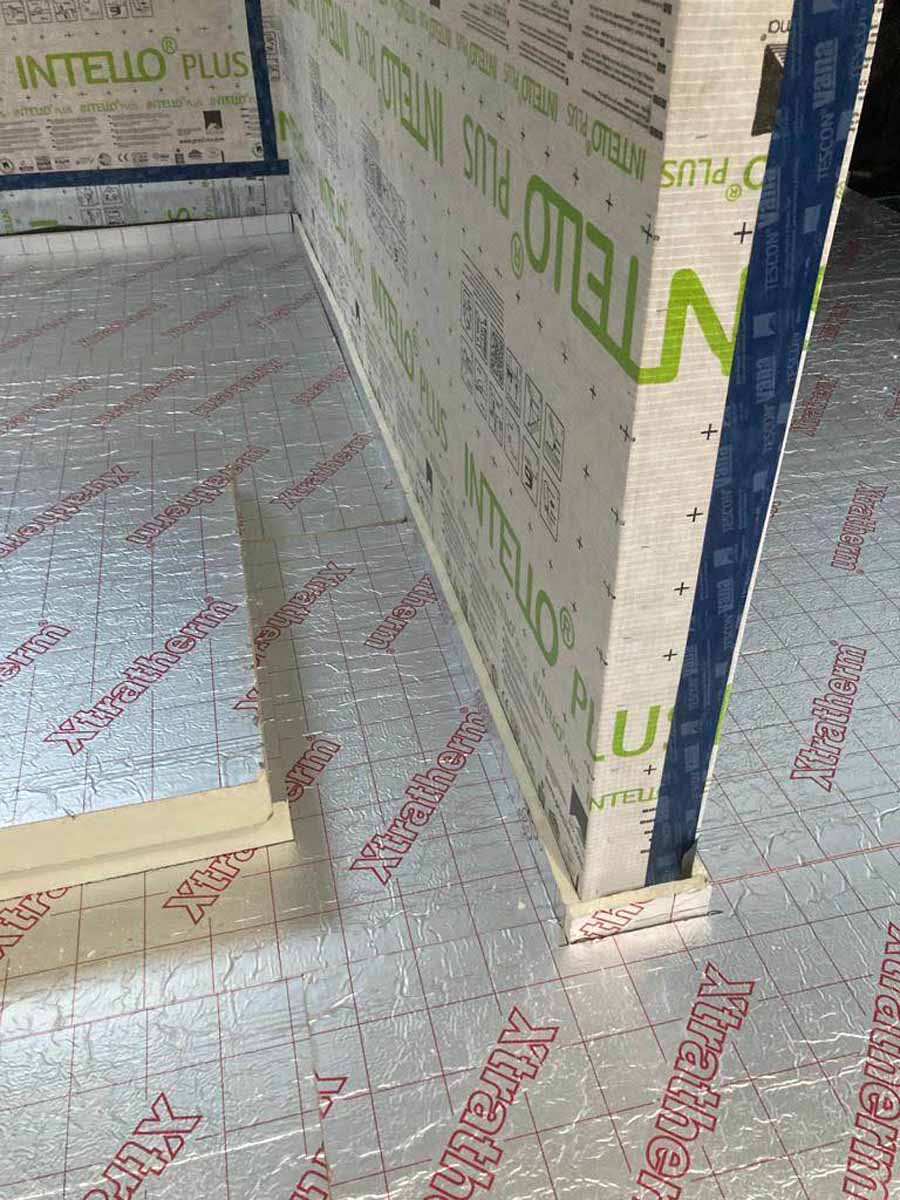
PIR insulation below screed with 25mm upstand throughout, fitted snuggly with no gaps. It was insisted that Kingspan and Celotex were not specified due to connections with the Grenfell atrocity
PIR insulation below screed with 25mm upstand throughout, fitted snuggly with no gaps. It was insisted that Kingspan and Celotex were not specified due to connections with the Grenfell atrocity
-
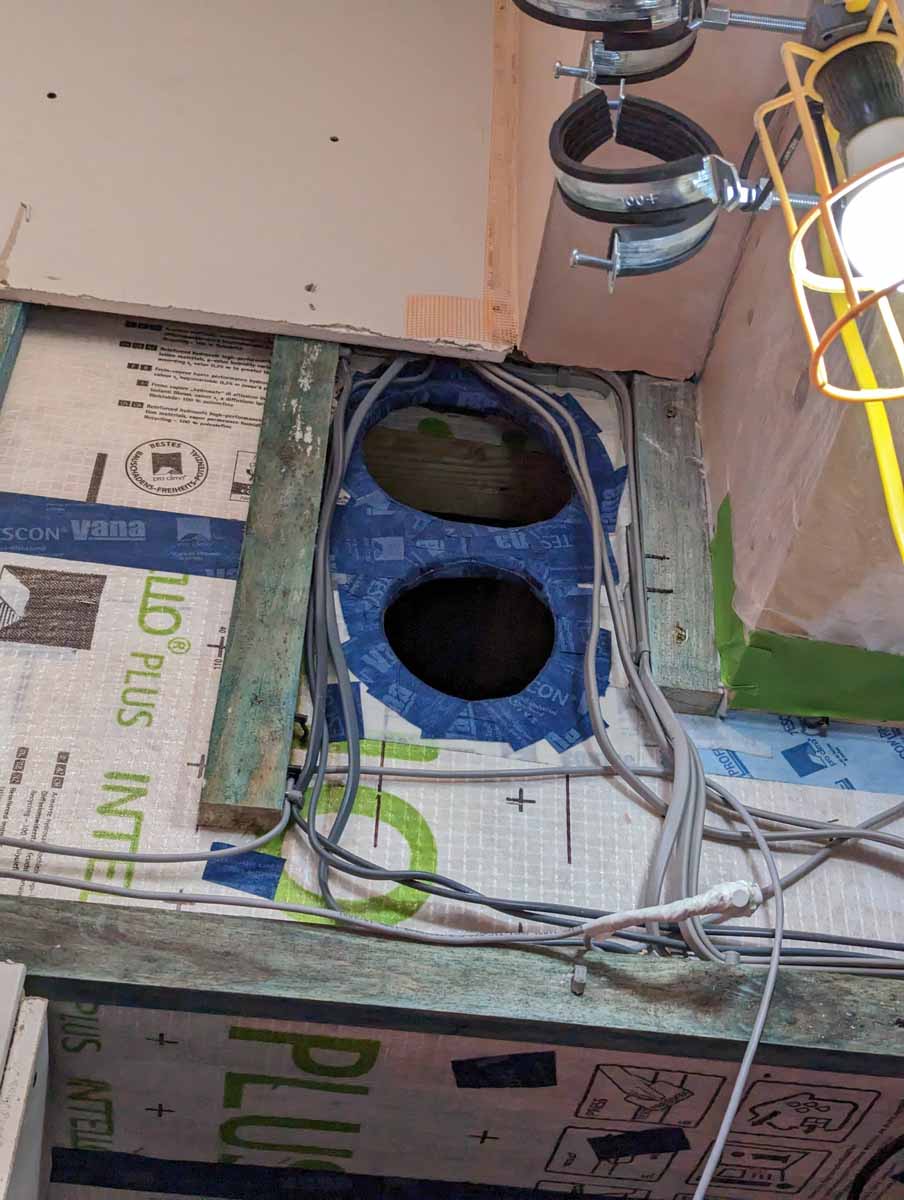
A tricky junction necessitated running MVHR ductwork through the airtight layer into the loft (within the thick insulation layer) and back into the living space
A tricky junction necessitated running MVHR ductwork through the airtight layer into the loft (within the thick insulation layer) and back into the living space
-
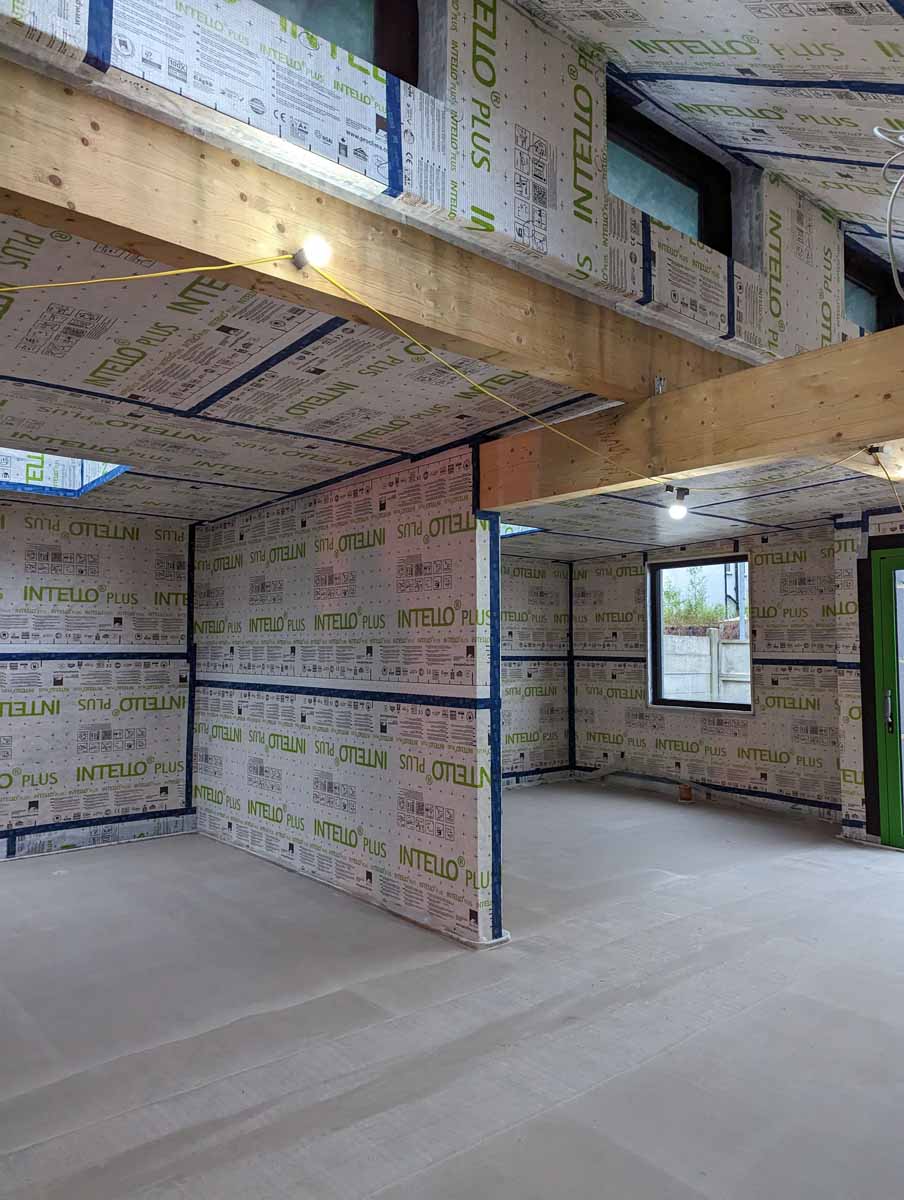
Airtightness complete – with the builder so keen to do well on airtightness that he went beyond the original detail by wrapping the internal partition, which was then taped onto the glulams and DPM
Airtightness complete – with the builder so keen to do well on airtightness that he went beyond the original detail by wrapping the internal partition, which was then taped onto the glulams and DPM
-
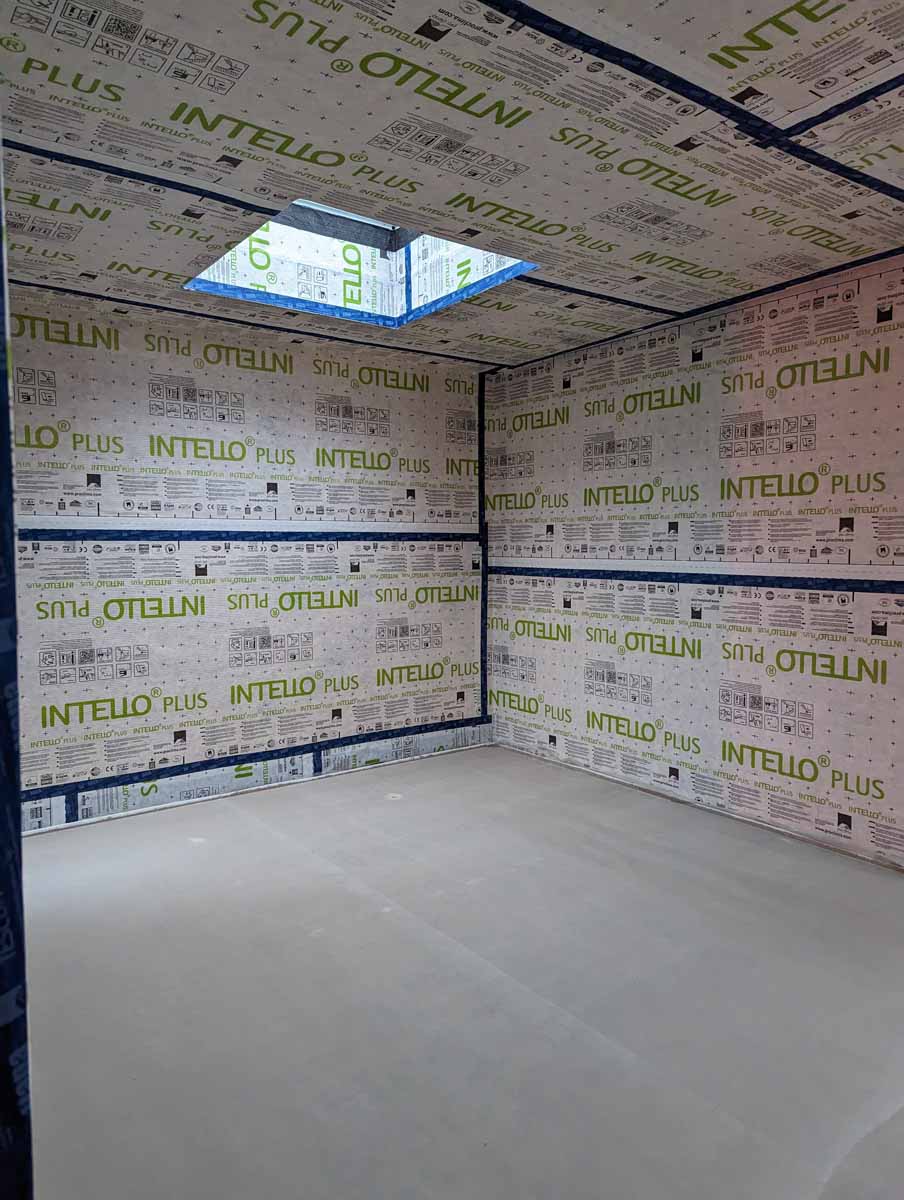
Airtightness, showing living space wrapped like a Christmas present, Installed by a female tiler, who was new to retrofit, but excelled at airtightness
Airtightness, showing living space wrapped like a Christmas present, Installed by a female tiler, who was new to retrofit, but excelled at airtightness
-
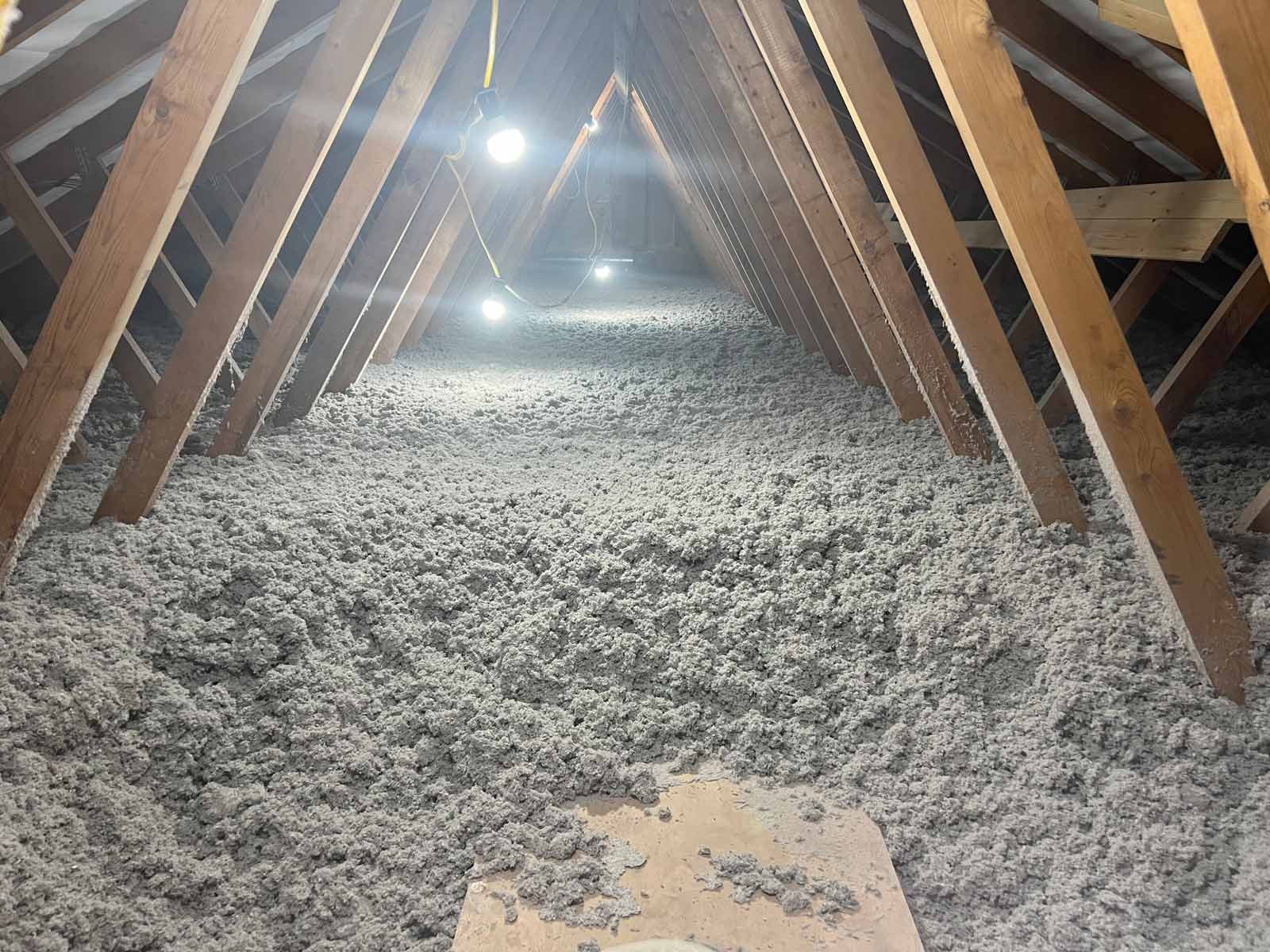
Cellulose in loft, used around the repeating trusses – partly for its low embodied carbon and partly because it made it simple/possible to fill all of the little gaps between a lot of complicated structure.
Cellulose in loft, used around the repeating trusses – partly for its low embodied carbon and partly because it made it simple/possible to fill all of the little gaps between a lot of complicated structure.
https://mail.passive.ie/magazine/upgrade/accessible-manchester-retrofit-delivers-comfort-and-low-bills#sigProId8a88fca6c1
"Hannah of Progress in Practice brought me in because they had initially had some pushback from the local authority," Jones explained. The planning challenges centred on how accessibility needs informed design decisions that departed from standard approaches.
Traditional space standards for external areas, for instance, didn't account for Steve's specific requirements to maximise internal accessibility.
"The council has certain space standards for external space, but in this case, because the client had specific needs, it was designed to maximise the internal space," Jones says, noting how she justified the smaller garden by emphasising the innovative fusing of the passive house-informed CarbonLite Retrofit standard with accessibility integration.
The experience highlighted how planning frameworks struggle to accommodate projects that challenge conventional standards, even when delivering superior outcomes.
Balancing ventilation and client needs
The house also eschewed convention in its approach to ventilation, even in the context of the kinds of low energy buildings featured in this magazine. This may not be obvious to the casual reader, as the house features a whole house mechanical ventilation with heat recovery (MVHR) system. However, it is common in low energy buildings to supplement the MVHR with fenestration strategies that facilitate cross ventilation or stack ventilation – most notably to purge ventilate to reduce temperatures during summer nights.
At Ward Grove, the bungalow format itself created challenges for natural ventilation due to security concerns—"I can't leave my windows open at night", says Steve. The MVHR was therefore crucial to ensure consistent air quality and thermal comfort – two aspects which natural ventilation alone cannot reliably deliver.
While natural ventilation is inherently inconsistent and arbitrary, ranging from little or no air to the sort of occasional gale force breezes that cause many users to block vents, the house is provided with a constant, predictable supply of filtered fresh air - and at comfortable temperatures.
The MVHR system brings in fresh air, filters out pollutants before it reaches the home, and simultaneously exhausts stale, moist air — but not before grabbing hold of about 90 per cent of the heat that would otherwise escape, and transferring it to the incoming air. But accommodating a centralised ventilation system within a relatively constrained space without compromising the building envelope proved challenging.
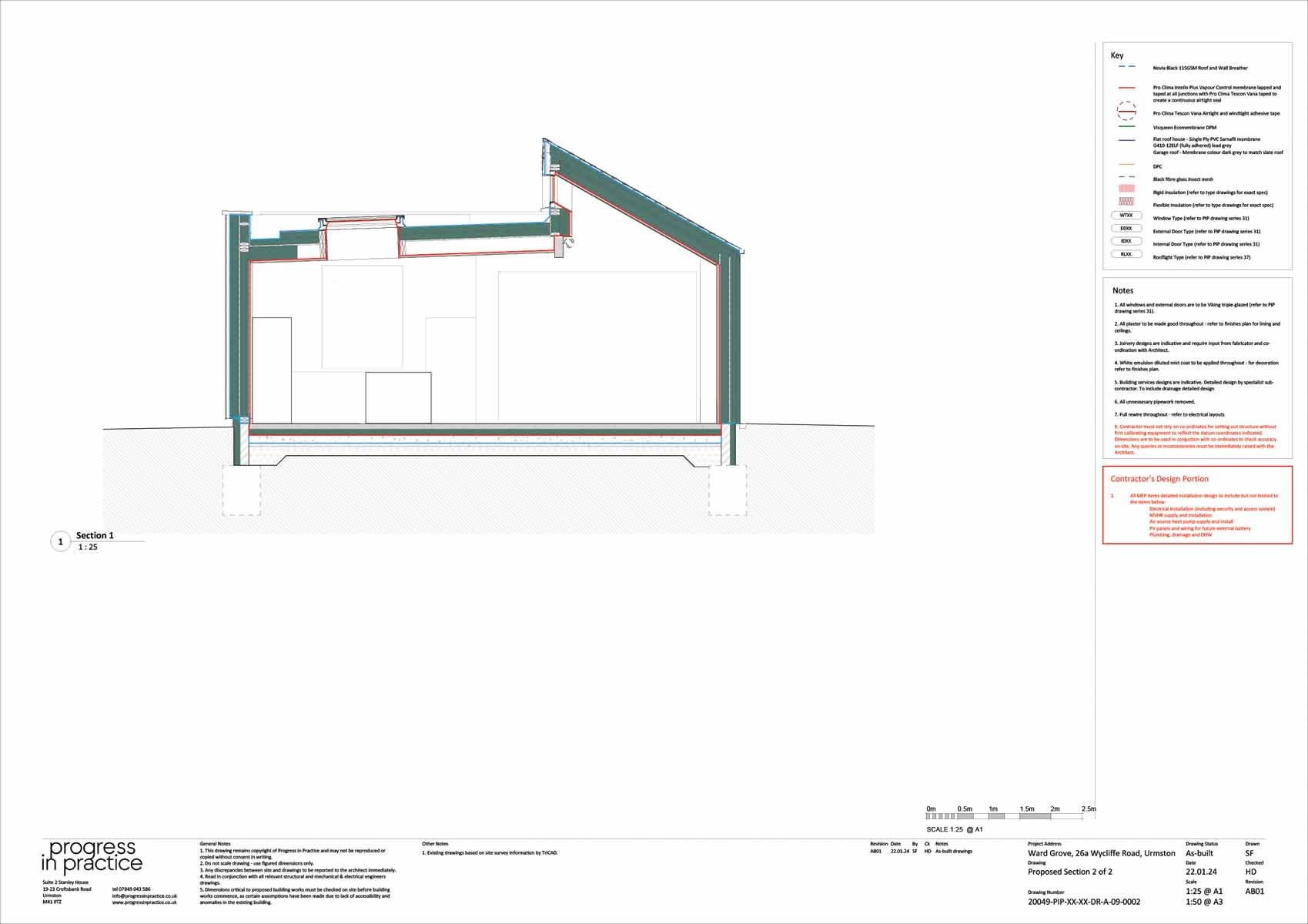
The design solution involved a relatively complicated junction taking the MVHR ductwork from the utility up through the airtight layer into the loft – but under the thick insulation layer – and back through the airtight layer into the living space.
“A lot of thought and effort was put into the airtightness around these penetrations,” says Dixon, “given the access into the loft space was also challenging. This was not an ideal detail, but we were very constrained by space as the bedroom areas already have a low head height.”
It was worth the effort, with the MVHR really proving its worth in winter. Principally, this is because it significantly reduced the home’s exposure to polluted outdoor air. Air pollution often increases in winter due to colder, drier air and increased domestic fuel burning – with Manchester air quality spiking last winter at a score of 110 AQI on Plume’s air quality index.
Plume describes levels of 100 and above as very high pollution, noting that “Everyone may start to experience more serious health effects at these levels”. But last winter, the MVHR served another unexpected function.
It proved particularly valuable during the heat pump breakdown that occurred during cold weather — added to the building’s highly insulated, highly airtight nature, the heat recovery ensured the system failure went unnoticed initially, demonstrating the resilience built into the house.
Steve reports "very steady" humidity levels throughout the year, demonstrating how accessibility needs drove the selection of systems that enhance both comfort and performance.
Melissa Edge, MVHR design manager at 21 Degrees, who designed the ventilation system for the project, explains the fundamental shift required in high-performance dwellings: “In the past, people didn't have to consider ventilation; it was just part of our leaky buildings, but as we are now taking airtightness seriously and having proper insulation, you need ventilation. The only way to do it is mechanically.”
However, Edge notes that 21 Degrees' role was limited to system design: “If we don't do the supply, we can't guarantee that the parts we specified have been fit and delivered. It's not the norm for us,” she says.
This design-only approach, while ensuring specialist expertise in system specification, places responsibility for installation quality on the main contractor. The distinction between design and installation becomes crucial when considering system performance.
Many homeowners worry about noise from mechanical ventilation, but as Edge points out, this may be because people’s perceptions have been shaped by undersized extract fans that abound in typical new homes. “We design the systems to be inaudible. We guarantee that,” she says. “You might think of an intermittent fan. This is continuous ventilation,” Beyond air quality, the MVHR system contributes directly to the project's energy performance.
Edge explains how proper ventilation design supports the overall building strategy: “When it is designed well and installed properly, it is excellent. It also aids in heating, bringing the requirement down slightly.” This connects well to Steve's experience with the underfloor heating system and overall energy performance.
Self-generated electricity to compliment electrified heat
A 5kW rooftop solar array with battery storage provides renewable electricity to power the heat pump and run the house. The net effect? Steve's actual electricity consumption costs just £512 annually – an average of just over £42 per month. The combination of high-performance fabric, a heat pump running at low temperatures and a PV array and battery which either serves the house or sells surplus electricity into the grid means that at times he finds himself 'massively in credit' with his energy supplier.
In the summer months, his solar generation covers virtually all his electricity needs, meaning he is essentially only paying standing charges while his credit balance continues to grow. “The panels are on a bungalow, meaning I get comparatively much worse solar in winter,” says Steve, “not just because of the gloom and shorter daylight, but because of buildings blocking the low sun. Friends round the corner still produce a fair bit in winter, as they often remind me. But they have to use stairs, so I suppose it evens out.”
Future directions
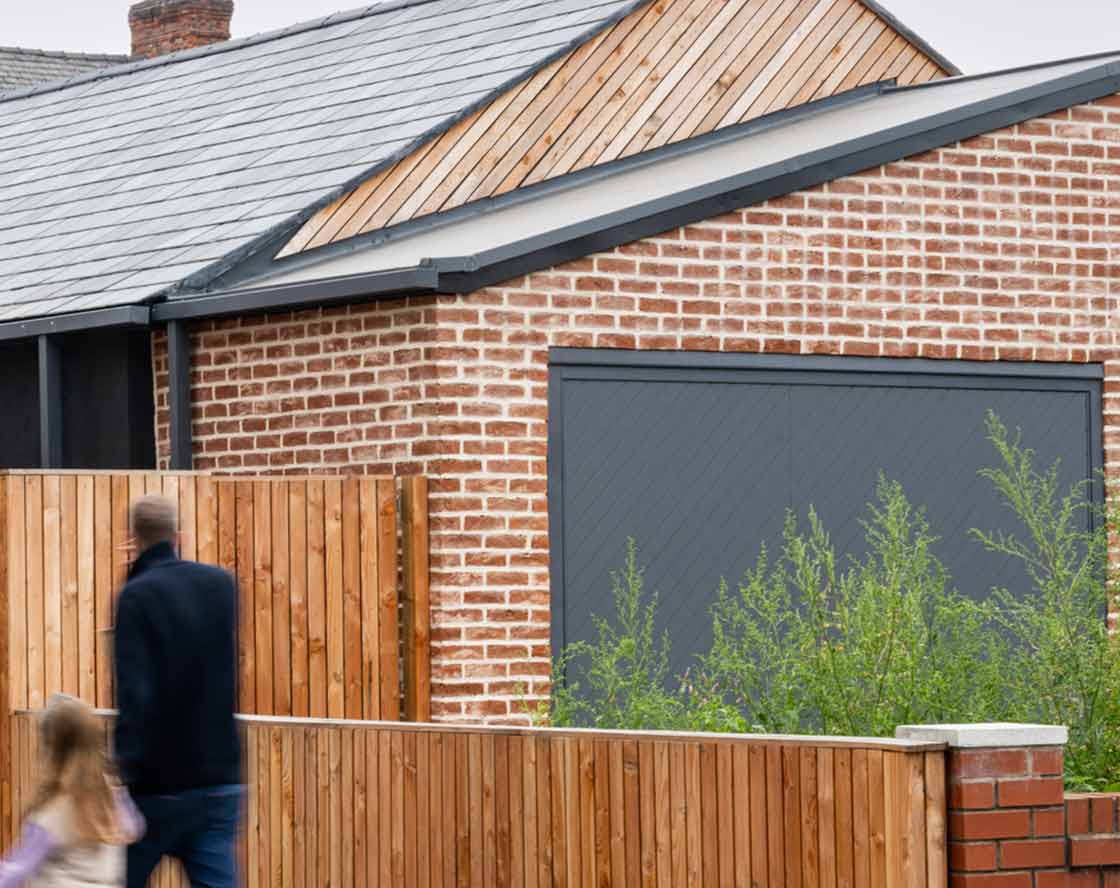
The Ward Grove project's recognition at the Exemplar Sustainable Buildings Awards — competing against established practices including Architype and John Gilbert Architects — signals growing industry appreciation for integrated design approaches.
The project challenges the conventional separation of accessibility and sustainability consultancy, demonstrating how user-centred design can drive environmental innovation rather than constrain it. Steve's journey from uncertainty — "I didn't really know what I was doing" — to confident building operation and planned improvements illustrates the potential for client empowerment in high-performance building delivery. His background developing environmental video games 15 years earlier, examining scenarios for two degrees of warming, provided climate awareness that aligned with Hannah Dixon's sustainability philosophy.
"When you see the light" of proper sustainable construction, Dixon explains, "it's very hard to go back and do things that are worse."
The skills required for passive house construction, she argues, "aren't that hard; it's really about keeping it to a certain level and doing it properly." The challenge lies in industry culture, time pressures, and the individualised working patterns that undermine quality delivery.
For Steve, the building's summer performance represents an ongoing design challenge that mirrors broader climate adaptation needs. While "amazing in winter," the building requires active management during heatwaves, though Steve notes his comfort levels matched or exceeded those of friends in Victorian houses during extreme temperatures. His planned external blinds and smart home integration demonstrate how high-performance buildings can evolve with occupant understanding and changing climate conditions. The economic implications extend beyond individual project success.
“There is huge economic potential, both in new build and from a retrofit point of view, that could benefit the wider economy,” Dixon says. The building's transformation has resulted in energy abundance.
In real terms this means substantial credit accumulation as the solar array generates surplus power, demonstrating the financial sense of taking integrated approaches. Ward Grove's success challenges the retrofit industry to reconsider the relationship between accessibility and sustainability. Rather than treating universal design as a constraint on environmental performance, the project demonstrates how user-centred thinking can drive innovative solutions that deliver both social and environmental benefits.
As Steve concludes, the bottom line is simple: "It is a fantastic house." For an industry seeking to scale sustainable retrofit whilst addressing diverse housing needs, Ward Grove provides a compelling template for integrated excellence.
Embodied carbon
Cradle to grave total:407 kgCO2e/m2 GIA
Upfront total excluding sequestration: 263 kgCO2e/m2 GIA
Upfront total sequestered CO2: -149 kgCO2e/m2 GIA
Standard/Framework: RICS WLCA standard, 2nd edition
Calculation tool: PHribbon
Reference study period: 60 years
Materials included: Building fabric including exterior walls, roof, ground floor, windows and rooflights, internal and external finishes and internal walls. Building services including PV, MVHR, air source heat pump and refrigerant, copper pipework, ceramics for sanitaryware, MVHR ductwork, but excluding battery and some plumbing). Demolition, some structural steel elements, some plumbing, interior paints and battery were not included.
Embodied carbon notes: The calculation was in accordance with the RICS whole life carbon assessment (WLCA) standard, 2nd edition, using EPDs for actual materials, industry associations, EPDs for similar products, and the ICE database –with data quality scores (WLCA uncertainty factor)attributed in each case. Construction process emissions used the RICS estimate based on GIA. Business as usual scenarios were used rather than projected decarbonisation scenarios for emissions for module B (the building's use phase, including replacement components, repair, etc) and module C (end of life disposal).
Selected project team members
Client: Steve Allen
Architect & passive house certifier: Progress in Practice
MVHR: 21 Degrees
Civil / structural engineer: Mark Edwards Associates
Main contractor: Built Green
Mechanical contractor: Robinsons Plumbing and Heating Engineers Ltd.
Life cycle assessment consultant: Tim Martel
Wall insulation: SPS Envirowall / Pavatex
Roof insulation: Warmcel
Additional roof insulation: Pavatex
Floor insulation: Xtratherm
Airtightness products: Pro Clima
Windows: Viking Windows by Ecospheric
Internal sliding doors: Selo
Entrance doors: Moralt
Roof lights: Fakro
Cladding supplier: SPS Envirowall
Furniture: Edge CNC
Cork flooring: Granorte
Project overview
Completion date: July 2023
Certification: Certified to the AECB’s Carbonlite Retrofit standard. Pre-retrofit Energy Performance
Certificate (EPC): F Post-retrofit EPC: A. (Other than EPC, all energy and overheating calculations done via PHPP.)
Space heating demand: 37kWh/m2/yr
Heat load: 15W/m2
Primary energy non-renewable: 60kWh/m2/yr
Primary energy renewable: 49kWh/m2/yr
Heat loss form factor: 4.1
Overheating: 0% modelled in PHPP
Number of occupants: 1 adult currently. Designed for small family.
Air quality context: Suburban site, circa 1km away from motorway
Outdoor air quality: An annual average score of 33 AQI (above the “Fair” pollution threshold of 20 AQI), based on Manchester, using the Plume Air Quality Index. peaking at a stage in the winter at 110 AQI, meeting Plume’s Unhealthy threshold, where health effects can be felt immediately by sensitive groups, and even healthy people may experience difficulty breathing or throat irritation with prolonged exposure.
Indoor air quality monitoring results: n/a
Measured energy consumption: From Jan to October Steve has imported at total of 2,767 kWh of electricity from the grid, with surplus generation from his PV array leading to 1,327kW being exported. Energy bills (measured or estimated): As of the end of October 2025, Steve has used £452 of electricity, with £318 paid for export, based on the Octopus Cosy tariff. By year end, the grid usage is projected to increase to circa £650, with exports rising to £330 – totalling £320. Including the standing charge, this is estimated to rise to £512 – for all energy use for heating, hot water, ventilation, lighting and appliance use.
Airtightness: Before: Unknown, but terrible
After: 0.54 air changes per hour at 50 pascals.
Thermal bridging: Traditional timber frame internally with continuous external insulation to eliminate thermal bridges. EWI extended to footings, with mineral wool connecting to loft insulation. Windows wrapped with reveal insulation in ply boxes. Thermal bridges not modelled as performance already exceeded thresholds with 15 per cent CarbonLite deduction.
Retrofitted ground floor: Before: Suspended timber floor, poorly ventilated with damp joist ends. After: (Bottom up) Existing concrete oversite retained as hardcore, sand, Visqueen DPM, 100 mm Unilin (formerly known as Xtratherm) PIR insulation (0.022W/ mK), separating layer, liquid screed with underfloor heating, Granorte Cork flooring. U-value: 0.21 W/m2K
Extension floor: As above – one continuous slab
Retrofitted (rendered) walls: (Inside out) Plasterboard with skim, 25 mm service void, Intello Plus airtight VCL, existing plaster, existing blockwork, cavity fully filled with grey EPS beads (0.032W/mK), existing brickwork, 150 mm SPS Envirowall EWI System using Grey EPS (0.032W/mK) or mineral wool (0.032W/mK) where boundary conditions dictate, charcoal render finish. U-value: 0.14 W/m2K
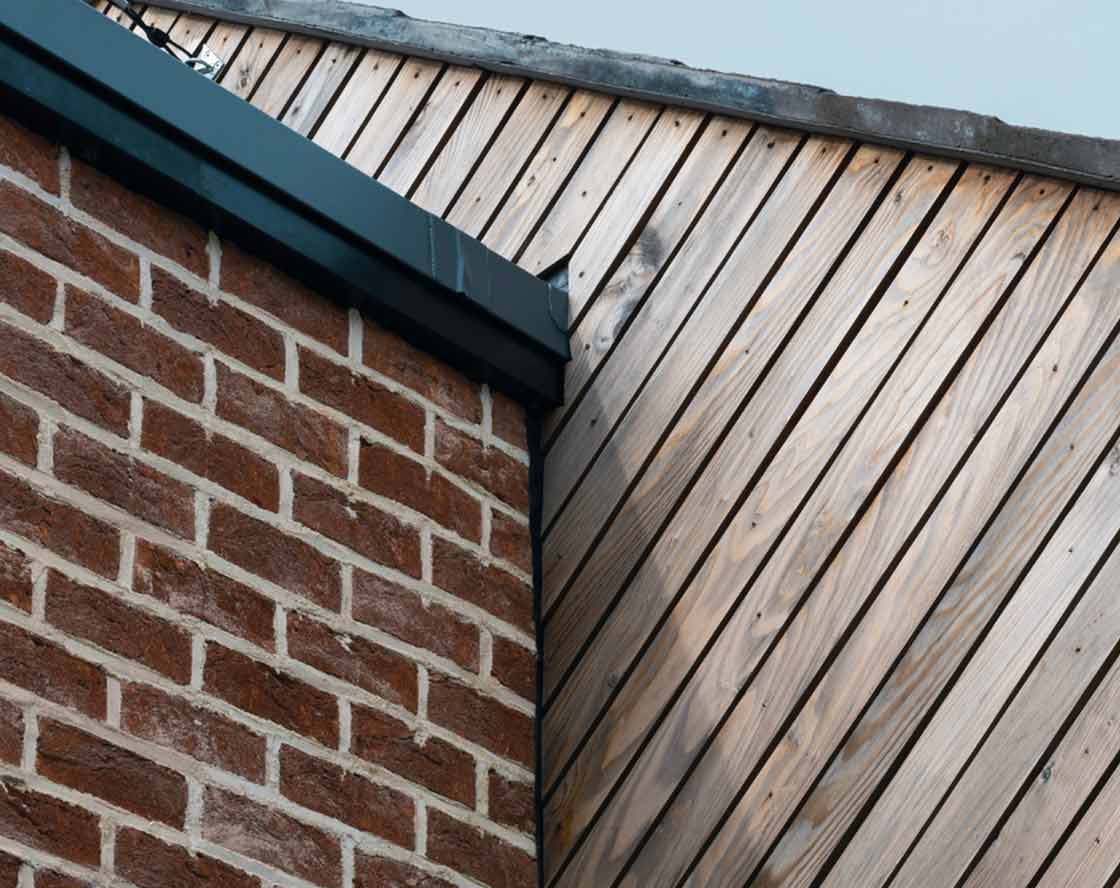
Retrofitted (timber clad) walls: (Inside out) Plasterboard with skim, 25 mm service void, Intello Plus airtight VCL, existing plaster, existing blockwork, cavity fully filled with grey EPS beads (0.032W/ mK), existing brickwork, 100 mm SPS Envirowall EWI System using Grey EPS (0.032W/mK) between timber battens (0.13W/mK), 50 mm SPS Envirowall EWI System using Grey EPS (0.032W/mK), 50 mm treated s/w battens, 22 mm untreated diagonal larch cladding. U-value: 0.15 W/m2K
Extension walls (rendered): Plasterboard with skim; 25 mm service void; Intello Plus airtight VCL; 12 mm OSB3; 140 mm timber stud fully filled with Pavaflex wood fibre insulation; 150 mm SPS Envirowall EWI System- using Grey EPS (0.032W/mK); charcoal render finish. U-value: 0.12 W/m2K
Extension walls (timber clad): Plasterboard with skim; 25 mm service void; Intello Plus airtight VCL; 12 mm OSB3; 140 mm timber stud fully filled with Pavaflex wood fibre insulation; 100 mm SPS Envirowall EWI System - using Grey EPS between timber battens; 50 mm SPS Envirowall EWI System - using Grey EPS; 50 mm treated s/w battens; 22 mm untreated diagonal larch cladding: U-value: 0.14 W/m2K
Existing Roof: (Before): Repeating timber trusses with 50 mm glass fibre insulation
After: (Inside out) Plasterboard with skim, existing truss, 600 mm loose fill Warmcel cellulose insulation (0.038W/mK), breather membrane, slate roof with inset PV panels. U-value: 0.068 W/m2K
Extension flat roof: Plasterboard with skim; 25 mm service void; new joists; 18 mm OSB3; Intello Plus airtight VCL; 200 mm PIR insulation (0.022W/m2K); single ply membrane. 0.11 W/m2K
Extension pitched roof: Plasterboard with skim; 25 mm service void; Intello Plus airtight VCL; 160 mm Pavatex Isolair wood fibre insulation (0.043 W/mK); 150 mm rafter stud fully filled with Pavaflex wood fibre insulation; breather membrane; battens and counter battens; slate roof with inset PV panels. 0.15 W/m2K
Windows & doors: Before: Extruded PVC double glazed windows and aluminium sliding door. After: Viking Windows by Ecospheric. Triple glazed, high performance timber windows. Typical Uw-value: 0.78W/m2K.
New rooflights: Fakro U6 thermally broken triple glazed roof windows with thermally broken timber frames. Overall U-value: 0.92 W/m2K
Heating system:
Before: Direct electric heaters
After: 6kW Samsung R32 air-to-water heat pump with hydronic underfloor heating throughout, and 194 litres insulated cylinder.
Ventilation:
Before: Trickle vents
After: Ubbink Ubiflux Vigor 225 MVHR (passive house certified) with exposed rigid steel ductwork to the living spaces and concealed ductwork to the bedrooms.
Water saving technologies: n/a
Electricity: 5kW PV array with battery storage.
Sustainable materials: Wood fibre, timber frame, timber cladding, bespoke plywood kitchen, cork flooring.
Image gallery
https://mail.passive.ie/magazine/upgrade/accessible-manchester-retrofit-delivers-comfort-and-low-bills#sigProId4894b1b7b9