
- Insight
- Posted
Are Ireland and the UK's energy ratings predicated on cold homes?
Passive houses aside, attempts at low energy building have a long and inglorious history of using more energy than predicted, with a key reason being “comfort-taking”, where occupants take back the benefit of energy efficiency by cranking up the thermostat. But is it rather that energy ratings are assuming miserly heating use – and temperatures that fail to meet the requirements of a new EN comfort standard.
by Lenny Antonelli and Jeff Colley.
This article was originally published in issue 44 of Passive House Plus magazine. Want immediate access to all back issues and exclusive extra content? Click here to subscribe for as little as €20, or click here to receive the next issue free of charge
The national dwelling energy calculation tools for Ireland and the UK may assess buildings in a way that assumes occupant discomfort, and that creates a ‘performance gap’ between a home’s designed energy performance and its real-world energy use.
The Dwelling Energy Assessment Procedure (DEAP), in Ireland, and the Standard Assessment Procedure (SAP), in the UK, both assume indoor temperatures which appear to be far lower than those recommended in a recent European standard for indoor environmental quality and occupant comfort.
For DEAP, this was pointed out to Passive House Plus by architect John Morehead. Having designed a detached dwelling in the passive house software, PHPP, Morehead then entered the building’s specification into DEAP.
At the suggestion of Passive House Plus, Morehead reduced the specification of all building fabric elements to the backstop levels in Part L of Ireland’s building regulations (also known as the nearly zero energy building, or NZEB, standard).
Morehead specified the worst permitted U-values for the walls, roof, floor, windows and doors, as well as the worst allowable values for airtightness and thermal bridging. He also dramatically increased the size of the building’s notional solar PV array, to see if it would still comply with Irish regulations.
Despite the poorer performance of the building fabric, and the oversized PV array, the building still complied with the NZEB standard. Morehead then noticed that two figures in the ‘ht use’ tab of DEAP indicated that outside of heating hours, indoor temperatures would be uncomfortably low.
The mean internal temperature for unheated periods was given as 15.57 C, while the mean internal temperature for the whole heating season was just 16.5 C. DEAP assumes that, during heating hours, living areas (defined as the living room plus any adjacent spaces in open plan dwellings) are heated to 21 C, while bedrooms are heated to 18 C.
However, DEAP heating hours are only assumed to be eight hours per day from 1 October to 31 May. No heating is assumed at other times.
EN 16798 comfort standard
These temperatures fall below the thresholds for indoor environmental quality set in a recent European standard, EN 16798.
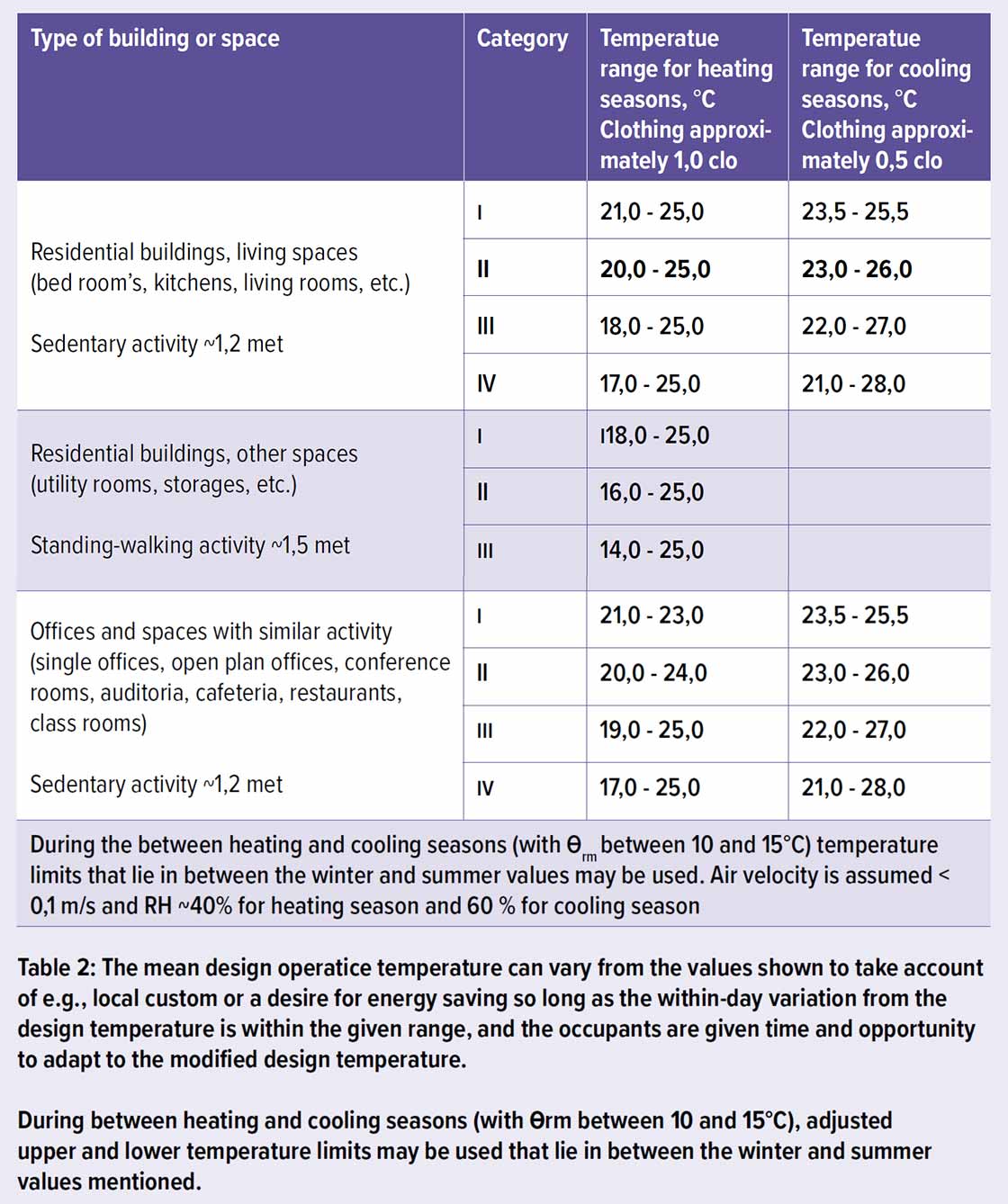
The standard includes a table with four categories of indoor environmental quality for buildings: high, medium, moderate, and low (see table 1). The appendix to part two of EN 16798 then gives recommended indoor operative temperatures to correspond with these categories (see table 2).
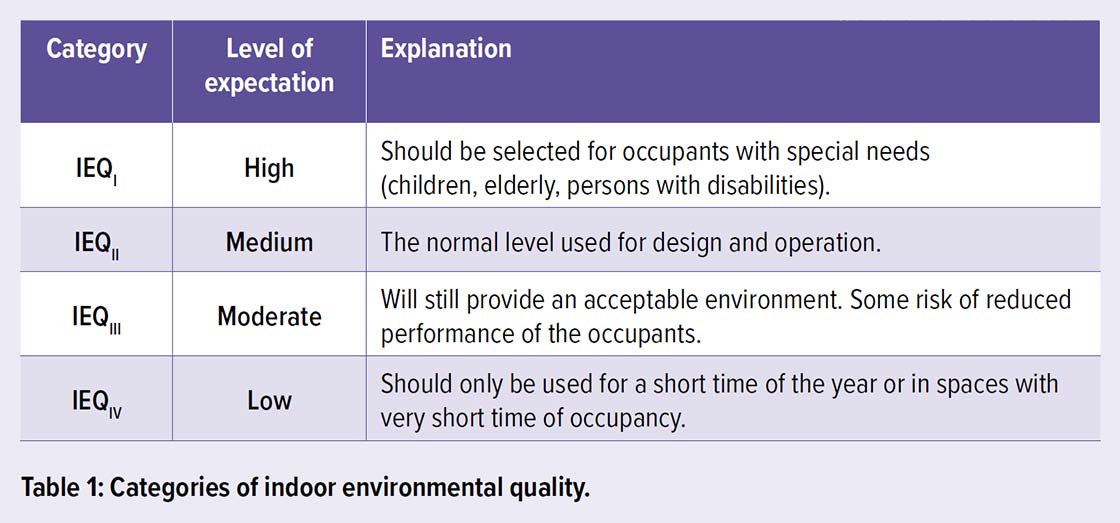
The standard suggests that, even for the worst indoor environmental category for living spaces, bedrooms and kitchens, temperatures should not fall below 17 C. The standard says that this category is only intended for spaces that are “used for a short time of year” or spaces “with very short time of occupancy”.
Category two is suggested as the “normal level used for design and operation” of buildings, and this recommends a minimum indoor winter temperature of 20 C. However, John Morehead’s example shows that it may be possible to design NZEB dwellings that fall well outside this comfort recommendation. It should be noted that EN 16798 is a voluntary standard and is not yet referred to in any official Irish legislation or technical guidance.
SAP assumes low temperatures
SAP, the UK’s dwelling energy assessment software, appears to make similar assumptions as DEAP. Leading consultancy Elmhurst Energy examined the temperature profiles of new dwellings in England for Passive House Plus.
“The result of all of this is after looking through a number of Part L 2013 compliant buildings typically the mean internal temperature across the whole building ranges from around 17-18 C in the winter months to 20-21 C in the summer months,” the company’s new-build dwellings manager, Jason Hewins, said. This would put these buildings in the bottom two comfort categories, categories three and four, for dwellings.
In Ireland, the theoretical dwelling modelled by John Morehead does not appear to be an exception. Indeed, the DEAP files for example dwellings provided by the Department of Housing to show different ways of complying with Part L typically show mean internal temperatures for unheated periods, and for the whole heating season, (including periods when the heating system is switched off) of 17 or 18 C.
However, these sample dwellings have high ‘living area fractions’ of 25 or 50 per cent, indicating the proportion of the dwelling heated to 21 C during heating hours. Analysis of recently built dwellings in SEAI’s national BER database indicates that the mean living area fraction for detached houses built to the NZEB standard to date is 18.2 per cent, which would reduce the mean internal temperature of these dwellings even further.
This indicates that a substantial proportion of newly built dwellings in Ireland may be assumed to be running at mean indoor temperatures that do not, or just barely, meet the lowest categories of indoor temperature recommended by EN 16798.
In response to a question from Passive House Plus about whether EN 16798 might be incorporated into DEAP, the Sustainable Energy Authority of Ireland (SEAI) told Passive House Plus that the EU’s Energy Performance of Buildings Directive is currently being revised, and that this may have an impact on BER calculation methods. “SEAI plans to commence this year a review to consider future changes to the methodologies. This would include consideration for EN 16798 and related calculation standards,” wrote SEAI programme manager Antonella Uras.
Operative vs dry bulb temperatures
SEAI had previously told Passive House Plus that because the EN standard gives “operative temperatures” (i.e., the temperature EN 16798 comfort standard experienced by a person in the room) while DEAP uses “dry bulb temperatures (i.e., air temperatures), these figures could not be directly compared. Operative temperatures are a combination of the dry bulb temperature and the radiant temperature.
However, having consulted various experts on the topic, Passive House Plus understands that in well insulated buildings, unless there is a large area of glazing and thus high solar radiation, the difference between the operative and air temperature is very small.
There is concern about the extent to which building assessment tools such as DEAP and SAP may struggle to capture the actual temperatures to which dwellings are heated, potentially leading to a performance gap where buildings consume more energy for space heating than is initially projected. In reality, building occupants are likely to maintain indoor temperatures at a higher level than the 15-18 C assumed by DEAP during unheated hours, and thus energy consumption could turn out to be higher than predicted.
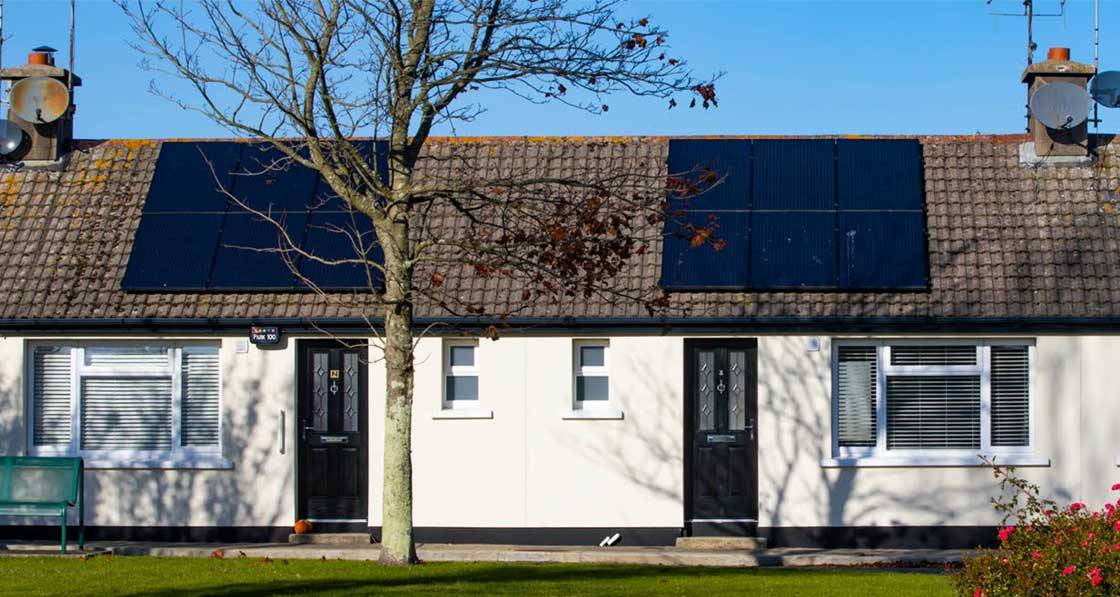
Issue 37 of Passive House Plus featured a case study of College View, a social housing retrofit scheme in Wexford, in which energy consumption was significantly higher for most dwellings than that projected by DEAP, in some cases between 25 and 50 per cent more. A post occupancy evaluation study carried out by the NZEB101 project subsequently found that many occupants were heating the dwellings to temperatures significantly higher than assumed by DEAP.
For all but two of the dwellings, living room temperatures were above 20 C for 75 per cent of the time, and the warmest dwelling had median temperatures of between 23.4 C and 25.2 C across the four seasons.
This is a complex and technical subject and Passive House Plus welcomes any input from readers at This email address is being protected from spambots. You need JavaScript enabled to view it.